







Yes, a natural alternative to testosterone replacement therapy (TRT) can help some men with borderline levels. Weight loss, restored sleep, and interval exercise each raised testosterone in men in published studies, and ashwagandha added 14.7% in one trial. None of these replaces TRT for a confirmed deficiency, so a morning blood test always comes first.
Key Takeaways
A natural alternative to testosterone replacement therapy is any lifestyle, nutrient, or herbal step that supports the body's own testosterone. Weight loss, sleep, exercise, vitamin D, zinc, and certain herbs make up the main options. Prescription medicines that restart the body's own signal sit in a separate category.
Men who want a full picture can begin with men's hormone health testing before changing anything. Testing shows whether levels are truly low and what is driving them.
Low testosterone must be confirmed before any plan makes sense, and the next section shows how doctors confirm it.
Low testosterone is confirmed by symptoms plus two low morning blood tests, according to the Endocrine Society's 2018 guideline. The guideline calls for a fasting morning total testosterone level, repeated to confirm the result. Free testosterone is checked when the total sits near the lower limit.
Houston Methodist defines low testosterone as total testosterone below 300 ng/dL. The same source says nearly 40% of men over 45 have low levels. Common signs of low testosterone include low energy, reduced sex drive, and loss of muscle.
A confirmed low result raises the next question, which is whether levels can recover without medication.
Yes, low testosterone can return to normal in men whose low level has a reversible cause. The Asian Journal of Andrology cites the European Male Aging Study, which found that 85% of hypogonadal men have secondary hypogonadism. Secondary means the testes are under-stimulated by the brain's signal, not damaged.
Reversible drivers include excess body fat, poor sleep, and nutrient gaps. A hormonal imbalance evaluation looks for these drivers alongside thyroid and adrenal markers.
Normal aging also plays a part. Leproult and Van Cauter reported in JAMA that aging lowers testosterone by 1% to 2% per year. Finding the root causes of a low reading guides which natural step comes first.
Weight has pooled data from 24 studies, so the next section starts there.
You cannot fully replace testosterone naturally, but you can raise your own output with six steps. Lose excess weight, sleep enough, train, correct deficiencies, manage stress, and test again after three to six months. Each step has study data, covered one at a time below.
Natural alternatives to TRT work best together because body fat, sleep, and stress all act on the same hormone signal. Body fat is the first target.
Yes, losing weight raises testosterone in men with obesity. A 2013 meta-analysis in the European Journal of Endocrinology pooled 24 studies of diet and bariatric surgery. It found higher total and free testosterone after weight loss. The amount of weight lost best predicted the rise.
Men who carry extra weight around the waist can gain from this step. Structured weight loss support pairs food changes with habits that last.
Sleep affects testosterone as strongly as weight does, which leads to the next topic.
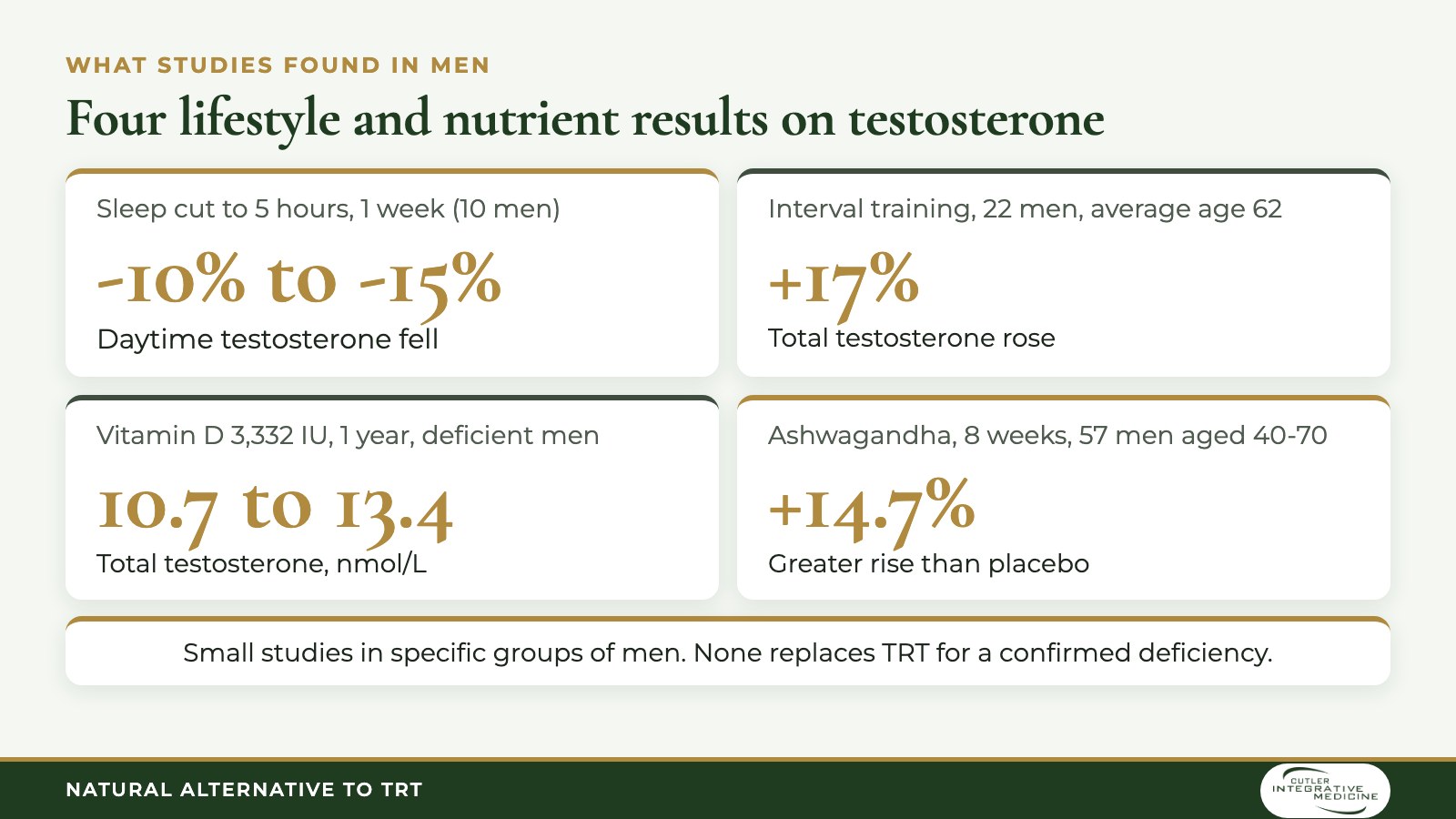
Poor sleep lowers testosterone, and 5 hours a night for one week cut daytime levels 10% to 15%. Leproult and Van Cauter tested 10 healthy men, average age 24.3, in a JAMA study. The men also reported lower vigor as the week went on.
The study was small and short, so it shows a direction and not a long-term dose. Protecting better sleep habits costs nothing and supports every other step on this list.
Exercise improves sleep and testosterone together, so training comes next.
High-intensity interval training (HIIT) raised testosterone in older sedentary men. In a 2017 study of 22 lifelong sedentary men, average age 62, total testosterone rose about 17% after two six-week phases. Free testosterone rose about 4.5%, a small but significant gain.
The Centers for Disease Control and Prevention (CDC) advises adults to get 150 minutes of moderate activity weekly. The CDC also advises muscle-strengthening work on at least 2 days a week. Men with heart disease should clear any interval program with their doctor first.
Food fuels that training, so diet is the next piece.
Zinc-rich whole foods help testosterone in men who are short on zinc. Oysters, beef, and pumpkin seeds supply zinc. Eggs, olive oil, and nuts supply fats that the body uses to build hormones. No single food raises testosterone in men who already eat well.
Whole-food eating also helps weight loss, which raises testosterone on its own. A clinician-guided plan for diet and nutrition matches foods to your lab results.
Zinc and vitamin D also come as supplements, so the evidence on both is next.
Yes, vitamin D and zinc raised testosterone in men who were deficient. In a 2011 trial, 3,332 IU of vitamin D daily for one year lifted total testosterone from 10.7 to 13.4 nmol/L. The trial included 31 supplemented men and 23 on placebo, all overweight with low vitamin D.
Zinc showed a similar pattern. Six months of zinc raised testosterone from 8.3 to 16.0 nmol/L in nine older men with marginal zinc deficiency. Both studies were small, and neither tested men with normal levels of the nutrient.
The graphic below sums up four study results on sleep, exercise, vitamin D, and ashwagandha.
Herbs get more attention than nutrients, so the next sections cover them.
Ashwagandha increased testosterone by 14.7% over placebo in one 8-week trial. The trial enrolled 57 overweight men aged 40 to 70, and 43 finished all 16 weeks of the crossover design. Fatigue, vigor, and sexual well-being did not differ from placebo.
The National Center for Complementary and Integrative Health (NCCIH) calls the evidence limited. NCCIH says short-term use up to 3 months may be safe. NCCIH also reports rare cases of liver injury. Men with hormone-sensitive prostate cancer should avoid it.
Ashwagandha is one of two herbs that stand out, and the next section compares them.
No herb is proven the most powerful, but fenugreek and ashwagandha show the clearest results so far. A 2021 systematic review in Advances in Nutrition covered 32 trials of 13 herbs. Only 9 of the 32 trials showed significant testosterone increases.
Only 6 of those trials had a low risk of bias, and 16 of 32 enrolled men under 40. A separate meta-analysis of four fenugreek trials found a significant effect on total testosterone. Small samples limit every one of these findings.
Herbs reach many men through store-bought blends, which raises a different question.
No, there is no over-the-counter TRT, because testosterone products are prescription drugs. The Food and Drug Administration (FDA) limits approved testosterone products to men with low levels linked to a medical condition. Testicular failure is one example.
Shelf products called testosterone boosters are supplements. A 2019 review of popular boosters covered 37 human studies on their ingredients. Only 30% saw a rise, while 46% saw no effect. Another 3% saw a decrease, and 22% were indeterminate.
Supplements also carry drug and liver concerns, so review supplement interactions with a clinician before starting. Prescription alternatives are a separate group, covered next.
Men can take clomiphene, enclomiphene, or human chorionic gonadotropin (hCG) instead of TRT, and a doctor must prescribe them. These medicines prompt the body to make its own testosterone. A prescribing physician manages that route.
Clomiphene blocks estrogen receptors in the brain, which raises luteinizing hormone (LH) and follicle-stimulating hormone (FSH). A 2025 meta-analysis of randomized trials found testosterone rose 273.76 ng/dL over placebo. It found no significant difference against testosterone gel.
The table below compares the four main routes by how they work, the evidence behind them, and who manages them.
| Option | How it works | Evidence | Who manages it |
|---|---|---|---|
| Weight loss, sleep, exercise | Removes factors that lower output | 24-study weight meta-analysis; small sleep and HIIT studies | You, with your doctor |
| Vitamin D and zinc | Corrects a deficiency | Small trials in deficient men | You, after a blood test |
| Ashwagandha and fenugreek | Herbal extracts | Small trials, mixed results | You, with a clinician's review |
| Clomiphene, enclomiphene, hCG | Prompts the body's own signal | Meta-analysis of randomized trials | Prescribing physician |
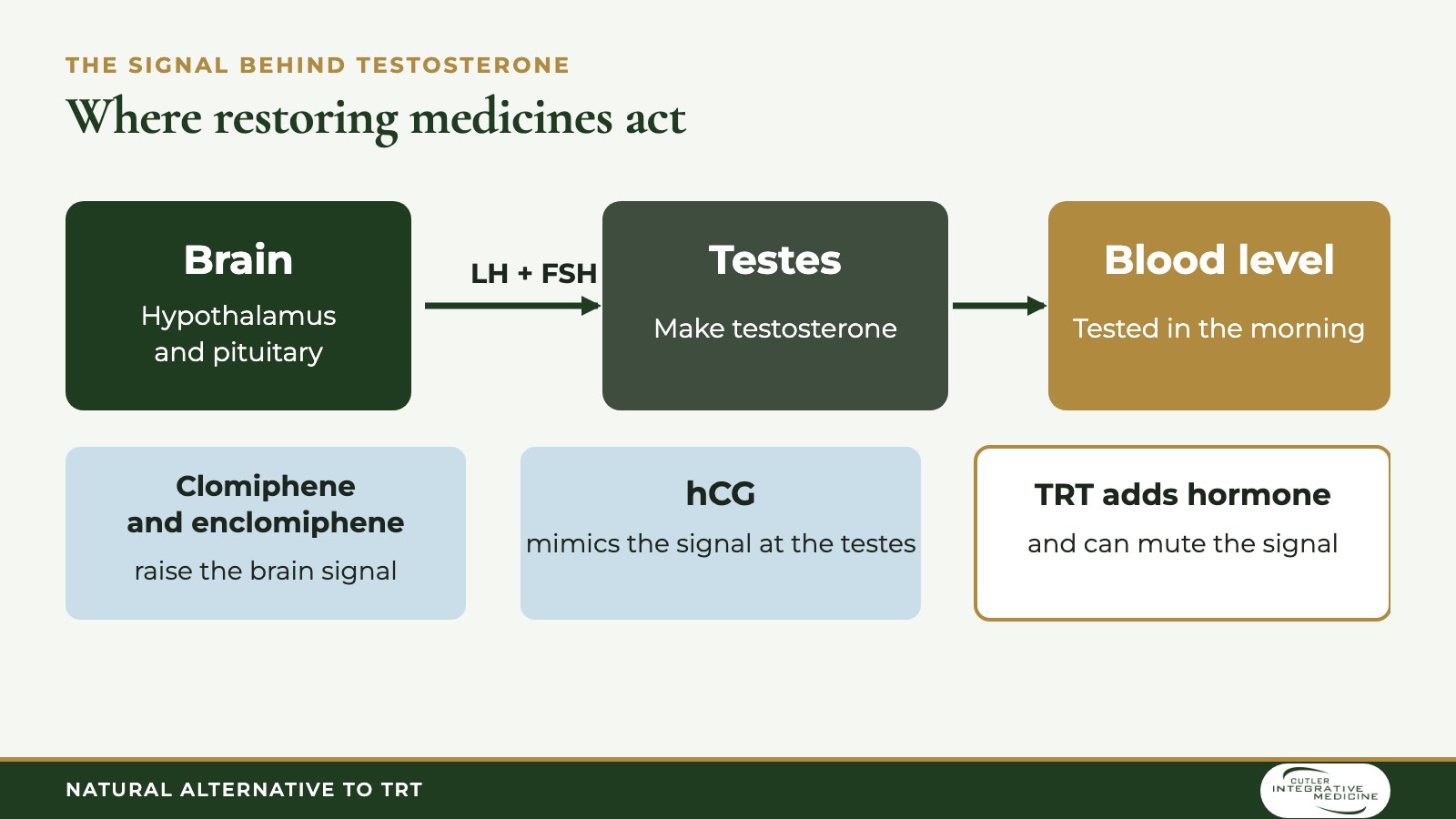
The diagram above shows the brain-to-testes signal that these medicines act on. Each route in the table suits a different starting point, and the table shows why testing comes before choosing.
Some men choose clomiphene or human chorionic gonadotropin (hCG) over TRT because testosterone alone can shut down sperm production. In one study cited in the Asian Journal of Andrology, intratesticular testosterone fell to 5% of baseline on testosterone alone. Adding 250 IU of hCG kept it at baseline.
Men who plan to father children therefore ask about restoring production and not replacing it. Doctors weigh that goal against symptoms and lab values. Those who still consider replacement can read about the TRT downsides before deciding.
Age changes how these options apply, so the next section covers men in their fifties.
A 50 year old man can increase his testosterone by combining five steps, starting with a morning blood test. Testosterone falls 1% to 2% per year with age, so small gains matter. The steps below follow a logical order.
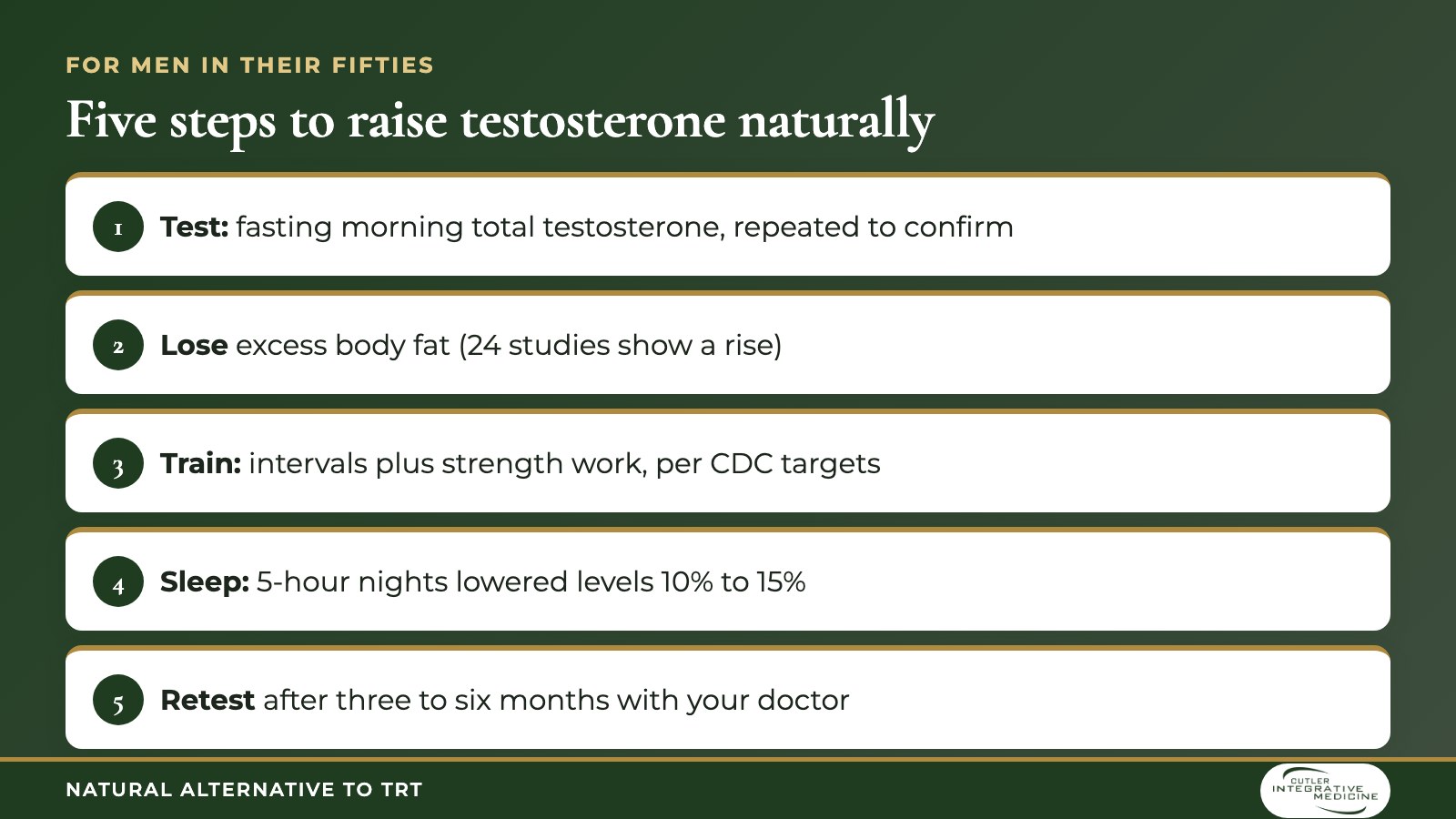
The graphic above lays out the same five steps. Men of any age should know the limits of these steps, which brings up who needs extra caution.
Men with prostate cancer, liver disease, or heart disease should avoid testosterone boosters without a doctor's approval. NCCIH says men with hormone-sensitive prostate cancer should avoid ashwagandha. Talk to your doctor before starting any herb or supplement if you take prescription drugs.
Men with high red blood cell counts or untreated sleep apnea also need medical review before changing hormone levels. NCCIH notes that supplements are not approved by the FDA before they are sold.
The questions below are shorter and cover related topics.
A natural alternative to testosterone replacement therapy for women follows different rules than the plan above. Women make testosterone too, but doses and risks differ. Our guide to women's testosterone covers that topic.
Natural methods take 8 weeks to 12 months to raise testosterone in studies. Ashwagandha ran 8 weeks, and the HIIT program ran 12 weeks. Zinc ran 6 months, and vitamin D ran 1 year.
Yes, men on TRT can keep the lifestyle steps, and the prescribing physician should approve any supplement. Sleep, training, and weight control support the whole plan. Details on men's TRT are in our separate guide.
Sleep, exercise, and weight loss are the safest natural boosters because they carry no supplement risks. Vitamin D and zinc suit men with confirmed low levels. Herbs need more caution, since NCCIH reports rare liver injury with ashwagandha.
Weight loss has a 24-study meta-analysis behind it, which is more pooled data than other natural steps. Ashwagandha added 14.7% in one 8-week trial. No supplement matches prescription testosterone for men with a true deficiency.
No natural method raises testosterone fast, because studies show changes over 8 weeks to 12 months. One week of 5-hour nights lowered levels, so sleep is a quick lever to protect.
Doctors fix low testosterone by finding the cause first, then using lifestyle changes, nutrients, or prescription medicine. Treatment depends on two confirmed morning blood tests. Fertility goals also shape the choice.
You cannot check testosterone accurately at home, because diagnosis needs a fasting morning blood test and repeat confirmation. Symptoms alone do not confirm a deficiency. A doctor orders the test and reads the result.
Cutler Integrative Medicine supports men who want to understand their hormones before choosing a path. We test hormone levels and look for root causes in stress, gut health, thyroid, toxins, nutrition, and sleep. Then we build natural and nutritional plans. We work alongside your prescribing physician when medication is needed.
Our lab testing options give a clear baseline for those plans. Men in Bingham Farms and across Metro Detroit can book in person or through telemedicine.
To start, call (248) 663-0165 and ask for a consultation. Dr. Doug Cutler, ND, and the team at Cutler's practice review your results and explain each option in plain terms.








Cutler Integrative Medicine blends naturopathic and conventional care to treat the root causes of illness. Through personalized wellness plans, advanced diagnostics, and holistic therapies.


Copyright © 2025 Cutler Integrative Medicine. All Rights Reserved.


