



Estrogen only hormone replacement therapy delivers estrogen without a progestin, and providers use it mainly for women who have had a hysterectomy. The FDA names it one of four main HRT types, and ACOG says women with a uterus need added progestin. The Women's Health Initiative (WHI) estrogen-alone trial followed 10,739 women for 6.8 years, and its results still shape the advice below.
Key Takeaways
Estrogen only hormone replacement therapy is a menopause treatment that supplies estrogen without any progestin or progesterone. The FDA calls it systemic estrogen-alone therapy and lists pills, skin patches, spray, gel and a vaginal ring as its forms. Providers usually prescribe it to women who have had their uterus removed.
The American College of Obstetricians and Gynecologists (ACOG) explains that ovaries shrink and slowly stop making estrogen near menopause. The medicine replaces that estrogen. Women who want hormone wellness support can pair a prescriber's plan with testing for related causes such as thyroid or stress. Understanding who qualifies is the next step.
Women who have had a hysterectomy are the main group who can take estrogen only HRT. The NHS states that oestrogen-only HRT is recommended after the womb is removed. The Cleveland Clinic adds that estrogen alone carries fewer long-term risks than the combined form.
No uterus means no uterine lining to protect, so no progestogen is needed. Women who are unsure how surgery changes their hormone picture can review hormones after hysterectomy for the full background. Even then, the decision belongs with a prescribing provider after a history review.
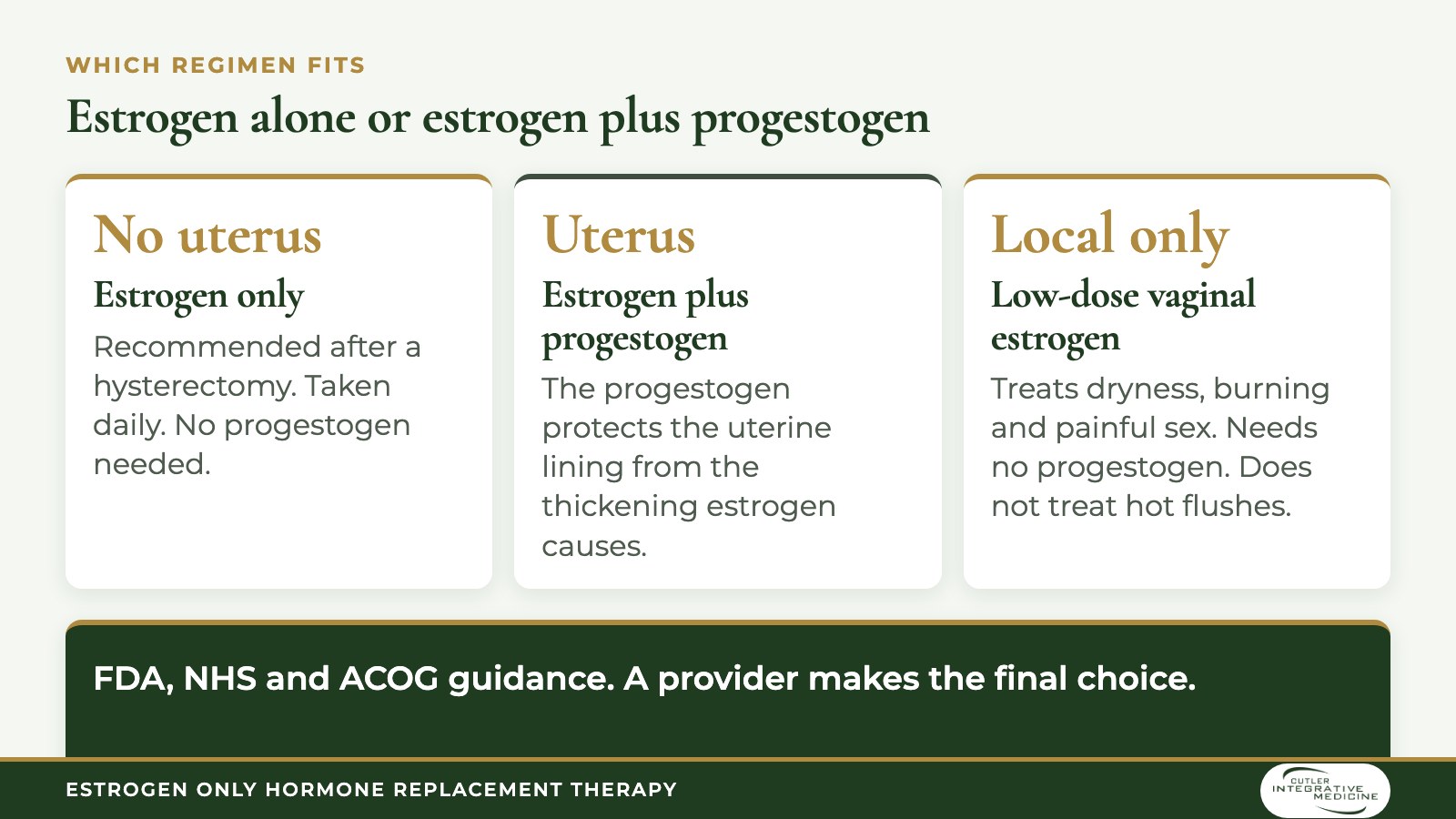
The graphic above maps which regimen fits which situation. Women who still have a uterus raise a separate question.
No, women with a uterus should not use systemic estrogen alone. The FDA says it can be used in that group only when progesterone-alone therapy is also added. That pairing is estrogen plus a progestogen, which the NHS calls combined HRT.
One exception exists. The NHS says low-dose vaginal estrogen needs no progestogen, even with a womb. Vaginal estrogen treats dryness, burning and painful sex rather than hot flushes. Skipping the progestogen with systemic estrogen carries a specific risk, covered next.
Taking estrogen alone without progesterone thickens the uterine lining, and that thickening raises endometrial cancer risk in women with a uterus. ACOG states that adding a progestin lowers the risk again.
A Cochrane review of 46 studies tied unopposed estrogen to endometrial hyperplasia, an overgrowth of the lining. The link held at all doses over one to three years. The FDA has not asked manufacturers to remove the endometrial cancer boxed warning from systemic estrogen-alone products. Progestogen therefore stays standard for anyone with a uterus.
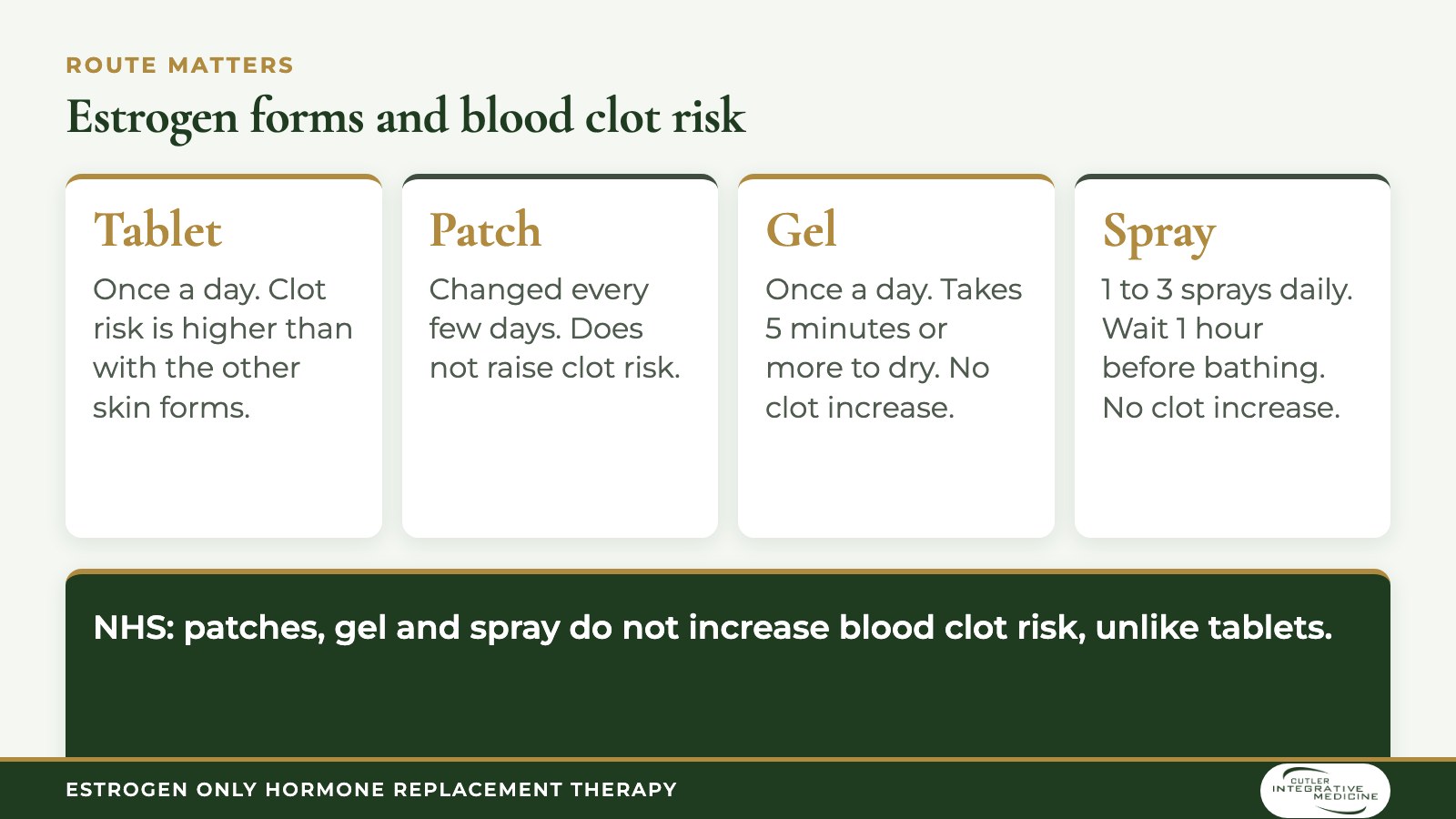
Estrogen only HRT comes in tablets, patches, gel, spray and vaginal products, and ACOG says estrogen-only therapy is taken daily. Each form differs in application and clot profile, as the table below shows from NHS and ACOG guidance.
| Form | How it is used | Key point |
|---|---|---|
| Tablet | Taken once a day | Clot risk is higher than with patches, gel or spray; gallbladder risk is greatest with pills |
| Patch | Stuck on lower-body skin and changed every few days | Does not raise clot risk; may not stick well on moisturized skin |
| Gel | Smoothed on the skin once a day | Does not raise clot risk; takes 5 minutes or more to dry |
| Spray | 1 to 3 sprays on the inner arm or thigh daily | Does not raise clot risk; wait 1 hour before bathing |
| Low-dose vaginal cream, tablet or ring | Placed in the vagina | Treats local symptoms only; needs no progestogen |
The table shows that route matters more than hormone type for clot risk. Women comparing forms of HRT in more detail can match each option to their health history with a prescriber.
The main difference between estrogen only and combined HRT is the uterus, because combined therapy adds a progestogen. The progestogen protects the lining. Women choosing hormone replacement therapy estrogen only or combined are sorted by that single anatomical fact before anything else.
| Feature | Estrogen only | Estrogen plus progestin |
|---|---|---|
| Who uses it | Women without a uterus | Women with a uterus |
| Uterine lining | Estrogen alone thickens it | Progestin lowers the cancer risk |
| WHI women enrolled | 10,739 with prior hysterectomy | 16,608 with a uterus |
| Breast cancer, long-term follow-up | 238 vs 296 cases on placebo (HR 0.78) | 584 vs 447 cases on placebo (HR 1.28) |
| Routine | Estrogen every day | Continuous, or cyclic with progestin 10 to 14 days a month |
The breast cancer row comes from a 2020 JAMA analysis of both WHI trials. Those trial results deserve a closer look.
The WHI estrogen-alone trial found more strokes, fewer hip fractures and no coronary heart disease change, over 6.8 years on average. That trial enrolled 10,739 women aged 50 to 79 with a prior hysterectomy. They received placebo or 0.625 mg a day of oral conjugated equine estrogens (CEE).
The 2004 JAMA report put the stroke hazard ratio at 1.39, equal to 12 additional strokes per 10,000 person-years. Hip fractures fell by 6 per 10,000 person-years. The coronary heart disease hazard ratio was 0.91, which was not statistically significant. Stroke risk is one reason providers review each woman's cardiovascular history first.
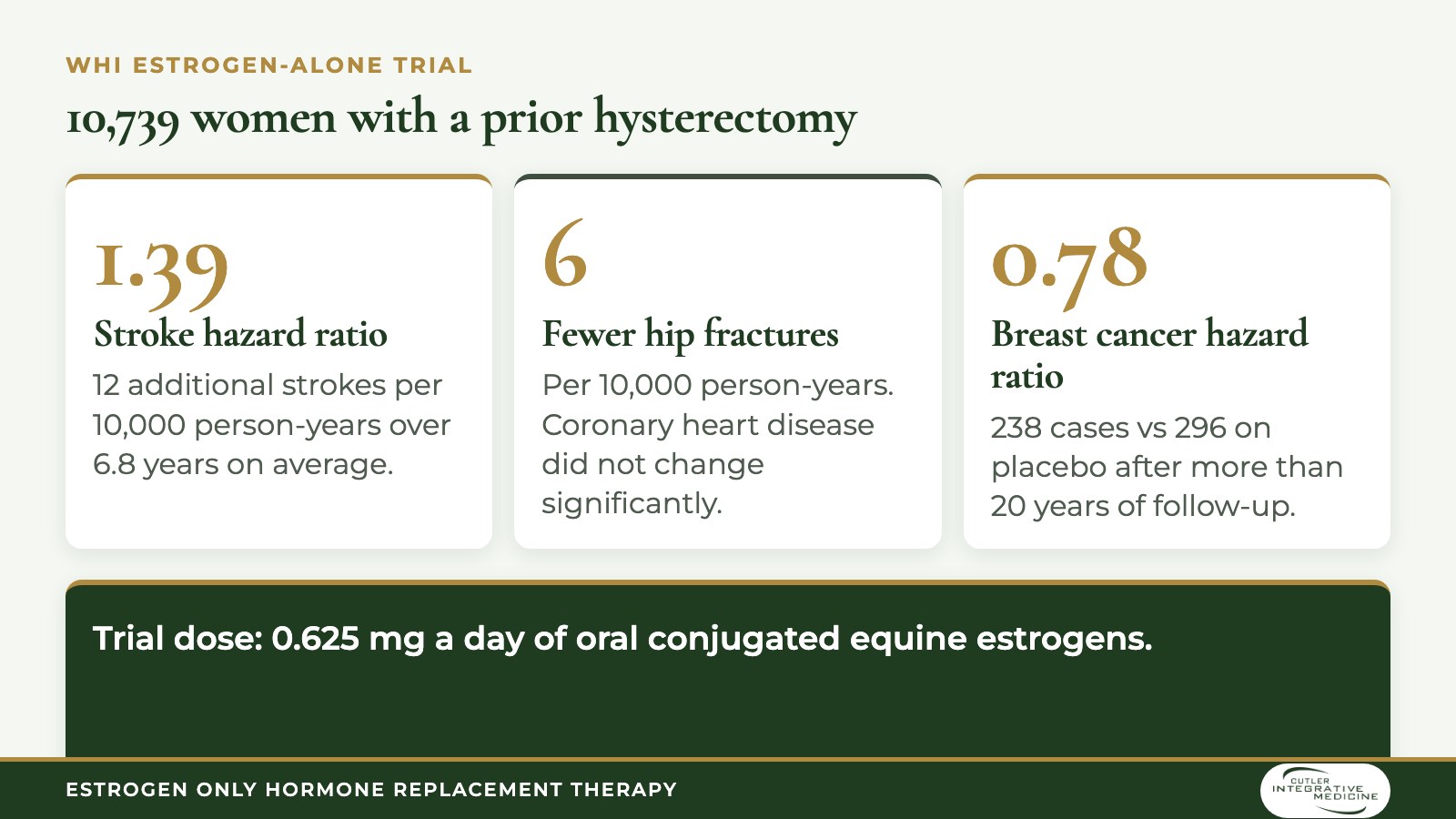
Breast cancer results changed after the trial ended. A 2020 JAMA study followed the women for more than 20 years. It found 238 breast cancer cases on estrogen alone against 296 on placebo, a hazard ratio of 0.78. Breast cancer deaths were 30 against 46, a hazard ratio of 0.60.
The same analysis found the opposite pattern for estrogen plus a synthetic progestin: 584 cases against 447, a hazard ratio of 1.28. Women worried about HRT cancer research can see how risk differs by regimen. A 2017 JAMA analysis added that estrogen alone showed no significant link to death over 18 years. The all-cause hazard ratio was 0.94.
Yes, estrogen-only HRT is a reasonable option for many healthy women after a hysterectomy, especially when started before age 60. The Menopause Society's 2022 position statement calls the benefit-risk balance favorable under age 60 or within 10 years of menopause onset. That applies to women without contraindications.
The balance is less favorable when therapy starts later. The Cleveland Clinic also says risks are lower with the lowest effective dose and an FDA-approved product. ACOG recommends FDA-approved hormone therapy over compounded versions, and it found no evidence that compounded hormones are safer or more effective. Safety still has limits, which the next section lists.
The risks of using only estrogen in hormone replacement therapy are a small rise in stroke, blood clots and gallbladder disease. Women who keep a uterus also face endometrial cancer risk. ACOG says clot and stroke risk rises with age, heart disease, kidney disease and obesity.
Route changes the picture. ACOG notes that patches, sprays and rings may pose less risk than pills, and gallbladder risk is greatest with pills. Cleveland Clinic adds that heart risk climbs when therapy starts more than 10 years after menopause. Hormone and thyroid hormonal imbalance testing can show a woman's baseline before she talks with her prescriber. Some women should skip systemic estrogen altogether.
A history of certain cancers, clots or organ disease disqualifies most women from systemic HRT. ACOG says systemic hormone therapy usually is not recommended after any of these.
Women with any of these conditions should talk to their doctor before starting or stopping any hormone. Nonhormone options exist for them, and a later section covers those. Dose and form come first for women who qualify.
No single form is healthiest for every woman, but patches, gels and sprays carry lower clot risk than pills. The NHS states that, unlike tablets, they do not increase blood clot risk. ACOG reports a similar pattern for stroke and gallbladder disease.
The Cleveland Clinic recommends starting with the lowest effective dose and working with a provider to minimize risk. Quality also matters. ACOG favors FDA-approved products over compounded ones because compounded hormones vary in strength and purity. A clear starting process helps women apply these points.
Start estrogen only HRT with a prescribing provider and follow five steps in order.
Cleveland Clinic says early side effects usually resolve within a few months. Providers can adjust the dose or form when they do not. Symptom relief differs by person, and HRT timeline depends on the form and dose chosen. Some women need an option without estrogen.
Progesterone only hormone replacement therapy is an option in limited cases, but the evidence is thin. A 2020 systematic review of seven randomized trials with 601 patients found hot flash relief in three of them.
The largest oral trial used 300 mg of micronized progesterone and reported a 58.9% improvement in hot flashes against 23.5% on placebo. The largest transdermal progesterone trial, with 230 women, found no improvement. Hormone replacement therapy progesterone only is therefore a narrower tool. The Menopause Society calls estrogen-based hormone therapy the most effective treatment for hot flashes. Several related questions follow.
Taking progesterone and not estrogen gave mixed results in the 2020 review. Headaches and vaginal bleeding were significant in five of seven trials. Those side effects led 6% to 21% of patients to stop. No trial reported better mood. Women who suspect low progesterone can review low progesterone symptoms.
Taking estrogen may reduce belly fat, because a 2006 meta-analysis of 107 randomized trials found HRT cut abdominal fat by 6.8%. A 2012 review likewise found that estrogen therapy ameliorates central fat accumulation. Exercise and nutrition still drive most weight change.
No, HRT estrogen does not clearly cause weight gain. The 2012 review found weight gain cannot be attributed to the menopause transition itself. Fat does shift toward the abdomen when estrogen falls. Women tracking HRT weight changes should review diet, sleep and activity too.
No fixed age makes HRT too late. The Menopause Society said in 2024 that women over 65 can continue therapy with counseling and risk assessment. Starting after 60 or more than 10 years past menopause is less favorable. A provider weighs the individual risks.
The NHS says women usually need HRT for 2 to 5 years, although it can be longer. Cleveland Clinic says most people use it five years or less. ACOG advises a yearly review. Women planning a timeline can consider the length of HRT with their provider.
Yes, hormone therapy can cause vaginal spotting or bleeding, and ACOG says it usually stops within 6 months. Women who bleed beyond that point should tell their doctor. Details on spotting on HRT explain when to call.
Fezolinetant is the newer nonhormone alternative, and the Cleveland Clinic says it and paroxetine are both FDA-approved to treat hot flashes. The FDA has approved three nonhormone therapies in all. Women exploring nonhormone treatments should discuss them with a prescriber.
Yes, systemic estrogen therapy relieves hot flashes and night sweats. ACOG says systemic estrogen therapy, with or without progestin, has been shown to relieve them. The Menopause Society names hormone therapy the most effective treatment for these symptoms.
Yes, systemic estrogen protects against the bone loss that occurs early in menopause, according to ACOG. In the WHI estrogen-alone trial, hip fractures fell by 6 per 10,000 person-years. Bone protection alone is not a reason to start.
No, low-dose vaginal estrogen can be used without progestogen even when a woman still has a womb, the NHS says. It treats vaginal dryness, burning and painful sex. It will not help hot flushes, mood swings or sleep problems.
Yes, ACOG notes that estrogen-only therapy is sometimes called simply estrogen therapy. The other main type is estrogen plus progestin, also called combined hormone therapy. Women with a uterus need the combined type.
No evidence shows that bioidentical compounded hormones are safer or more effective than standard hormone therapy, according to ACOG. The FDA does not review compounded drugs for safety, quality or effectiveness. ACOG recommends FDA-approved products.
Cutler Integrative Medicine supports women weighing estrogen only hormone replacement therapy through hormone testing, root-cause care and coordination with the prescriber. Dr. Doug Cutler, ND, and the team do not replace a gynecologist or primary care doctor. The team does not prescribe the therapy itself.
Care can include advanced hormone testing, saliva adrenal testing and blood work. Nutrition, botanical medicine and lifestyle plans for sleep and stress add further support.
Results and goals then go into a written hormone balance plan that stays organized for the prescriber visit. Dr. Cutler created the Integrative Health Model, the framework behind this whole-body approach.
Women in Bingham Farms and across Metro Detroit can also meet by telemedicine. Call (248) 663-0165 to talk with the Cutler integrative team about testing before or after a prescriber visit.








Cutler Integrative Medicine blends naturopathic and conventional care to treat the root causes of illness. Through personalized wellness plans, advanced diagnostics, and holistic therapies.


Copyright © 2025 Cutler Integrative Medicine. All Rights Reserved.