



No, testosterone replacement therapy (TRT) has not been shown to cause new prostate cancer in men. In the TRAVERSE trial, high-grade prostate cancer appeared in 5 of 2,596 men on testosterone and 3 of 2,602 on placebo. Testosterone can still feed a tumor that already exists, so doctors check prostate-specific antigen (PSA) levels before and during therapy.
Key Takeaways
No, testosterone replacement therapy does not appear to cause cancer, based on TRAVERSE, a placebo-controlled trial of 5,246 men. The men were aged 45 to 80, with symptoms of low testosterone and two blood levels under 300 ng/dL. They received either 1.62% testosterone gel or placebo gel.
Dr. Conor Best of UT MD Anderson Cancer Center said in October 2025 that doctors do not worry testosterone will induce a tumor. He added that testosterone could drive growth of an existing tumor. Men who want levels checked first can start with hormonal imbalance support and lab work.
Questions about testosterone replacement therapy and cancer concern one organ, the prostate. The next section looks at that gland first.
No, testosterone replacement therapy does not cause prostate cancer in men with confirmed low testosterone, according to current trial data. A meta-analysis of 18 prospective studies covering over 3,500 men found no link between blood androgen levels and prostate cancer. Androgens are male sex hormones, and testosterone is the main one.
Searches for testosterone replacement therapy prostate cancer assume the gland reacts to every extra dose. The data say otherwise for men with normal baseline PSA. PSA is a protein made by the prostate, and a blood test measures it.
Men ask whether prostate cancer and testosterone replacement therapy can ever be combined safely. That depends on timing and testing, which the TRAVERSE results make clearer.
TRAVERSE found that prostate cancer rates did not differ significantly between men on testosterone gel and men on placebo gel. The prostate analysis covered 5,204 men and 14,304 person-years of follow-up. Treatment lasted a mean of about 21.8 months in the testosterone group.
High-grade prostate cancer, the more aggressive type, occurred in 0.19% of men on testosterone and 0.12% on placebo. The hazard ratio was 1.62, but the 95% confidence interval of 0.39 to 6.77 means chance could explain it. The table below lists the main prostate results.
| Outcome | Testosterone gel | Placebo gel | Result |
|---|---|---|---|
| High-grade prostate cancer | 5 of 2,596 men (0.19%) | 3 of 2,602 men (0.12%) | Not significantly different |
| Prostate biopsies | 16 men (0.62%) | 14 men (0.54%) | Not significantly different |
| Any prostate cancer, urinary retention, new prostate drugs | Low | Low | Not significantly different |
The table shows low and similar prostate event counts in both groups. The trial excluded men with a PSA above 3.0 ng/mL, so the results apply to carefully screened men.
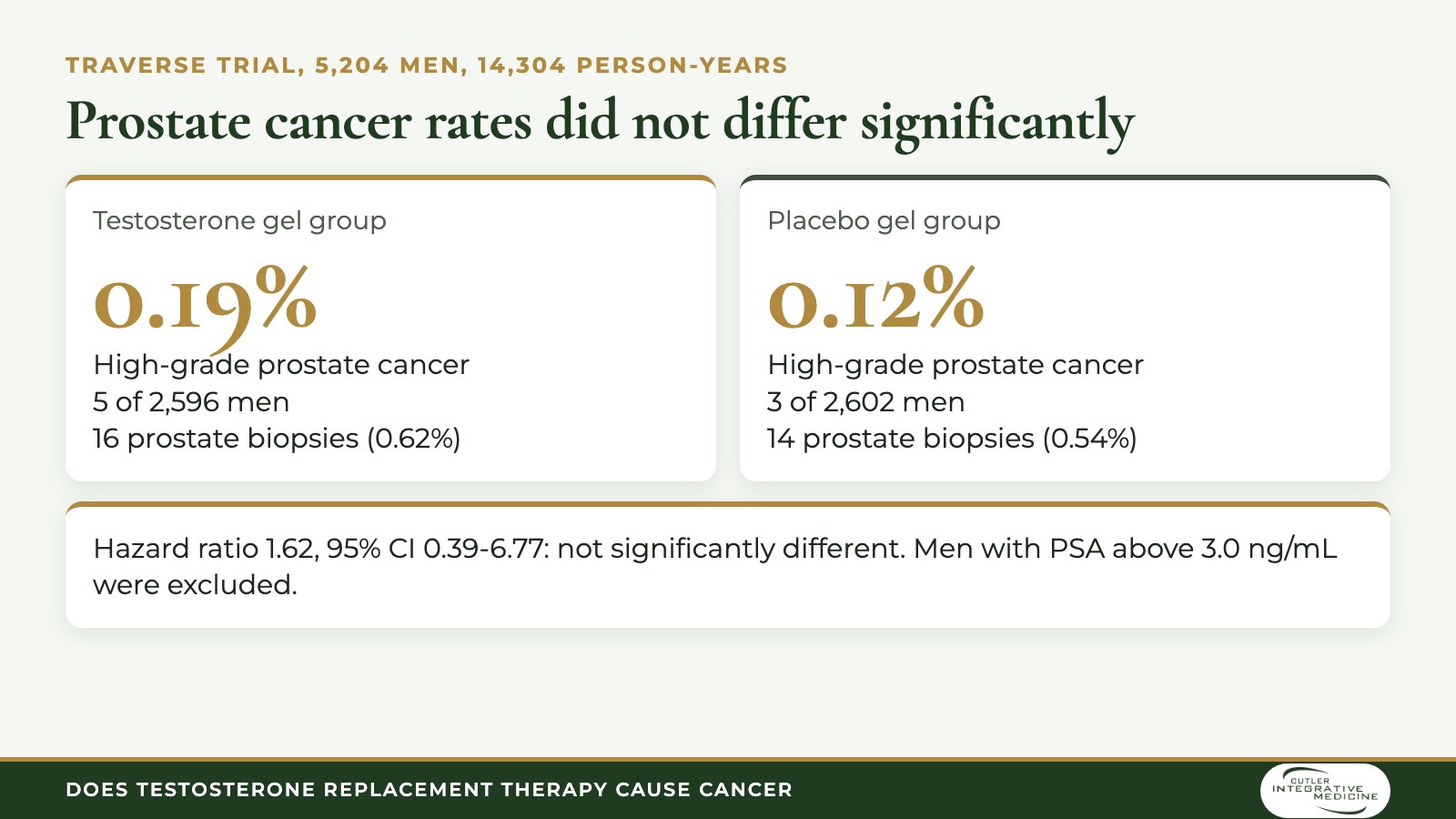
The graphic above shows these TRAVERSE counts side by side. Researchers still needed to explain why a hormone linked to prostate cancer fails to cause it.
The saturation model says prostate cells stop responding to extra testosterone once levels reach the normal range. A PubMed Central review describes it as prostate growth becoming insensitive to changes at normal androgen levels. The reason is that the androgen receptor, the protein that senses testosterone, becomes saturated.
The same review says growth rises steeply only at castrate levels, meaning very low testosterone. Duke Health reported a related finding in September 2024 in Nature Communications. Low androgen levels pushed prostate cancer cells to multiply, while higher levels halted their growth.
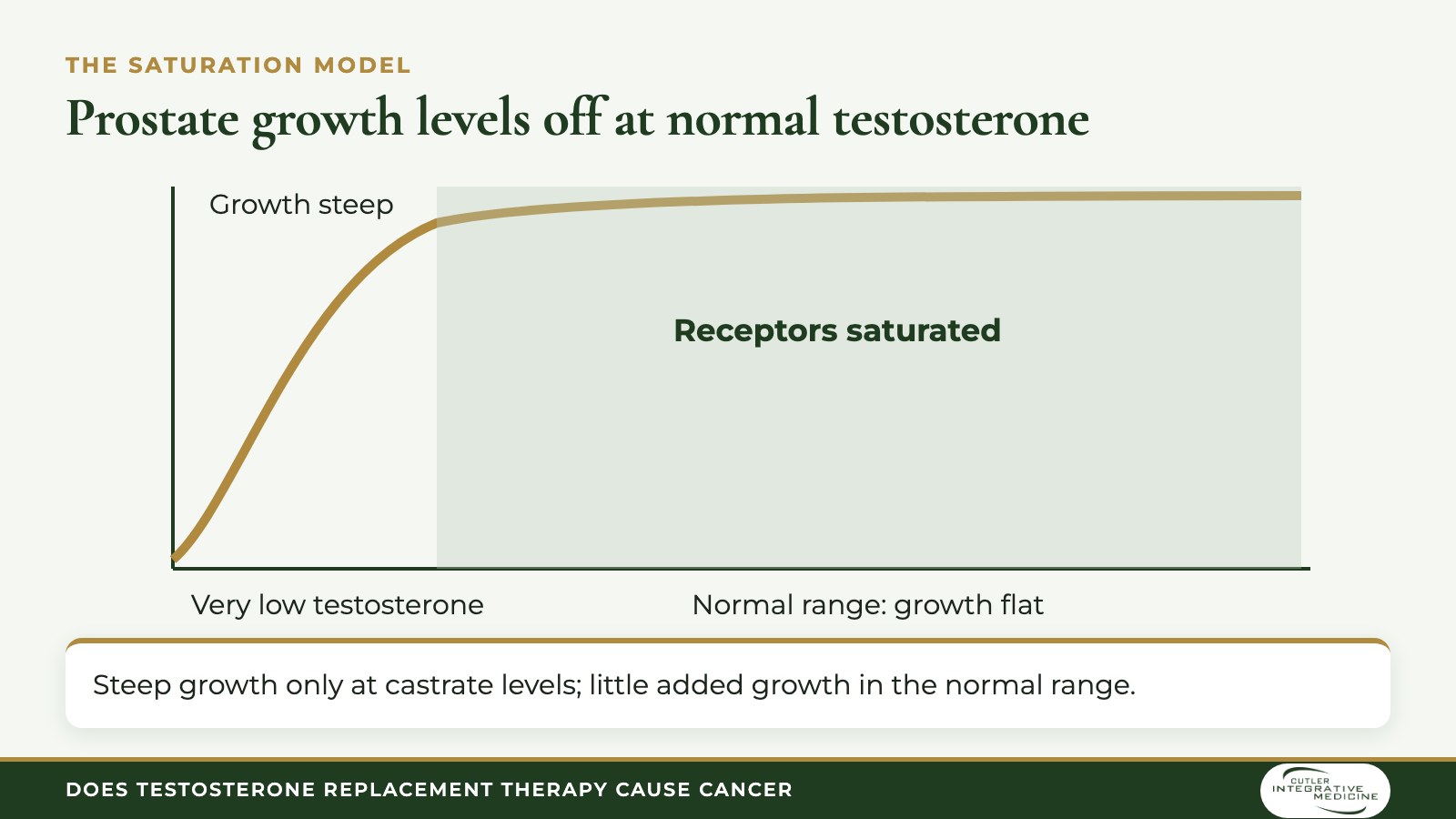
The diagram above shows prostate growth flattening once testosterone reaches normal levels. That flat curve explains why doctors still ask whether testosterone is bad for the prostate.
Testosterone is not bad for a healthy prostate, but it can fuel a cancer that is already there. Dr. Best of MD Anderson calls the prostate a testosterone-sensitive tissue. Prostate cancer treatment relies on that sensitivity. The Prostate Cancer Foundation says hormone therapy for the disease lowers or blocks testosterone.
A PubMed Central review warns that testosterone may speed up development of a cancer that is already forming. TRT can also enlarge the prostate slightly, and the PSA rises with it. Doctors therefore treat a PSA jump as a signal to look closer.
That signal depends on regular testing, so the next question is how PSA behaves during therapy.
Yes, TRT raises PSA levels a little, and the average rise is small. In TRAVERSE, PSA increased more on testosterone than on placebo. The gap between the two groups did not widen after 12 months.
A PubMed Central review says a PSA jump above 1 ng/mL within 3 to 6 months may reflect an existing cancer. TRAVERSE referred men to a urologist when a confirmed PSA rose more than 1.4 ng/mL in year one. A confirmed PSA above 4.0 ng/mL also triggered referral.
Because PSA movement guides decisions, monitoring needs a clear plan. The next section lays out that plan.
Doctors monitor prostate cancer risk during testosterone therapy with a standard plan, and the first year gets the closest attention. The Endocrine Society plan includes four checks in that period:
MD Anderson notes that the Endocrine Society suggests starting PSA checks at age 50 for men without prostate cancer history. Men with risk factors start at age 40. The prescribing physician sets the schedule, and our biointelligent lab panels can add context on hormones and stress markers between visits.
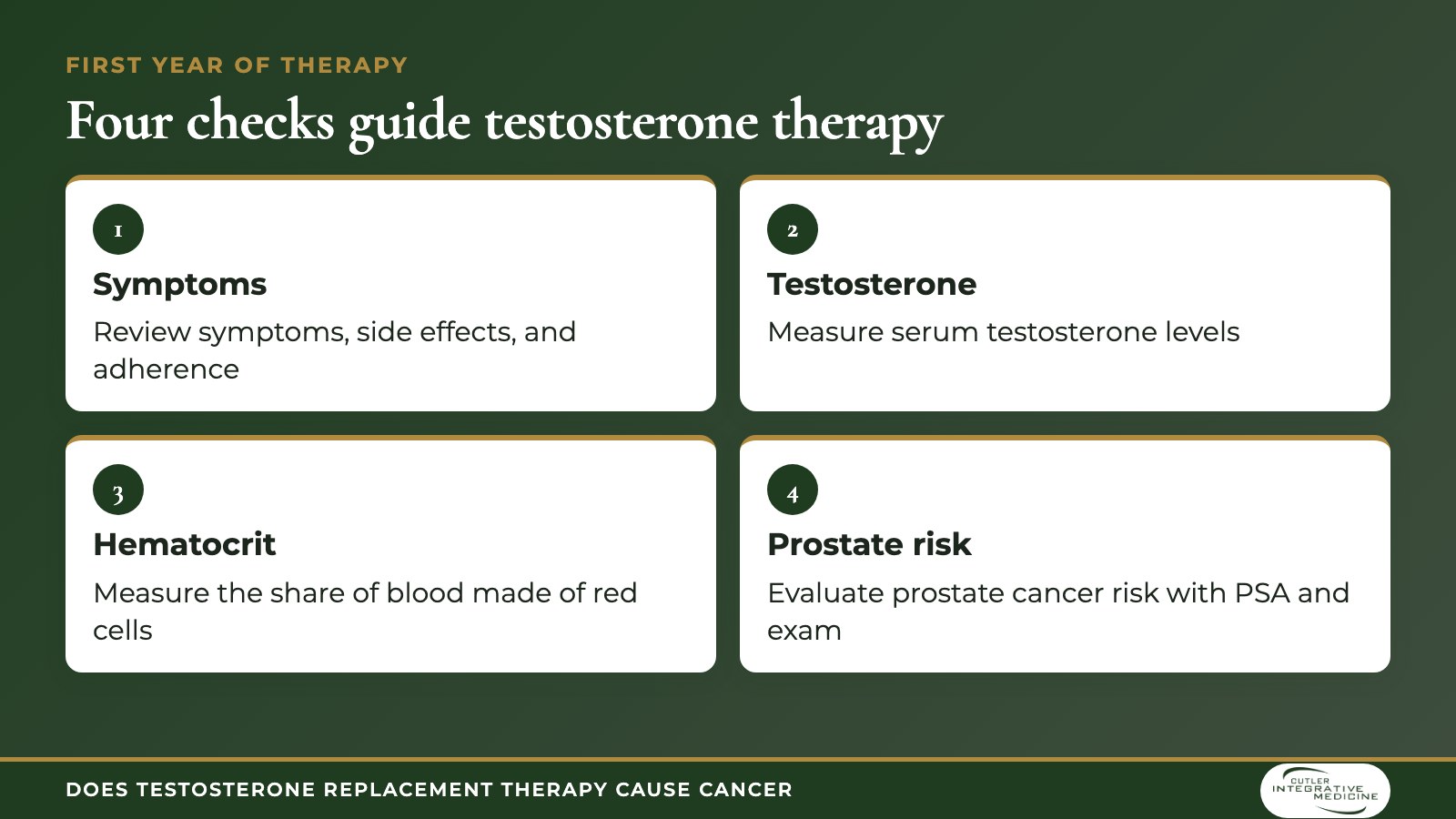
The graphic above maps those four checks onto the first year of therapy. Prostate risk is only one half of the cancer question, and breast tissue comes next.
No clear evidence links testosterone replacement therapy and breast cancer in men, and breast cancer is rare in men. The National Cancer Institute (NCI) says fewer than 1 in 100 breast cancers in the United States occur in men. A PubMed Central review finds no known physiologic link between testosterone and breast cancer.
The same review notes one theory about testosterone converting to estrogen. That process is called aromatization. Case reports exist, and one small retrospective review followed 45 men on long-term TRT, so firm conclusions are not possible yet.
The NCI lists higher estrogen states as male breast cancer risk factors. Examples include Klinefelter syndrome, liver cirrhosis, and obesity. For comparison, women face a different risk picture, which our guide to cancer and HRT explains.
Yes, TRT can cause gynecomastia, which is enlarged male breast tissue, but it is not cancer. A PubMed Central review reports gynecomastia or breast pain in 10 to 25% of men on TRT. The ratio of estradiol to androgens appears to matter more than the absolute testosterone level.
Men who notice a lump, nipple discharge, or skin changes on one side should see a doctor promptly. Doctors can tell harmless tissue growth from a mass. That distinction brings up the broader question of other cancer types.
The strongest evidence on testosterone replacement therapy and cancer risk covers the prostate, so data on other cancers is thinner. TRAVERSE tracked prostate events as its main cancer safety question. It reported heart outcomes and a few other safety events in its New England Journal of Medicine paper.
Men with a personal history of any cancer should discuss testosterone with an oncologist before starting. The Endocrine Society names breast and prostate cancer as reasons not to start. Other cancer types call for an individual review of the evidence.
Men with breast or prostate cancer should avoid starting testosterone replacement therapy until a specialist clears them. The Endocrine Society 2018 guideline recommends against starting therapy in men with these conditions.
The guideline counts African American men and men with a first-degree relative with prostate cancer as higher risk. Men on this list who still have symptoms may benefit from hormonal health support that works around the prescribing physician.
Some men can take testosterone replacement therapy after cancer, but only under specialist supervision. A PubMed Central review says TRT after treatment is becoming more accepted. It also advises caution for men previously treated for high-risk prostate cancer.
The review cites a retrospective study of 103 men who took testosterone after radical prostatectomy, surgery that removes the prostate. PSA rose in those men, yet the control group had twice as many recurrences after 36 months. A study of 13 men with untreated cancer saw no progression over a median of 2.5 years.
Those studies are small, so the table below compares the three common situations.
| Situation | What the evidence says | Typical next step |
|---|---|---|
| No prostate cancer, low testosterone confirmed | TRAVERSE found no significant difference in prostate cancer | PSA and exam before and during therapy |
| Untreated prostate cancer | The Endocrine Society advises against starting therapy | Specialist decision only |
| Prostate cancer treated with surgery | Small studies show no excess recurrence, but data is limited | Cautious, urologist-led plan |
The table shows that cancer status, not testosterone alone, decides the plan. Treatment length raises its own question about long-term safety.
TRT has not been shown to harm long-term health in carefully screened men, but long-term evidence remains limited. TRAVERSE treated men for a mean of 21.7 months and followed them for 33.0 months. Major cardiac events occurred in 7.0% on testosterone and 7.3% on placebo.
The same New England Journal of Medicine paper reported more atrial fibrillation, acute kidney injury, and pulmonary embolism with testosterone. Pulmonary embolism is a blood clot in the lungs. Our overview of testosterone side effects covers the full list.
The long term effects of testosterone replacement therapy also include effects on fertility. MD Anderson says the body senses plenty of testosterone and lowers its own production. Doctors therefore weigh benefits against these effects before any start date.
No guideline sets a fixed safe limit, so safe duration depends on monitoring rather than a number of years. TRAVERSE provides randomized data to about 33 months of follow-up. The Endocrine Society plan keeps testosterone, hematocrit, and prostate risk under review during treatment.
Men who stay on therapy should keep every scheduled lab visit. Doctors adjust the dose when levels drift above range. The grouper section below answers several shorter questions that follow from this one.
No, naturally higher testosterone has not been tied to more prostate cancer. MD Anderson says no clear correlation exists between a testosterone level and prostate cancer risk. The 18-study meta-analysis supports that view. Men with symptoms should still have their levels checked properly.
Doctors prescribe testosterone carefully because guidelines require a confirmed deficiency and a safety screen first. Dr. Best says there is no reason to start therapy when levels already look normal. Reviewing low testosterone signs helps men decide when testing is worthwhile.
No research here ties over-the-counter boosters to cancer, but they are unregulated and may hold unknown ingredients. MD Anderson says weak hormone precursors are not necessarily dangerous but are not very effective. Men who take supplements should review supplement safety with a clinician.
Stopping testosterone therapy after years of use is possible, but it should happen under a doctor's guidance. MD Anderson says weaning off can be lengthy after long use. The body may need time to restart its own production.
Testosterone is used experimentally in a method called bipolar androgen therapy, which cycles high doses in advanced disease. Duke Health says clinicians have begun treating late-stage, therapy-resistant cancers with monthly high-dose injections. That research setting differs from standard TRT for low testosterone.
Low testosterone symptoms include low sex drive, fatigue, reduced muscle mass, and mood changes. The Endocrine Society says diagnosis needs symptoms plus consistently low morning blood levels. Symptoms alone are not enough to start therapy.
Doctors diagnose low testosterone with fasting morning total testosterone tests, repeated to confirm. The Endocrine Society recommends a free testosterone test when total levels sit near the lower limit. A doctor then looks for the cause.
TRAVERSE found major cardiac events in 7.0% of men on testosterone and 7.3% on placebo. It also found more pulmonary embolism and atrial fibrillation with testosterone. Men with clotting or heart conditions should ask their doctor first.
MD Anderson says the Endocrine Society suggests PSA monitoring from age 50, or age 40 with risk factors. Men on TRT also get PSA checks during the first year. Results guide any urology referral.
Lifestyle changes may help some men with low testosterone symptoms. MD Anderson says weight loss, more activity, and better diet can improve energy, strength, and sex drive. A hormone check shows whether those steps are enough.
Cutler Integrative Medicine supports men by testing hormone levels, finding root causes, and working alongside the prescribing physician. We do not prescribe testosterone or manage prostate treatment. Our care covers stress, sleep, thyroid, gut, and toxin exposure that can affect energy and hormones.
Dr. Doug Cutler, ND, applies a naturopathic perspective to look at the whole person. His Integrative Health Model connects stress, sleep, gut health, thyroid function, and toxin exposure to hormone health. Each plan starts with listening and testing.
Men who want to meet our founder can learn about his training and approach. The clinic also offers telemedicine visits for men who live farther away. Men with a cancer history should keep their oncologist involved.
Nutrition forms part of the plan, and clinical nutrition plans may help men support healthy weight and energy. Healthy weight, steady blood sugar, and enough protein all affect hormone balance.
Men who already take testosterone need a separate reference. Doctors adjust doses based on labs, and patients should never change a dose alone. Our guide to male hormone replacement covers how prescribers weigh labs, symptoms, and monitoring. Patients should bring cancer history, family history, and recent PSA results to that conversation.
Questions about testosterone replacement therapy and cancer deserve individual answers. Call (248) 663-0165 or reach our team to talk through testing options and questions for your doctor. Bring recent lab results and a list of current medicines to the first conversation.
Testing comes first in every plan because treatment choices depend on accurate numbers, not guesses or advertising claims. Hormone panels, adrenal saliva testing, and blood work show where levels stand. The Bingham Farms clinic can walk through each result with you and your prescribing physician. Teams at Cutler Integrative can explain which labs fit your situation.








Cutler Integrative Medicine blends naturopathic and conventional care to treat the root causes of illness. Through personalized wellness plans, advanced diagnostics, and holistic therapies.


Copyright © 2025 Cutler Integrative Medicine. All Rights Reserved.