

The latest research on hormone replacement therapy found no added heart risk for women aged 45 to 59 in a 52,330-woman study. The FDA also removed heart disease, breast cancer, and dementia statements from the boxed warning on menopausal hormone products in 2026. Some findings remain preliminary or observational, so timing and health history still decide the choice.
Key Takeaways
The latest research on hormone replacement therapy (HRT) shows fewer heart and brain concerns near menopause and a steep drop in use. Five dated findings lead the latest news on hormone replacement therapy, listed here newest first.
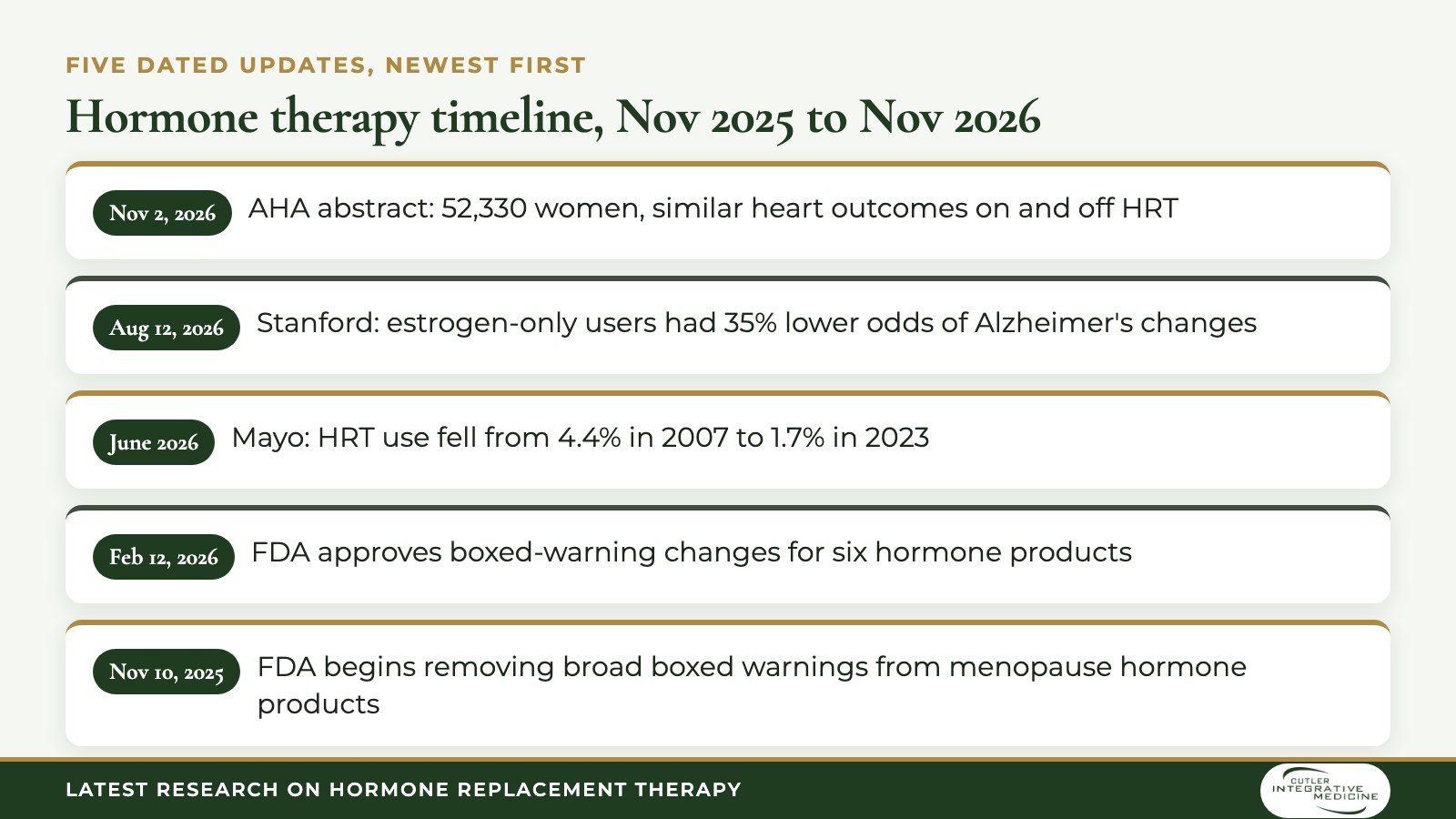
The timeline graphic above places each update on its date. Women weighing these findings can start with hormone level testing, then bring the results to a prescribing doctor.
The FDA removed the black box warning on estrogen after a literature review, a July 2025 expert panel, and public comment. A black box warning is the agency's most prominent safety-related warning. The FDA noted that 2002 Women's Health Initiative (WHI) participants averaged 63 years, over a decade past the average age of menopause.
The agency began the removal on November 10, 2025, and approved labeling changes for six products on February 12, 2026. A total of 29 drug companies submitted proposed label changes at the FDA's request. The boxed warning for endometrial cancer stays on systemic estrogen-alone products.
Endometrial cancer is why women with a uterus take a progestogen with estrogen. The new labels also set timing rules, covered next.
The FDA label's new HRT guideline is to start systemic therapy within 10 years of menopause or before age 60. The Menopause Society's 2022 position statement uses the same window. The statement calls the benefit-risk balance favorable under age 60 or within 10 years of onset, without contraindications.
Both documents leave the final choice to the patient and prescriber. The wider safety of HRT picture also includes dose, route, and personal history.
Use remains low. The FDA reports that about 41 million US women were aged 45 to 64 in 2020. Only about 2 million aged 46 to 65 received a hormone-therapy prescription. Heart findings explain why timing matters.
No, modern hormone replacement therapy did not raise heart disease risk in a preliminary study of 52,330 Israeli women aged 45-59. Researchers followed the women for an average of 12 years. Heart attack, stroke, or related heart disease occurred in 4.4% of the HRT group and 4.6% of the comparison group.
Deaths before age 80 were 1.3% with HRT versus 1.2% without. Blood clots occurred in 0.33% of both groups. Results were similar for oral, patch, and gel forms.

The graphic above compares the four outcomes side by side. The AHA states that abstracts are not peer-reviewed, so the findings stay preliminary until a journal publishes them.
Older WHI data explain why timing matters. A 2007 JAMA analysis by Rossouw and colleagues compared heart disease risk by years since menopause, shown in the table below.
| Years since menopause | Hazard ratio (95% CI) | What the number shows |
|---|---|---|
| Under 10 years | 0.76 (0.50-1.16) | No significant increase in risk |
| 10 to 19 years | 1.10 (0.84-1.45) | No significant difference |
| 20 or more years | 1.28 (1.03-1.58) | Statistically higher risk |
The table shows risk rising with distance from menopause. The same analysis found a stroke hazard ratio of 1.32, with no significant change by age. Over 18 years, all-cause mortality was 27.1% with hormone therapy versus 27.6% with placebo. Breast cancer is the next concern.
Yes, estrogen plus progestin therapy raised breast cancer risk in the WHI, while estrogen alone did not. A 2020 JAMA follow-up of more than 20 years covered 27,347 women. Among 16,608 women with a uterus, estrogen plus progestin carried a hazard ratio of 1.28, with 584 cases versus 447 on placebo.
Among 10,739 women with a prior hysterectomy, estrogen alone carried a hazard ratio of 0.78, with 238 cases versus 296 on placebo. Absolute numbers stay small in both groups. A separate guide on cancer risk findings breaks them down by hormone type.

The graphic above contrasts the two WHI arms. Women with a personal or family history of breast cancer should talk to their doctor before starting any hormone. Estrogen-only therapy also appears in the newest brain research.
Estrogen-only hormone therapy was linked to lower dementia risk in a 2026 Stanford Medicine study published August 12 in Neurology. Researchers compared 258 autopsied estrogen-only users with about 2,701 women who never used hormone therapy. Estrogen-only users had 35% lower odds of Alzheimer's brain changes.
Living participants who used estrogen-only therapy had 39% lower odds of a lifetime dementia diagnosis. The women averaged age 70, and many had hysterectomies. The results apply only to oral estrogen-only therapy, not to estrogen plus progestin or topical estrogen. The association is not proof of causality.
The 2003 WHI Memory Study pointed the other way for estrogen plus progestin started at older ages. Conflicting findings help explain doctor caution.
Many doctors became cautious about HRT after the 2002 WHI results led the FDA to apply boxed warnings. The FDA says use plummeted in the early 2000s afterward. Mayo Clinic Proceedings data show use among women 40 and older fell from 4.4% in 2007 to 1.7% in 2023.
Even among women aged 50 to 59, only about 3.5% used hormone therapy in 2023. Use was defined as at least 180 days of filled prescriptions in a year. Newer labels may shift that caution, but age still decides eligibility.
Age 60, or 10 years past menopause onset, marks where starting HRT becomes less favorable, according to The Menopause Society. The FDA label uses the same window for systemic therapy. Rossouw's 2007 table above shows the risk signal at 20 or more years.
Women past the window can still discuss options with a prescriber, who weighs symptoms against personal risk. A guide to starting HRT explains how that window works in practice. Age is one filter, and health history is the other.
A history of vaginal bleeding, stroke, heart attack, blood clots, or liver disease rules out hormone therapies, says the FDA. The agency's 2023 notice lists five histories.
Women with a uterus also need a progestogen, because estrogen alone carries an endometrial cancer warning. A full list of known HRT risks covers side effects as well. Starting or stopping any hormone should happen with a prescribing physician. Women who cannot take hormones have newer drug options.
Neurokinin 3 (NK3) receptor antagonists are the new nonhormonal alternative to HRT for hot flashes and night sweats. The FDA approved Veozah (fezolinetant) on May 12, 2023, as the first NK3 drug for moderate to severe hot flashes. The label warns of liver injury and calls for blood work before use and every three months for nine months.
A second drug, elinzanetant, was tested in the OASIS-3 trial of 628 women over 52 weeks. At week 12, daily moderate to severe hot flashes fell by 5.4 with elinzanetant versus 3.5 with placebo. Treatment-related side effects occurred in 30.4% versus 14.6%, mainly sleepiness, fatigue, and headache.
The FDA also approved a nonhormonal hot flash treatment on November 10, 2025. Drugs are one path, and lifestyle changes are another.
Natural options instead of HRT include exercise, nutrition, sleep habits, and a few herbs, though herb evidence is limited. The NHS advises at least 150 minutes of moderate exercise weekly, particularly for women with menopausal symptoms.
The National Center for Complementary and Integrative Health (NCCIH) says soy may reduce hot flashes, though the effect may be small. Results are inconsistent. A 2023 review of 22 black cohosh studies found potential benefit for hot flashes, with rare reports of liver damage. Herbs can interact with medicines, so a doctor should review them. Several options, such as drug-free support, are compared in a separate guide.
Women who do choose hormones face a form question next.
The safest form of estrogen replacement is an FDA-approved product matched to the woman's health history, dose, and route. The American College of Obstetricians and Gynecologists (ACOG) recommends FDA-approved hormone therapy over compounded versions. ACOG finds no evidence that compounded products are safer or more effective.
The AHA abstract found similar heart results across oral, patch, and gel forms. Women with a uterus need a progestogen with estrogen. Each of the hormone therapy forms carries its own tradeoffs. Men face a different set of findings.
The latest hormone replacement therapy research on testosterone in men, the TRAVERSE trial, found no higher rate of major cardiac events. The trial enrolled 5,246 men and gave testosterone gel or placebo gel. Major cardiac events occurred in 7.0% of men on testosterone and 7.3% on placebo, with a hazard ratio of 0.96. The trial was published in the New England Journal of Medicine in 2023.
Men on testosterone had more atrial fibrillation, acute kidney injury, and pulmonary embolism. Prostate cancer and blood pressure need separate monitoring. Details on male testosterone therapy are available in a dedicated post.
A 70-year-old woman should decide on estrogen with her doctor, because starting systemic therapy at that age falls outside the favorable window. The Menopause Society says therapy should be individualized and reevaluated periodically. Women already on estrogen can review continuation with their prescriber.
After 5 years of HRT, the main decision is whether benefits still outweigh risks. The WHI estrogen-plus-progestin trial ran a median 5.6 years, and some elevated breast cancer risk persisted after stopping. Women at the 5-year mark should check in with a prescriber. See the guide on duration of therapy for typical timelines.
Whether skipping HRT is healthier depends on age, timing, and symptoms, and the research gives no single answer. A 2013 WHI analysis did not support HRT for chronic disease prevention but called it appropriate for symptom management. Women who skip hormones can still get hormone symptom care aimed at stress, gut, thyroid, and sleep.
No, the research reviewed here does not show that going without estrogen speeds aging. The FDA lists symptom relief and bone loss as hormone therapy uses. The 2013 WHI analysis did not support HRT for chronic disease prevention.
No study here shows that stopping HRT speeds aging, but symptoms can return. A WHI survey found moderate or severe hot flashes in 21.2% of former estrogen-plus-progestin users versus 4.8% on placebo. A separate study linked stopping to a 55% higher hip fracture risk than continuing.
Many women feel better on HRT because it restores declining estrogen and progesterone. The FDA says HRT can relieve hot flashes, night sweats, sleep disturbances, and bone loss. Relief varies by person and product.
Hormone replacement therapy is not bad for every woman, but it carries real risks for some. The WHI found higher breast cancer risk with estrogen plus progestin and higher stroke risk. Timing, dose, and history decide the balance.
Cutler Integrative Medicine helps women sort through new hormone research with testing and root-cause care. Women can work with Cutler's integrative clinic in Bingham Farms or by telemedicine. We test hormone levels with saliva adrenal testing and blood work.
We also look for root causes in stress, gut, thyroid, toxins, nutrition, and sleep. Founder Dr. Doug Cutler, ND, builds a hormone health plan with nutrition, botanical medicine, and lifestyle changes. Each plan is built around the patient's own test results and symptoms, not a fixed protocol for every woman in the clinic.
Extra lab detail from biointelligent panels can add to that picture. Results go to the patient's prescribing physician, and our team works alongside that doctor instead of replacing that care.
Patients curious about training can read why naturopathic doctors approach hormones through root causes. Call (248) 663-0165 to schedule a conversation.








Cutler Integrative Medicine blends naturopathic and conventional care to treat the root causes of illness. Through personalized wellness plans, advanced diagnostics, and holistic therapies.


Copyright © 2025 Cutler Integrative Medicine. All Rights Reserved.