





The pros and cons of testosterone replacement therapy (TRT) depend on one result: total testosterone under 300 ng/dL plus symptoms. In the 5,246-man TRAVERSE trial, TRT improved sexual activity, mood, energy and anemia. TRT also lowers sperm production, raises red blood cell counts and usually continues long term. This guide weighs each pro against its matching con.
Key Takeaways
The pros and cons of testosterone replacement therapy are five benefits against six downsides for men with confirmed low testosterone. The benefits are sexual desire, mood and energy, lean mass, bone density and anemia correction. The downsides are fertility loss, high red blood cell counts, skin and breast changes, sleep apnea, ongoing treatment and monitoring.
Every item on both lists depends on a true deficiency, so a root-cause workup through hormone care plan comes before any decision. The table below sets the benefits beside the downsides.
| Area | Pro | Con | Evidence |
|---|---|---|---|
| Sexual health | Higher desire; sexual activity up 0.49 acts per day at 6 months | Erectile function did not improve versus placebo | TRAVERSE 2023 |
| Mood and energy | Modest gains in mood and energy | Not a depression treatment; no gain in cognition or sleep quality | TRAVERSE 2024 |
| Blood | Anemia corrected in 41.0% versus 27.5% at 6 months | Hematocrit above 54% in 22% versus 1% on placebo | TRAVERSE, T4DM |
| Body | Lean mass and spine bone density rise; fat mass falls | Small effects; no proven strength or fracture benefit | AAFP 2017 |
| Fertility | None | Sperm count falls and the testicles shrink | Cleveland Clinic |
| Skin and breast | None | Acne, oily skin, breast tenderness in 10% to 25% | Cleveland Clinic, PMC |
| Commitment | Symptom relief for as long as treatment works | Ongoing treatment and yearly monitoring | Cleveland Clinic, AAFP |
The table shows that each benefit carries a matching trade-off. The graphic below turns the same list into a quick side-by-side view.

A good candidate for testosterone replacement therapy is a man with low-testosterone symptoms and two confirmed low morning blood tests. A Houston Methodist urologist defines low testosterone as total testosterone under 300 ng/dL. Hypogonadism means that low result plus symptoms, which separates it from a number alone.
Nearly 40% of men over 45 have low testosterone, according to the same urologist, so testing matters more than guessing. The Endocrine Society 2018 guideline asks for repeat measurement, and free testosterone is checked when the total sits near the lower limit. Our overview of TRT for men covers the basics.
Diagnosis and safety screening follow four steps before the first dose.
Cleveland Clinic lists the same baseline labs, and the results decide which benefits and risks apply next.
The benefits of testosterone replacement therapy are better sexual function, lean body mass, bone mineral density, mood, energy and sense of well-being. Cleveland Clinic names these six gains for men with low testosterone. Trial evidence is strongest for sexual desire and anemia, and weaker for strength and thinking.
The next sections grade each benefit by its evidence, starting with sex drive.
Testosterone replacement therapy improves sex drive in men with low testosterone, but it helps erections less. The TRAVERSE Sexual Function Study followed 1,161 men with low libido. Sexual activity rose 0.49 acts per day at 6 months. The gain was 0.47 acts per day at 12 months.
The same study found better sexual desire but no better erectile function than placebo. A review from the American Academy of Family Physicians (AAFP) found libido benefits in 13 of 23 trials. Eight trials showed none and two were mixed. The AAFP also notes that testosterone has no evidence of helping erections in men with normal levels.
Desire is only one of several symptom changes, and mood follows it closely.
Testosterone replacement therapy can modestly improve mood and energy in men with low testosterone. A TRAVERSE analysis found modest but significantly greater gains in mood and energy than placebo. Cognition and sleep quality did not improve.
Depressive symptoms were present in 2,643 of the 5,204 men, or 50.8%. The AAFP review calls the earlier depression trials mixed, so TRT is not a depression treatment. Energy changes also link to the blood count, which brings up anemia.
Testosterone replacement therapy can correct mild anemia in men with low testosterone. In a TRAVERSE anemia trial, anemia corrected in 41.0% of testosterone-treated men versus 27.5% on placebo at 6 months. At 12 months the figures were 45.0% and 33.9%.
Testosterone stimulates red blood cell production, which explains the benefit and also the risk covered later. Muscle and bone are the next body systems to compare.
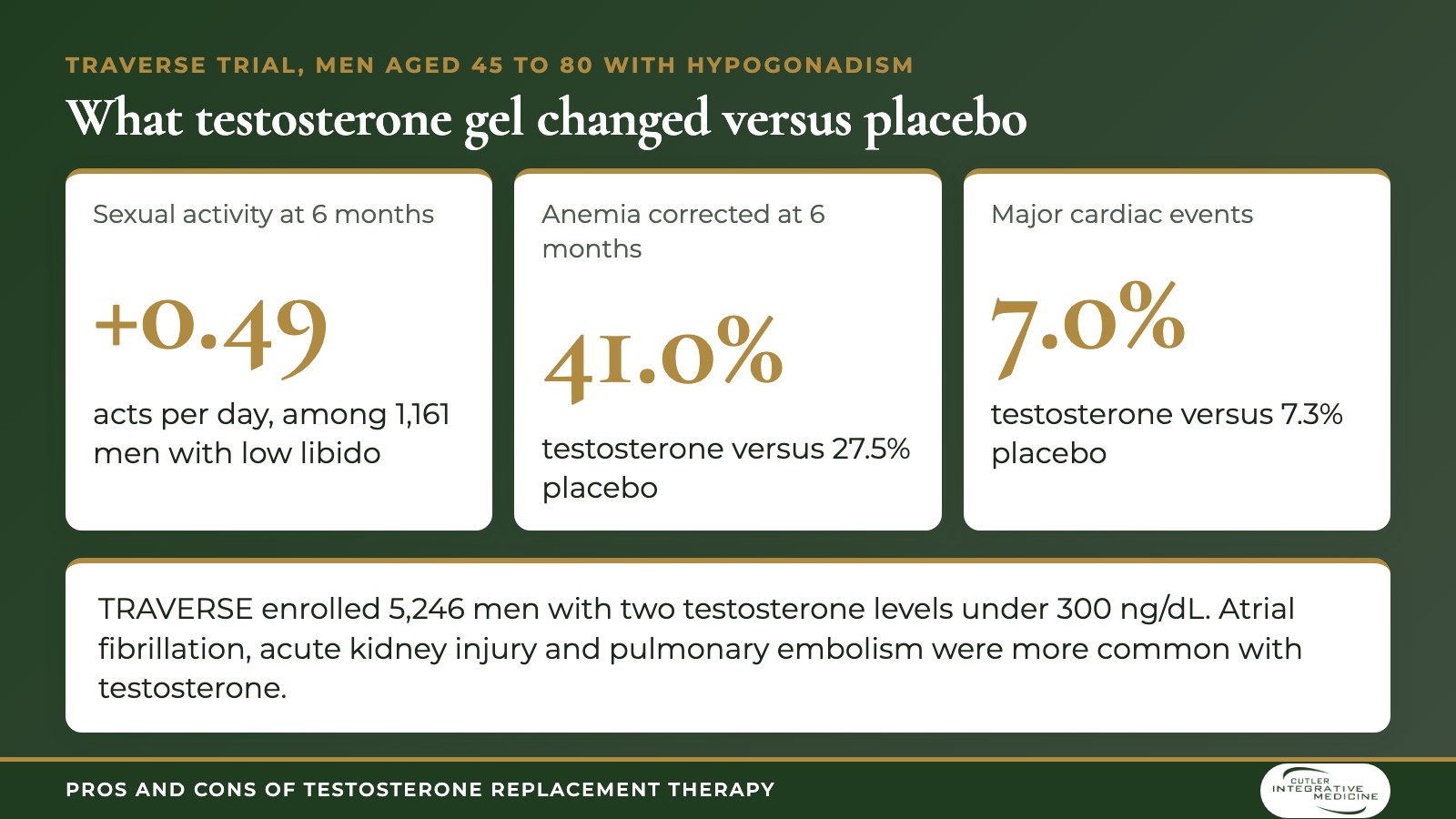
The graphic above shows the three TRAVERSE results used in this section.
Testosterone replacement therapy raises lean mass and spine bone density, but the strength gains are small. The AAFP review reports that lean mass rises and fat mass falls, with small effect sizes. Studies have generally not shown better strength or physical function.
Bone density rose at the lumbar spine in middle-aged men, and in the spine and hip in older men. The AAFP review found no evidence of fewer fractures or falls. Body fat is the next question men ask.
Yes, testosterone lowers fat mass modestly, but it is not a weight-loss drug. A meta-analysis of 59 randomized trials found fat mass fell and lean mass rose without a change in body weight. Waist size and body mass index (BMI) did not change significantly either.
In the T4DM trial of 1,007 men with larger waists, every participant also followed a lifestyle program. Diet and movement remain the weight-loss foundation, and clinical nutrition supports that part.
The downsides of testosterone replacement therapy are skin, breast, fluid, sleep, fertility and blood changes. Cleveland Clinic lists eight side effects and two lab changes, including smaller testicles and higher PSA. Many are manageable with monitoring, yet some require stopping.
The common side effects and lab changes are listed below.
Gynecomastia or breast pain occurs in 10% to 25% of men on TRT, per a PMC review. The side effects of testosterone replacement therapy are rechecked at every follow-up visit. Our page on TRT side effects covers each one in detail. Fertility is the downside that raises the next question.
Yes, TRT affects fertility because testosterone therapy suppresses sperm production. Cleveland Clinic says TRT causes the testicles to stop working, so sperm count drops. The AAFP lists a desire for fertility as a relative contraindication.
Men who plan biological children should avoid TRT, and Cleveland Clinic adds that repairing fertility afterward can be slow and expensive. A fertility specialist should guide any plan to conceive. Red blood cell counts are the next downside.
Yes, testosterone replacement therapy can raise red blood cell counts, a condition called erythrocytosis. In the T4DM trial, hematocrit went above 54% in 22% of men on testosterone versus 1% on placebo. Hematocrit is the share of blood made of red cells.
The AAFP says a hematocrit above 54% means stopping TRT, lowering the dose or switching formulations. Thicker blood raises concern for clots, so blood counts are checked at baseline, at 3 to 6 months, and yearly. Heart and prostate safety come next.
Testosterone replacement therapy was not linked to more major heart events in the TRAVERSE trial, but it raised other risks. Major cardiac events occurred in 7.0% of men on testosterone versus 7.3% on placebo. Atrial fibrillation, acute kidney injury and pulmonary embolism were more common with testosterone.
The prostate substudy found high-grade prostate cancer in 5 of 2,596 men on testosterone and 3 of 2,602 on placebo. That gap was not statistically significant. Men with prostate cancer should still avoid starting TRT.
Men with prostate cancer, breast cancer, a hematocrit above 54% or a PSA above 4 ng/mL should avoid testosterone replacement therapy. The AAFP lists these as absolute contraindications. Cleveland Clinic adds a recent heart attack or stroke, untreated sleep apnea and plans for children.
Relative contraindications call for a specialist's judgment.
Men with any of these conditions should talk to their doctor before starting or stopping any hormone.
No single form of testosterone is most effective, because the AAFP says no formulation has superior clinical effects. Route, side effects and cost drive the choice. Testosterone products are Schedule III controlled substances.
The table below compares the common forms by schedule and main trade-off.
| Form | Schedule | Main trade-off |
|---|---|---|
| Skin gel | Daily | Can transfer to partners and children through contact |
| Injection | Every 1 to 2 weeks; some long-acting forms every 10 weeks | Levels can peak and dip between doses |
| Pellets | Every 3 to 6 months | Requires a procedure to implant under the skin |
| Oral pill | Twice daily | Older forms raised liver concerns; newer forms do not, per Houston Methodist |
| Nasal gel | Three times daily | Highest dosing frequency of any form |
| Skin patch | Daily | Skin rash is common, so sites rotate |
Gels carry a transfer risk to partners and children, which pushes some men toward injections. The form changes how steady the levels stay, which affects the timeline.
Testosterone replacement therapy takes a few weeks before mood and body changes appear. Providers typically check levels about 30 days after the first dose, according to Cleveland Clinic. Results vary from person to person.
The TRAVERSE sexual activity gain showed at 6 months. Cleveland Clinic says a provider may recommend stopping when symptoms do not improve after 3 to 6 months. The low level may not have been the cause.
A man can stay on TRT for as long as it relieves symptoms and causes no health problems. Cleveland Clinic calls TRT a long-term therapy, since levels return to baseline after stopping. The body then needs time to restart its own production.
The AAFP monitoring schedule keeps long-term use safe: a check 3 to 6 months after starting, then yearly. Targets sit at the midnormal range of 400 to 700 ng/dL. A urology referral follows a PSA rise above 1.4 ng/mL in 12 months.

The graphic above lays out the monitoring timeline. Cost, shots and lab visits make the worth question fair.
Yes, testosterone replacement therapy is worth it for men with confirmed hypogonadism and symptoms, and not worth it for normal levels. The FDA approves it for low testosterone from testicle, pituitary or brain disorders, not for age-related decline. Age-related use is off-label.
The American Urological Association (AUA) advises against TRT for erectile dysfunction with normal testosterone. Weighing the risks and benefits of testosterone replacement therapy starts with a confirmed diagnosis. Testosterone replacement therapy pros and cons differ for each man. Lifestyle changes come first, per Houston Methodist. A fuller plan for hormonal health care addresses sleep, stress, weight and nutrition alongside any prescription.
Doctors are hesitant to prescribe TRT when risks are unclear, and the 2015 FDA advisory flagged possible cardiovascular risk. The AAFP notes that long-term data were uncertain then. TRAVERSE later reported its heart results, and monitoring remains required.
The signs you need testosterone are low libido, fatigue, low mood, lost muscle and extra body fat. Only blood tests confirm a deficiency, since these signs overlap with other conditions. Our guide to low T symptoms explains when to test.
Testicles can recover after TRT stops as natural production restarts, but the recovery time varies. Cleveland Clinic says the body needs time to restart testosterone production. A doctor can check whether levels have recovered.
Testosterone therapy can worsen sleep apnea in some men. An 18-week trial of 67 obese men with severe apnea found worse oxygen levels at 7 weeks, recovered by 18 weeks. Anyone with loud snoring or daytime sleepiness should look at sleep disorder care first.
Diabetes medicines, blood thinners such as warfarin, propranolol and steroids such as prednisone interact with testosterone. Cleveland Clinic lists these interactions for testosterone injections. Herbs and supplements can also interact, so herbal safety deserves a review with the prescriber.
The evidence supports testosterone therapy in women only for low sexual desire after menopause. The 2019 Global Consensus names that as the one evidence-based indication. Our page on female testosterone therapy covers the details.
No, a total testosterone of 1,500 ng/dL sits far above the 400 to 700 ng/dL goal range. The AAFP says values outside that range need a dose adjustment. A man seeing this result on treatment should contact his prescriber.
Bioavailable testosterone is the portion of testosterone the body can use, meaning free testosterone plus testosterone loosely bound to albumin. The Endocrine Society advises checking free testosterone when total testosterone sits near the lower limit. A prescriber orders the right test.
No, TRT does not cause weight gain in studies. A 59-trial meta-analysis found no significant change in body weight, waist size or BMI. Fat mass fell and lean mass rose.
Yes, a man can stop testosterone replacement therapy at any time with his provider's guidance. Cleveland Clinic says levels return to baseline afterward. Natural production takes time to restart.
Cutler Integrative Medicine supports men with low testosterone by finding root causes and working alongside the prescribing physician. We help men weigh the pros and cons of testosterone replacement therapy with their doctor. We do not prescribe testosterone. Our role is testing, nutrition, naturopathic hormone care and lifestyle planning.
Dr. Doug Cutler, ND, reviews hormone levels through blood work, including saliva adrenal testing. The plan looks at stress, gut health, thyroid function, toxin exposure, sleep and nutrition. Those factors can lower testosterone, and addressing them may support symptom relief. We also use biointelligent lab testing where it adds useful detail.
Men in Bingham Farms and across Metro Detroit can also meet with us by telemedicine. Call (248) 663-0165 to book a visit. Learn how Cutler Integrative care fits around the treatment from your doctor.








Cutler Integrative Medicine blends naturopathic and conventional care to treat the root causes of illness. Through personalized wellness plans, advanced diagnostics, and holistic therapies.


Copyright © 2025 Cutler Integrative Medicine. All Rights Reserved.


