


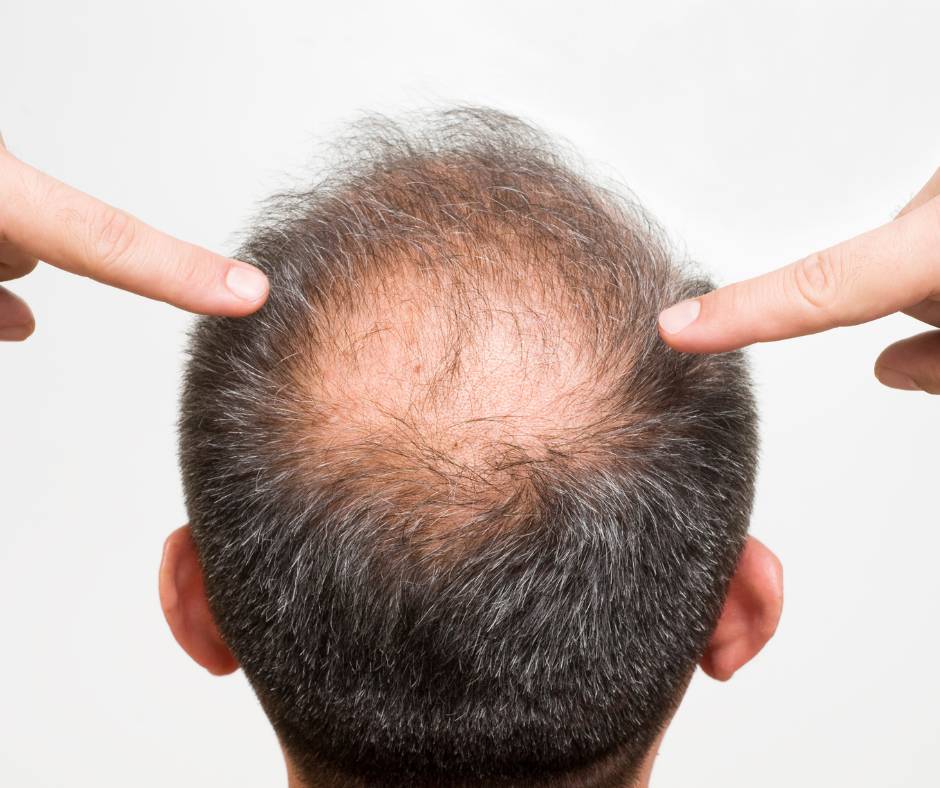
Testosterone replacement therapy does not directly cause hair loss. It raises dihydrotestosterone, or DHT, which accelerates male pattern baldness in men who are genetically predisposed to it. If you do not carry the genetic trait for pattern baldness, raising your testosterone will not make you go bald.
That distinction matters because it changes what you should actually do about it. Below we cover how TRT raises DHT and by how much, who is genuinely at risk, when hair changes show up on the calendar, how your delivery method affects your DHT levels, what you can do to protect your hair while staying on therapy, whether lost hair can come back, what happens if you stop TRT, which natural approaches hold up, and what else could be causing your shedding.
Testosterone replacement therapy does not cause hair loss on its own. TRT accelerates hair loss that was already going to happen in men who carry the genetic trait for male pattern baldness, and it does nothing to the hairline of men who do not.
Genetics is the gate. The medical term for male pattern baldness is androgenetic alopecia, and it is the most common form of hair loss in men. In most cases it is a genetic condition in which the growth phase of your hair follicles is programmed to shorten over time, producing finer, shorter and lighter hair. TRT does not install that programming. It speeds it up when the programming is already there.
The scale of the underlying condition is worth knowing. According to the American Academy of Dermatology, 80 million people in the United States are affected by androgenetic alopecia, 50 million of them men. Published dermatology reviews put the lifetime prevalence at roughly half the male population, climbing to about 80 percent of men by age 70 in the Annals of Dermatology data. A large share of men starting TRT were already on that path.
What TRT does is move the timeline. A man who might have noticed thinning at 45 may notice it at 40 instead. That is a real cost and it deserves planning for, which is a different conversation from the one most men arrive with, where they assume TRT will make them bald from scratch. Sorting out what your hormones are actually doing is the same work involved in correcting any hormonal imbalance.
TRT causes hair loss through DHT. An enzyme called 5-alpha reductase converts part of your testosterone into dihydrotestosterone, and studies show TRT can elevate DHT levels 2 to 3 times above baseline depending on the dose and the route of administration.
DHT is where the damage happens. Urologists at Baylor College of Medicine describe DHT as a more potent androgen than testosterone that binds strongly to androgen receptors in the hair follicle. Those receptors, in men who carry the genetic trait, respond by shortening each follicle's growth phase.
Shortened growth phases produce a process called miniaturization. Each cycle, the follicle produces a slightly thinner, shorter, lighter hair than the one before it, until eventually it stops producing visible hair at all. This is gradual rather than sudden, and it is why pattern baldness shows up as thinning long before it shows up as bald scalp.
One detail puts the whole mechanism in perspective. Dermatology reference literature notes that balding men typically have above-average DHT concentrations inside their hair follicles while carrying entirely normal levels of circulating testosterone. The problem has never been how much testosterone a man has. It is how much of it his scalp converts and how sensitive his follicles are to the result.
DHT levels are highest in men during their late teens and twenties, following the same curve as testosterone, which peaks in early adulthood and declines slowly afterward. Pattern baldness nonetheless tends to become visible later.
Cumulative exposure explains the gap. Follicle miniaturization builds across years of DHT exposure rather than responding to any single peak, so a man in his thirties is seeing the effect of a process that started in his twenties. Published prevalence research found that 62 percent of men aged 20 to 40 already show recession at the temples.
Age also shifts the baseline that TRT starts from. A man beginning therapy at 50 has lower natural DHT than he did at 25, so the same proportional increase lands on a scalp with a different exposure history behind it.
You are at risk of hair loss on TRT if you carry the genetic predisposition for male pattern baldness. Family history on either side of your family, existing recession at the temples, and early onset of thinning are the three strongest predictors.
Family history counts from both parents. The old idea that baldness comes only from your mother's side is wrong, and Baylor lists family history on either side as a risk factor alongside age and elevated androgen levels from medications such as TRT.
Your own scalp is the better predictor. A man with visible recession at the temples at 30 has already demonstrated follicle sensitivity, and adding TRT to that is adding fuel to a fire that is burning. A man of 45 with a full hairline and no thinning has demonstrated the opposite, and his risk from TRT is genuinely low.
Published figures give a sense of the base rate. Research in Pediatric Dermatology reported that roughly 50 percent of men over 40 experience hair thinning or balding, and roughly 33 percent of trans men on testosterone therapy experience it. Those numbers describe the same underlying condition responding to the same androgen.
TRT takes about 3 to 6 months to produce visible androgenetic thinning in genetically susceptible men. Most men see no scalp change at all in the first six weeks, and any shedding that happens between weeks 6 and 12 is usually a temporary shed rather than permanent loss.
Knowing which is which prevents a lot of unnecessary panic. The general timeline runs like this:
Losing hair in the shower during month two is not evidence that TRT is destroying your hairline. Losing hair at the temples in month five, in a pattern, probably is.
Telogen effluvium is a temporary, reversible shedding in which a high proportion of hair follicles enter the resting phase early and shed together. It produces diffuse thinning across the whole scalp rather than a pattern.
The trigger is usually a systemic shift rather than a hormone receptor effect. Illness, major stress, surgery, rapid weight loss and significant hormonal change can all set it off, which is why starting or changing TRT sometimes produces one.
Shape is how you tell them apart. Telogen effluvium thins everywhere at once and typically recovers over a few months. Androgenetic alopecia thins at the temples and crown in a recognizable pattern and does not recover on its own. Men dealing with chronic fatigue or sustained stress alongside the shedding are often looking at the first rather than the second.
Yes, the type of TRT affects hair loss, and the finding surprises most men: transdermal gels and patches may produce higher DHT spikes than intramuscular injections. Baylor's urology team flags formulation as a key point to discuss before starting, noting that transdermal TRT may cause higher spikes in DHT compared with intramuscular injections, which could affect hair health.
Skin is the reason. The skin contains substantial 5-alpha reductase activity, so testosterone absorbed through the skin passes through tissue that converts a meaningful share of it to DHT before it ever reaches general circulation. Injected testosterone bypasses that conversion step on its way in.
The comparison below reflects how the routes differ on the factors that matter for hair, drawing on Baylor's guidance and standard urology practice.
Delivery routeHow levels behaveRelative DHT impactDose adjustabilityWorth considering ifIntramuscular injectionPeaks after dosing, falls before the nextLower than transdermalEasy, change dose or intervalHair preservation is a prioritySubcutaneous injectionSteadier, with smaller peaksLower than transdermalEasy, frequent small dosesYou want stable levels and fewer spikesTransdermal gelSteady daily, with a mild rhythmHigher, skin converts to DHTVery easy, fine incrementsYou prefer no needles and accept the trade-offSkin patchSteady across 24 hoursHigher, same skin conversionEasy, change strengthYou want hands-off daily dosingImplanted pelletsSteady for months, tapering lateDepends on dose, not adjustableNone until they wear offHair is not a concern for you
Pellets carry the specific problem that if your DHT runs high, nothing can be done about it for three to six months. For a man already worried about his hairline, the least adjustable option is the hardest one to defend. The broader differences across types of HRT are worth discussing properly rather than accepting whatever a clinic defaults to.
Testosterone injections generally cause less hair loss than gel, because gels are absorbed through skin that converts a portion of the testosterone to DHT on the way in. Injections skip that step.
Dose still matters more than route for most men. A high dose of injected testosterone will raise DHT more than a low dose of gel, so the route comparison holds only when the doses are comparable.
Both routes are adjustable, which is the practical point. A man who starts on gel and sees his DHT climb can switch, and a man on injections who sees the same can lower the dose or shorten the interval.
To avoid losing hair on TRT, establish your baseline DHT before starting, choose a lower-conversion route, use the lowest dose that controls your symptoms, and discuss preventive treatment with both your prescriber and a dermatologist before you begin. Prevention works far better than rescue on this particular problem.
Baseline testing comes first and gets skipped most often. Measuring DHT and testosterone before you start sets realistic expectations and, more importantly, gives you something to compare against later. Without a baseline you cannot tell whether your DHT actually rose or whether thinning that appeared at month four was already underway. That is the practical argument for baseline testing rather than starting from a symptom checklist.
Dose is the lever men underuse. Baylor's dermatology team notes that reviewing the TRT formulation or dose is a legitimate strategy, since some men achieve symptom control at lower dosages. A dose that relieves fatigue and libido complaints without pushing DHT to the top of the range is a better outcome than a maximal dose plus a second prescription to manage what the first one caused.
At our Bingham Farms office we would rather map out the hair question before a man starts therapy than troubleshoot it at month five, which is the same reason we front-load testing on every hormone evaluation.
You stop testosterone from converting to DHT by blocking 5-alpha reductase, the enzyme responsible for the conversion. Finasteride and dutasteride are the medications that do this, and both require a prescription.
The effect is substantial. Research published in the Annals of Dermatology reports that finasteride reduces DHT in serum, scalp and prostate by roughly 60 to 70 percent, which slows hair loss and frequently produces some regrowth.
Blocking conversion does not block the benefits you started TRT for. Baylor's dermatologist notes that at the right doses these medications can lower activated testosterone in the hair follicle without altering the other benefits of TRT, though she adds that this must be done alongside the patient's endocrine or urology team.
You should take finasteride with TRT only after your prescribing physician and a dermatologist have discussed it together. Adding a DHT blocker to testosterone therapy on your own is the most common self-managed mistake men make on this topic.
The coordination requirement is explicit rather than a formality. Baylor's dermatology team states plainly that she never prescribes finasteride or dutasteride to a patient on TRT without first consulting the urology team, and that the two specialties refer patients to each other and stay in communication about these cases.
The efficacy data supports the medication when it is appropriate. Trial results published in the Journal of the American Academy of Dermatology found that at 12 months, 86 percent of finasteride-treated men had no further decrease in hair count in the target area, compared with 42 percent on placebo, and 65 percent were rated as having increased hair growth. At five years, blinded photographic assessment showed 48 percent with increased visible hair and 42 percent with no further progression, against 75 percent of the placebo group showing visible progression.
Minoxidil works differently and pairs well with it. Available over the counter as a 5 percent foam or liquid, with higher concentrations available by prescription, minoxidil increases blood flow to miniaturized follicles and stimulates growth. Published research puts visible growth at roughly 45 percent of men with androgenetic alopecia using topical 5 percent. Adjunct options a dermatologist may add include platelet-rich plasma injections, microneedling, red-light therapy and mesotherapy.
You can regrow some hair lost on testosterone, particularly in areas where follicles have thinned but not stopped producing hair entirely. Regrowth is realistic in early and moderate thinning and unrealistic in areas that have been bald for years.
Follicle status determines the ceiling. A miniaturized follicle still producing fine hair can be pushed back toward producing thicker hair, which is the mechanism behind the regrowth figures above. A follicle that has stopped producing visible hair altogether and scarred over cannot be restarted by medication.
Timing therefore decides outcomes more than product selection does. Published dermatology reviews note that progression can be arrested and partly reversed in the majority of patients with mild to moderate androgenetic alopecia, while no treatment fully reverses advanced stages. A man who acts at month four has options a man who waits three years does not.
Hair loss from DHT can grow back where follicles are still alive, and cannot where they are not. The distinction is miniaturization versus complete follicle loss.
Miniaturized follicles are still cycling, just producing progressively weaker hair. Lowering scalp DHT gives them room to produce thicker hair again, which is why combination treatment produces the best results in men whose thinning is recent.
Fully lost follicles do not return. No medication regrows hair on scalp that has been smooth for years, which is where surgical options enter the conversation instead.
Stopping TRT will not reverse hair loss that has already happened, though it may slow further progression by lowering DHT back toward your natural level. Quitting usually costs more than it saves, because the hair you have already lost does not come back and the symptoms you treated do return.
The asymmetry is the problem. Miniaturization that has already occurred stays, your own testosterone production needs months to recover after suppression, and the fatigue, low libido and mood changes that sent you to TRT in the first place come back during that window.
The alternative is almost always better. Dermatologists treating this routinely combine therapies to slow hair loss from TRT rather than stopping the therapy, and the hair treatments run alongside the hormone therapy rather than replacing it. Thinking of hormone support as part of long-term anti-aging medicine rather than something to abandon at the first side effect usually produces the better outcome on both fronts.
No natural compound reliably blocks DHT the way prescription 5-alpha reductase inhibitors do. Saw palmetto has the most research behind it among natural options and produces a far weaker effect than finasteride, while most other marketed DHT blockers have little evidence at all.
That honesty is worth more than a longer list. Saw palmetto has been studied as a 5-alpha reductase inhibitor with modest results in small trials, and it is the only widely marketed natural option with meaningful research behind it. Pumpkin seed oil and green tea extract appear in smaller studies with weaker evidence. Biotin corrects hair problems caused by biotin deficiency, which is rare, and does nothing for androgenetic alopecia.
What does hold up is the supporting work:
Treating this as a foundation rather than a replacement is the honest framing, and it is where naturopathic medicine genuinely contributes. None of these will out-perform a 5-alpha reductase inhibitor in a man with aggressive pattern loss.
The exposure point is the one most men have never considered. Lowering your toxic burden will not block DHT, but it removes interference from a hormone system that is already being deliberately adjusted.
Hair loss in men besides DHT is caused by thyroid dysfunction, iron deficiency, severe stress, rapid weight loss, nutrient deficiencies, certain medications and autoimmune conditions. A man who starts shedding after beginning TRT may be losing hair for a reason that has nothing to do with his testosterone.
Thyroid disease is the most commonly missed. Both underactive and overactive thyroid produce diffuse hair thinning, and they also produce the fatigue, weight change and low mood that often prompted the TRT conversation in the first place. Checking thyroid function separates two problems that look identical from the outside.
Iron deficiency is the second. Low ferritin causes shedding well before it causes anemia on a standard blood count, which means a normal hemoglobin does not rule it out.
Pattern tells you a great deal. Androgenetic alopecia thins at the temples and crown in a recognizable shape. Thyroid dysfunction, iron deficiency and stress produce diffuse thinning across the whole scalp. A man shedding evenly everywhere is probably not looking at a DHT problem, whatever his TRT status.
Sorting this out takes a panel rather than a single hormone value. Our advanced testing runs over 500 markers in one pass, covering thyroid, iron, nutrient status and inflammation alongside hormones, so a man is not paying repeatedly to chase one answer at a time. Where hormones genuinely are the driver, the work is to rebalance hormones rather than to treat the scalp in isolation.
TRT commonly increases body and facial hair growth while potentially thinning scalp hair, because the same androgens that shrink scalp follicles in genetically sensitive men stimulate follicles elsewhere on the body. Chest, back, arm and facial hair often become thicker, darker and faster-growing. Body hair changes are largely permanent even after stopping therapy, while scalp changes follow the pattern described above.
Lowering your TRT dose can help hair loss, because less testosterone means less substrate available for conversion to DHT. Clinicians specifically list reviewing the dose and formulation as a strategy, since some men achieve full symptom control at lower dosages. Any dose change should be made with your prescriber and confirmed with repeat lab work rather than adjusted on your own.
Hair loss on TRT is permanent once follicles have fully stopped producing hair, and reversible to a degree while they are only miniaturized. The temporary shedding some men experience between weeks 6 and 12 typically resolves on its own and is not permanent at all. Acting within the first several months of noticing pattern thinning gives you considerably more options than waiting.
Testosterone can cause hair loss in women through the same DHT mechanism, producing what is called female pattern hair loss. In women it typically appears as diffuse thinning at the crown and a widening part rather than a receding hairline. Elevated testosterone in women is often linked to an underlying condition such as polycystic ovary syndrome or insulin resistance, which makes finding the cause the priority.
You know by looking at the pattern and the timing. Androgenetic thinning appears at the temples, crown or hairline in a recognizable shape and becomes visible around months 3 to 6 on therapy, while diffuse thinning across the whole scalp points elsewhere. Strictly speaking the two are not alternatives, since TRT accelerates genetic pattern loss rather than creating a separate condition. A baseline DHT measurement taken before starting makes the question far easier to answer.
You are unlikely to get pattern hair loss from TRT with no family history on either side, though family history is an imperfect proxy for genetic sensitivity. Some men carry the trait without obvious relatives showing it, particularly in families where men kept their hair into their sixties. Any shedding in a man with no family history is worth investigating for thyroid, iron and nutrient status rather than assumed to be androgenic.
TRT does not make men bald. It raises DHT by two to three times, and in men who carry the genetic trait for pattern baldness, higher DHT moves an existing timeline forward. Men without that trait keep their hair. That reframes the question from whether to take testosterone into how to take it, and the answers there are concrete: know your baseline DHT before you start, understand that transdermal routes convert more testosterone to DHT than injections do, use the lowest dose that controls your symptoms, and have the prevention conversation with your prescriber and a dermatologist together rather than adding medications on your own.
One last thing worth holding onto. Not every man who sheds hair on TRT is shedding because of TRT. Thyroid dysfunction, low iron, stress and nutrient gaps all thin hair, they all look different from pattern loss once you know what to look for, and none of them improves by changing your testosterone dose. If you want the full picture checked before you make decisions about your hormones or your hair, we are glad to help at Cutler Integrative Medicine in Bingham Farms, where we work with men across Oakland County and the greater Detroit area. You can also reach us at (248) 663-0165.








Cutler Integrative Medicine blends naturopathic and conventional care to treat the root causes of illness. Through personalized wellness plans, advanced diagnostics, and holistic therapies.


Copyright © 2025 Cutler Integrative Medicine. All Rights Reserved.