


No, tubal ligation does not cause perimenopause, because the fallopian tubes make no hormones and the ovaries stay in place. The symptoms of perimenopause after tubal ligation match those of any woman: irregular periods, hot flashes, poor sleep, and mood changes. Perimenopause usually begins in the mid- to late 40s, which can overlap with the years after the procedure.
Key Takeaways
Perimenopause symptoms after a tubal ligation match other women's, and irregular periods are generally the first sign, per Cleveland Clinic. The clinic lists nine common symptoms. Each one is shown below.
These signs of perimenopause after tubal ligation come from falling estrogen in the ovaries, not from damage caused by the surgery. Women can start with perimenopause hormone care, which reviews hormone levels, stress, thyroid health, and sleep.
Because the ovaries drive these symptoms, the next question is whether the procedure itself could start them.

No, tubal ligation cannot cause perimenopause, because perimenopause starts in the ovaries, and the procedure leaves the ovaries in place. The graphic above shows the split between the two organs. Tubal ligation blocks, cuts, or removes the fallopian tubes, which carry an egg from the ovary to the uterus.
A board-certified OB/GYN writing for Call Me Doctor P states that the tubes make no estrogen or progesterone. The ovaries make both hormones and keep working after the procedure. Perimenopause begins when the ovaries produce less estrogen, according to Cleveland Clinic.
Researchers still ask whether the surgery shifts the timing of the ovaries' decline. Anyone comparing symptoms can use a perimenopause symptom checklist while reading the menopause studies in the next section.
Tubal ligation is not a proven cause of early menopause, although one 106,633-woman study found a modest link. Early menopause here means natural menopause before age 45. Four studies on menopause timing and hormones are compared below.
| Study | Women studied | Result |
|---|---|---|
| Nurses' Health Study II (Langton, 2021) | 106,633 women aged 25-42 at start | Menopause before age 45: HR 1.17 (95% CI 1.06-1.28) |
| Sister Study (Nichols, 2013) | 50,884 women | Menopausal age: HR 0.99 (95% CI 0.96-1.02) |
| Lebanon case-control study (2018) | 50 with tubal ligation, 50 without | Menopausal age 48.86 vs 49.56 years (P=0.342) |
| Nelson et al. (2005) | 134 with tubal ligation, 172 without | Similar hormone levels over 4 years |
The graphic below repeats the four headline numbers. The table shows one modest association and three studies without a clear effect. The Nurses' Health Study II followed women from 1989 to 2017 and counted 2,579 early natural menopauses. A hazard ratio (HR) of 1.17 means a rate about 17% higher in women with a tubal ligation.
The authors state that they are not suggesting these methods cause menopause timing, because the study shows association only. They note that the mechanism is unclear. One proposed explanation is that the procedure may disrupt blood supply to the ovaries.

Hormone levels give a second check on that idea, so the next section looks at hormone balance directly.
No, tubal ligation has not been shown to cause hormone imbalance in studies that measured hormone levels. Nelson and colleagues compared 134 women with a tubal ligation to 172 women without one for four years. Women with a tubal ligation had similar hormone levels over the study period.
The same study found no link between tubal ligation and hot flashes, decreased libido, or increased anxiety. A hormone imbalance can still appear in any woman for other reasons, such as stress, thyroid changes, or perimenopause itself. Reviewing the hormonal imbalance signs helps sort out which cause fits.
Even so, some women report new symptoms after the procedure, and the timing needs an explanation.
Symptoms seem to start after a tubal ligation because the procedure and early perimenopause can fall in the same years. The Office on Women's Health says perimenopause usually begins in the mid- to late 40s. Some women notice symptoms in their mid- to late 30s.
Studies of self-reported symptoms give mixed results. The Sister Study found women with a tubal ligation were 9% more likely to report hot flashes (95% CI 1.06-1.12). A Harvard report on 56 sterilized women aged 40 to 44 also found more flushing, sweating, and vaginal dryness. Nelson's hormone study found no such link.
Women who notice changes in their early 40s should review the early perimenopause signs before blaming the surgery. Online communities have given these overlapping symptoms a name, which is covered next.
Post-tubal ligation syndrome (PTLS) is a patient-reported label for symptoms after tubal ligation, not a formal medical diagnosis. The North Carolina Center for Reproductive Medicine says no standardized test exists for it. Providers reach it by ruling out other causes.
Reported PTLS symptoms include heavier or irregular bleeding, pelvic pain, hot flashes, weight gain, low libido, fatigue, mood changes, and brain fog. Those overlap with perimenopause and thyroid disease, which explains why the label is debated.
A direct test of the idea came from the U.S. Collaborative Review of Sterilization. It followed 9,514 sterilized women and 573 women whose partners had vasectomies for up to five years. The authors concluded that sterilized women were no more likely than other women to have menstrual abnormalities. Period changes are a common worry, so the next section covers them.
No, tubal ligation does not stop periods, because the ovaries and uterus keep their normal monthly cycle. Periods stop at menopause, which is 12 months in a row with no period, according to the Office on Women's Health.
The Collaborative Review found small shifts after sterilization. Sterilized women were more likely to report fewer bleeding days (odds ratio 2.4) and more cycle irregularity (odds ratio 1.6). Cycle length itself did not change more than in comparison women.
Skipped periods in a woman with a tubal ligation usually call for a pregnancy test first. The perimenopause versus menopause difference then comes down to timing. Late perimenopause means 60 days or longer without a period, per the STRAW+10 staging system. Timing raises the next question about age.
Early perimenopause typically starts in the mid- to late 40s, though it can begin as early as the mid-30s. Cleveland Clinic gives a range from the mid-30s to the mid-50s. Perimenopause lasts about four years on average and can last up to 10 years, according to the Office on Women's Health.
The early transition shows up as a cycle that differs by 7 days or more from the previous one. The American College of Obstetricians and Gynecologists (ACOG) puts the average age of menopause at 51 years. Women who use tobacco regularly reach menopause about 1 to 2 years earlier, per Cleveland Clinic.
A tubal ligation done in the late 30s or early 40s therefore sits close to this window. Women can read about perimenopause at 45 to see how symptoms look in that decade. Age alone does not settle the cause, so the next step is sorting symptoms.
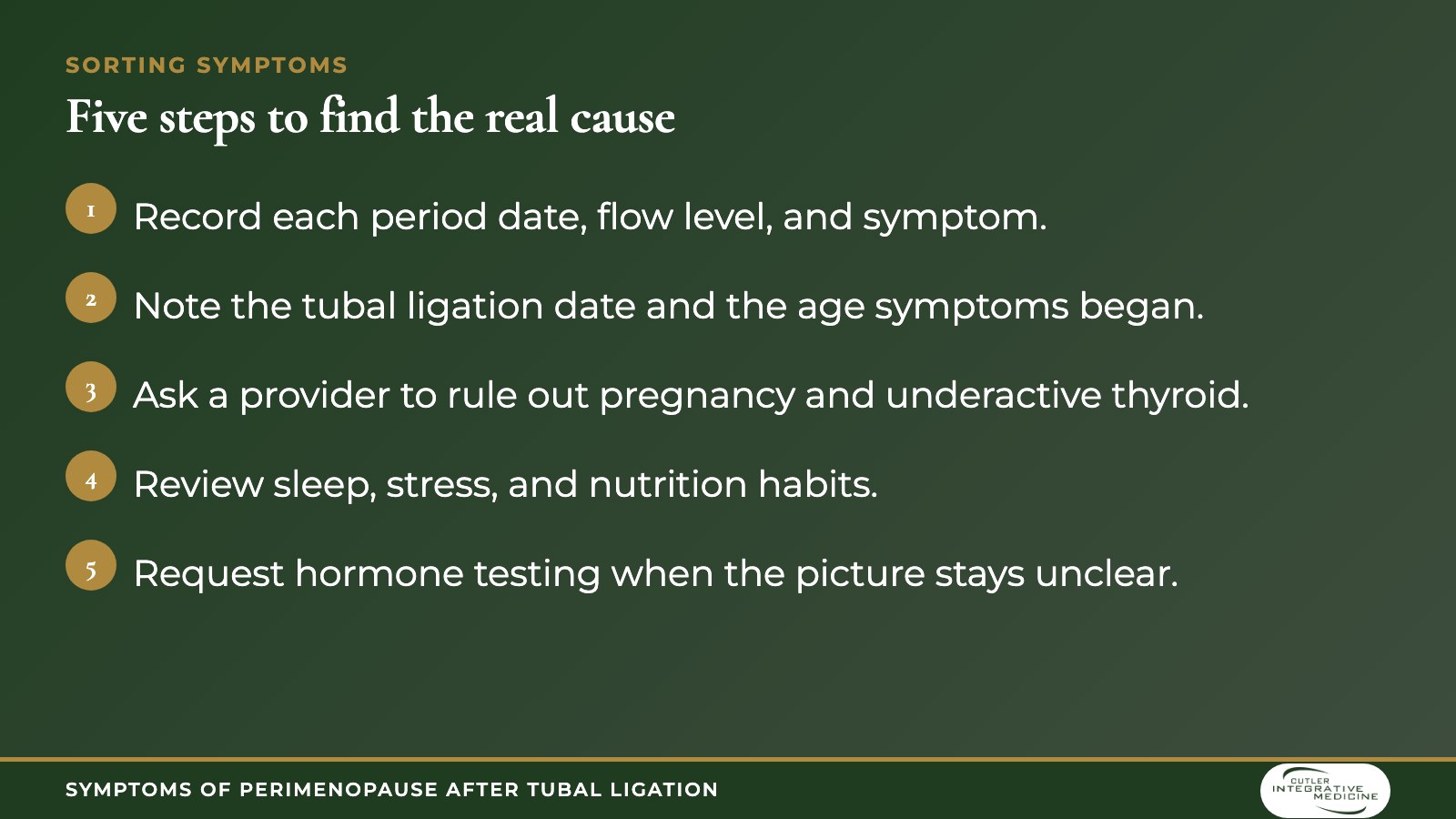
Telling perimenopause from other causes starts with a period and symptom diary that a provider reviews. Thyroid disease and stress cause overlapping symptoms. The National Institute of Diabetes and Digestive and Kidney Diseases (NIDDK) lists fatigue and weight gain as hypothyroidism symptoms. The agency also lists heavy or irregular periods, and says fatigue and weight gain do not necessarily mean a thyroid problem.
Five steps make the sorting easier.
Some bleeding patterns need a provider visit regardless of age. Cleveland Clinic lists these warning signs.
Testing can add detail to the diary, and the next section covers what the tests show.
Hormone tests after tubal ligation include follicle-stimulating hormone (FSH), estradiol, prolactin, and thyroid levels, per the North Carolina Center for Reproductive Medicine. One blood result rarely settles the question, because FSH tests can mislead when hormones rise and fall erratically, per Cleveland Clinic.
The Office on Women's Health says providers can identify perimenopause from age, symptoms, and period changes. Blood tests are not usually needed. The STRAW+10 staging criteria place late perimenopause at an FSH above 25 IU/L on a random blood draw. Testing adds value when symptoms start early, when cycles stay unclear, or when another cause is suspected.
We add saliva adrenal testing and blood work to look at stress hormones, thyroid, and sex hormones together. A functional medicine testing framework then connects the results to sleep, gut health, nutrition, and toxin exposure. Results can be shared with the prescribing physician.
After tubal ligation, a woman's body keeps its normal hormone cycle. The main change is that eggs can no longer meet sperm in the tubes. The ovaries stay inside and keep making estrogen and progesterone. Women with questions about new symptoms can book a consultation for a full review.
Five years after tubal ligation, women reported no more lasting cycle-length changes than other women did in the Collaborative Review. The study followed 9,514 women for up to five years. Nelson's group saw similar hormone levels over four years. Pregnancy risk remains the main long-term concern.
Tubal ligations failed in 7.5 to 36.5 of every 1,000 procedures within 10 years, depending on the method. The Collaborative Review followed 10,685 women for 8 to 14 years and recorded 143 failures. Unipolar coagulation had the lowest 10-year rate, at 7.5 per 1,000. Clip application had the highest, at 36.5 per 1,000. Women sterilized at a young age had higher rates, and a pregnancy at 20 years remains possible.
No symptom reliably shows that tubes have grown back together, so a positive pregnancy test is the signal that needs medical care. Doctors confirm tubal failure with a pregnancy test and imaging. A missed period with sudden one-sided pelvic pain needs urgent medical care, because a pregnancy outside the uterus is possible.
Tubal ligation is not a proven cause of weight gain. Weight gain is common in perimenopause and can also signal thyroid disease, so a full review works better than blaming the procedure. Women who want a plan can look at weight management support that addresses hormones, nutrition, and sleep together.
No single age fits every woman, but sterilization at a young age carries a higher chance of pregnancy later. Women sterilized young had cumulative pregnancy risks of 54.3 per 1,000 with bipolar coagulation and 52.1 per 1,000 with clips. Women should discuss method and timing with an OB/GYN.
Tubal ligation shows only modest later-life links, such as more reported hot flashes (HR 1.09) and early menopause (HR 1.17). The Sister Study found no change in overall breast cancer risk (HR 0.95). Removing both ovaries before menopause is different and causes surgical menopause. Women with a hysterectomy can read about hysterectomy and hormones.
No, tubal ligation does not cause menopause, because the ovaries still make hormones until they naturally slow down. Natural menopause arrives at about age 51 on average, per ACOG. A modest statistical link to early menopause (HR 1.17) is not proof of cause.
Signs of hormonal imbalance include irregular periods, hot flashes, night sweats, mood changes, low libido, sleep problems, and fatigue. These overlap with perimenopause and thyroid disease. A provider can sort them with a symptom history and lab work.
Signs of low estrogen include irregular periods, hot flashes, night sweats, vaginal dryness, mood changes, and poor sleep. Cleveland Clinic ties these symptoms to estrogen levels that begin to decline in perimenopause. Testing confirms whether levels have changed.
No quick fix restores hormonal balance, because the cause has to be identified first. A review of stress, thyroid, sleep, and nutrition guides the plan. Women should talk to a doctor before starting or stopping any hormone.
Tubal reversal has not been proven to relieve perimenopause symptoms. The North Carolina Center for Reproductive Medicine, which performs reversals, notes that high-level studies are lacking and that some women report improvement. Reversal is a surgical choice tied mainly to fertility goals.
Cutler Integrative Medicine supports women after tubal ligation by testing hormone levels, finding root causes, and building a natural plan. Dr. Doug Cutler, ND, and the team review stress, gut health, thyroid, toxins, nutrition, and sleep alongside saliva adrenal testing and blood work.
Our care covers botanical and nutritional support, lifestyle plans, and clear communication with the prescribing physician. Women should speak with that physician before starting or stopping any hormone. Visits are available in Metro Detroit and by telemedicine.
The symptoms of perimenopause after tubal ligation deserve a clear explanation rather than a label. Women with persistent symptoms can request a hormone health evaluation that looks at labs, stress, and daily habits together.
The first step is a conversation about timing, symptoms, and health goals, followed by a plan built around the findings. Dr. Cutler and the team stay in contact with the patient's prescribing physician throughout. Women can reach the Cutler naturopathic practice at (248) 663-0165 to begin.








Cutler Integrative Medicine blends naturopathic and conventional care to treat the root causes of illness. Through personalized wellness plans, advanced diagnostics, and holistic therapies.


Copyright © 2025 Cutler Integrative Medicine. All Rights Reserved.