



Knowing when to stop hormone replacement therapy (HRT) has no single age answer. The Menopause Society calls for individualized care with periodic review. Benefit-risk is favorable under age 60 or within 10 years of menopause onset. In a Women's Health Initiative survey, 55.5% of women with symptoms before treatment had moderate or severe hot flashes after stopping.
Key Takeaways
You know when to stop hormone replacement therapy when symptoms have settled or health risks have changed. The original reason for treatment may also no longer apply. The Menopause Society recommends periodic reevaluation of benefits and risks instead of a fixed end date. A 2009 study in the journal Menopause noted that no evidence-based guidelines exist for discontinuation strategies. That gap makes a personal review with the prescriber the deciding step.
Testing and a review of stress, sleep, gut and thyroid health show how much of the picture still depends on hormones. That is where hormone imbalance testing adds clarity. A clear picture of the current symptoms makes the stopping decision easier. Age is one factor in that decision, so the next section covers it.
Women should stop hormone replacement therapy when the prescriber and patient agree the risks outweigh the benefits. No required age exists. The Menopause Society finds the benefit-risk ratio favorable under age 60 or within 10 years of menopause onset for women without contraindications. The ratio appears less favorable for women who start later. Absolute risks of coronary heart disease, stroke, blood clots and dementia are higher.
The Food and Drug Administration (FDA) ties benefits seen in randomized studies to starting within 10 years of menopause onset. That window is generally before age 60. The American College of Obstetricians and Gynecologists (ACOG) puts the average age of menopause at 51 years. Women who start near that age reach the 10-year mark around age 61.
Longer use is not forbidden. The Menopause Society says longer durations should rest on a documented indication, such as persistent hot flashes, with shared decision-making. Women weighing HRT duration in more detail can use the existing guide on staying on therapy. Duration questions lead to the reasons that push women to stop.
The reasons to stop hormone replacement therapy include eased symptoms, a new health condition and side effects. Changing risk with age and a planned surgery also count. A new contraindication is the strongest reason to review therapy with the prescriber. The Menopause Society lists estrogen-dependent cancers and cardiovascular disease as contraindications.
Women who notice spotting or heavy bleeding should read about HRT bleeding and call the prescriber. Each reason raises the same safety question, so the next section answers it.
Yes, stopping hormone replacement therapy is a standard medical decision, and the main effect is that symptoms and bone loss can return. Heart event rates stayed similar after the Women's Health Initiative trial ended. Cardiovascular events ran 1.97% a year in the former hormone group and 1.91% in the placebo group.
The same follow-up of 16,608 women found a higher malignancy rate in the former hormone group, 1.56% versus 1.26% a year. Researchers followed the women for a mean 2.4 years after the trial stopped. These results describe the effects of earlier use, and they do not make stopping itself dangerous.
Safe stopping depends on pace and planning. Speed is the next question.
Tapering lowers the dose in steps. A 2009 observational study linked it to lower symptom scores than choosing to stop hormone replacement therapy cold turkey. The study surveyed 836 veterans who discontinued therapy. Of them, 75% stopped cold turkey and 25% tapered.
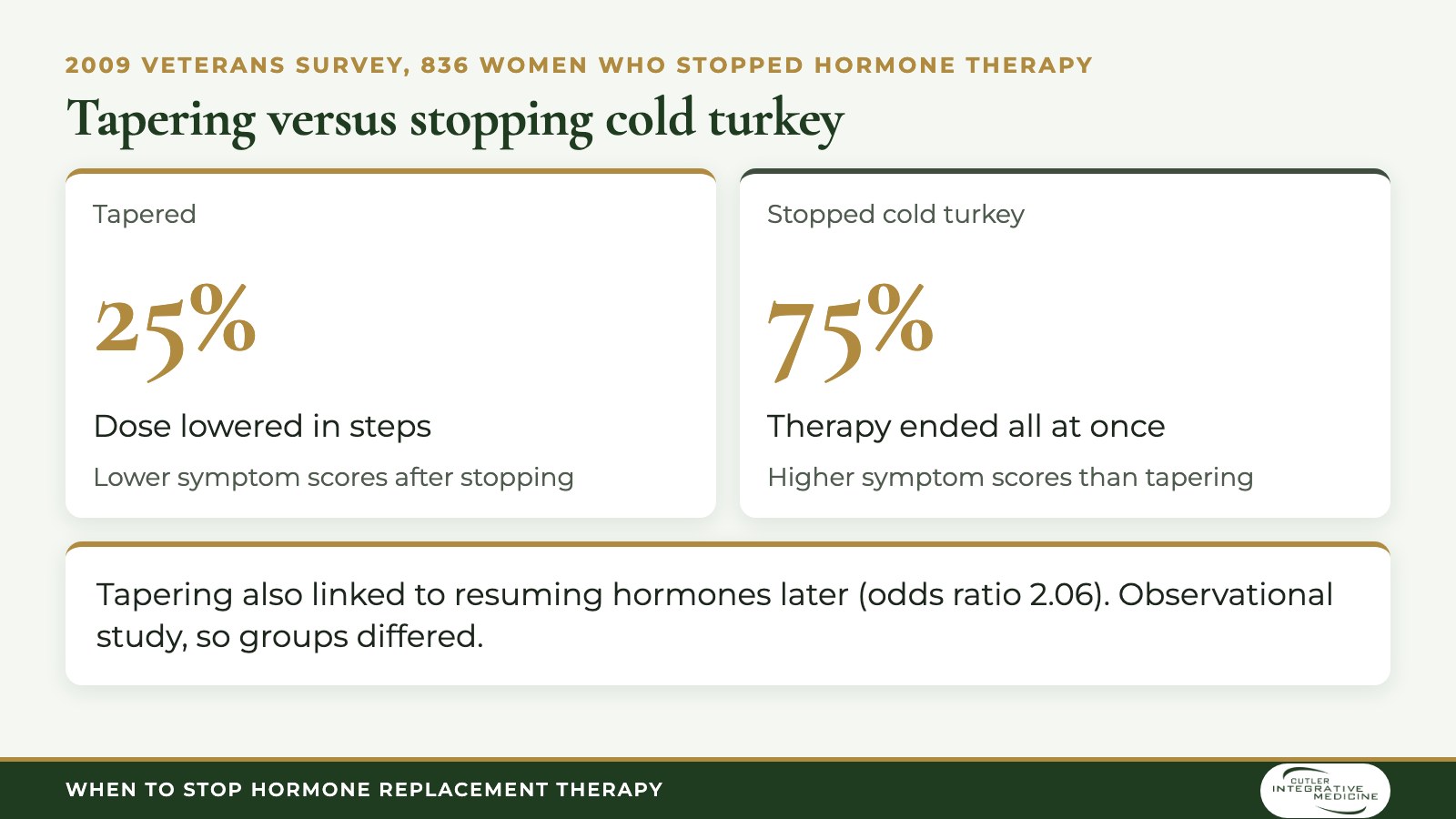
The graphic above compares the two approaches, and the table below adds what the evidence shows.
| Approach | How it works | Share of 836 women | Finding |
|---|---|---|---|
| Tapering | Dose is lowered in steps over time | 25% | Lower symptom scores after stopping, but more later restarts (odds ratio 2.06) |
| Cold turkey | Therapy ends all at once | 75% | Higher symptom scores after stopping than the tapering group |
The table shows a trade-off, and the groups were not identical. Tapering women reported more provider discussions and longer years of use. The authors still concluded that tapering may lessen symptom recurrence.
Prescribers set the pace based on the dose, the form and the patient's symptoms. A pace is only one part of the plan, so the steps below cover the rest.
Stop hormone replacement therapy safely by working through five steps with the prescribing clinician. A step-down plan agreed in advance keeps the process predictable. Patients should never cut doses or skip them without a prescriber's guidance.
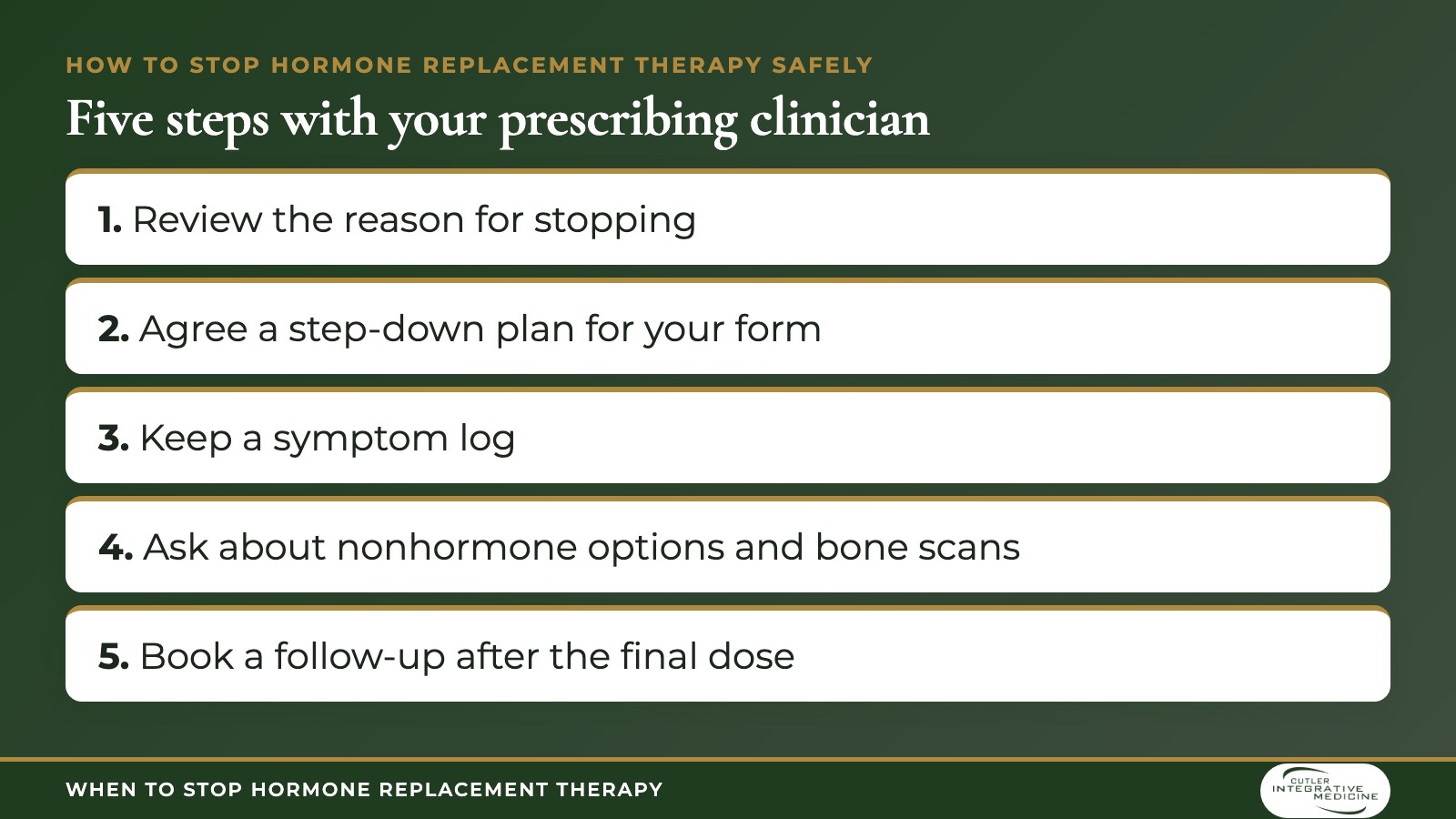
The graphic above lays out the five steps in order. These steps show how to stop hormone replacement therapy without guesswork. The next section explains what the body does once the last dose is taken.
When you stop hormone replacement therapy, hot flashes and night sweats can return. The Women's Health Initiative (WHI) measured how many women report them. Moderate or severe vasomotor symptoms were reported by 21.2% of former hormone users versus 4.8% on placebo. The survey reached 8,405 women 8 to 12 months after the trial stopped.
Women who had symptoms before treatment saw a larger gap. Of those women, 55.5% in the former hormone group and 21.3% in the placebo group reported moderate or severe symptoms. The authors said these findings matter when advising women to use hormone therapy for as short a time as possible.
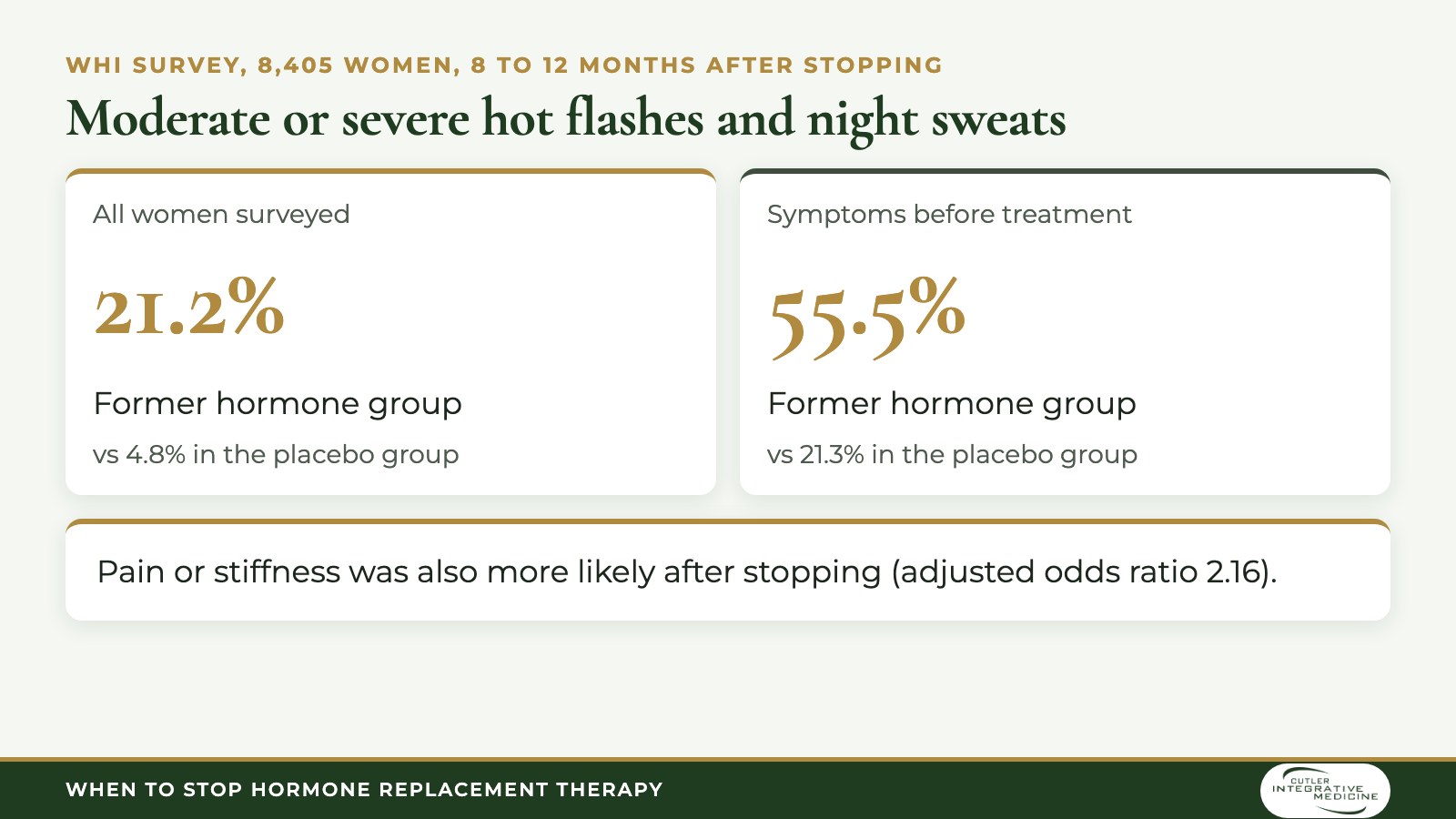
The graphic above shows both WHI comparisons side by side. Those numbers point to the specific symptoms women should expect, covered next.
The symptoms when stopping hormone replacement therapy are mainly the same ones the therapy was treating. Hot flashes and night sweats lead the list. The WHI survey also found more pain and stiffness (adjusted odds ratio 2.16) in the former hormone group.
Women with vaginal dryness have a targeted option. The Menopause Society recommends low-dose vaginal estrogen or other therapies for symptoms that over-the-counter products do not relieve. Symptoms raise the question of duration, so the next section covers how long they last.
No study sets one timeline for symptoms after stopping hormone replacement therapy. SWAN found frequent hot flashes last a median of 7.4 years overall. Symptoms persisted a median of 4.5 years after the final menstrual period in 881 women with an observable final period. Each woman's total depends on when symptoms began.
The WHI survey asked about symptoms 8 to 12 months after stopping, so the 55.5% figure reflects symptoms nearly a year later. Women who were already postmenopausal when hot flashes began had a median of 3.4 years in SWAN. Women who started in early perimenopause had a median over 11.8 years.
Duration varies, so the symptom log from the earlier steps helps the prescriber judge progress. Symptoms are not the only change, because bone follows the same hormone shift.
Yes, stopping hormone replacement therapy can speed bone loss and raise fracture risk. Hormone therapy has been shown to prevent bone loss and fracture. Women who stopped therapy had a 55% greater risk of hip fracture (hazard ratio 1.55). The study followed 80,955 women for 6.5 years.
Risk rose as early as 2 years after stopping, and longer time off therapy correlated with lower bone density. A 2025 UK study of 648,747 women with a fracture found risk rises steeply after stopping and then attenuates. ACOG notes bone loss is faster in the first 4 to 8 years after menopause.
Women can ask the prescriber about a bone density scan, weight-bearing exercise, calcium and vitamin D before the last dose. Natural menopause support covers lifestyle habits that complement medical care. Some signs, however, call for faster action than a bone plan.
Call emergency services for chest pain, sudden breathlessness or stroke signs while on hormone replacement therapy. Call the prescriber the same day for other warning signs. Blood clot and stroke symptoms are emergencies, since the Menopause Society lists cardiovascular disease as a contraindication.
The prescriber decides whether therapy stops at once or steps down. After stopping, many women look for other ways to ease symptoms.
Women can use nonhormone options instead of hormone replacement therapy. The Menopause Society's 2023 statement gives Level I support to five of them. Those five are cognitive-behavioral therapy, clinical hypnosis, selective serotonin reuptake inhibitors and serotonin-norepinephrine reuptake inhibitors (SSRIs and SNRIs), gabapentin and fezolinetant.
The same statement lists weight loss at Levels II-III and does not recommend supplements or herbal remedies for hot flashes (Levels I-II). Herbal products can also interact with medicines, so patients should review any supplement with the prescriber. The HRT alternatives guide compares more options.
Other pieces of the picture are worth a look. Sleep, stress and thyroid function can each make symptoms feel stronger, which the grouped questions below address.
Ask the surgeon and the prescriber together when to stop hormone replacement therapy before surgery. Timing depends on the procedure and personal risk. Women should not pause or restart on their own. A written plan from both clinicians prevents gaps.
The decision on when to stop testosterone replacement therapy belongs to the prescribing physician, who follows lab results over time. Men should not stop alone, since the original low-testosterone symptoms may need a new plan. The guide to men's hormone therapy explains the basics.
Thyroid problems and poor sleep can mimic or worsen menopause symptoms, so both deserve a check when symptoms return after stopping. Fatigue, mood changes and night sweats overlap with thyroid imbalance. Review thyroid support for related care.
Sleep problems may follow night sweats or stand alone, and a sleep review can separate the two. Fatigue and low mood also improve when rest improves. Women can explore sleep support when rest stays poor after stopping therapy.
Stopping hormone therapy may not remove side effects right away, and the timing depends on the symptom and the dose. Breast tenderness, bloating and headaches are among the HRT reactions prescribers review. Persistent effects should go on the symptom log.
Stopping hormone therapy does not erase risk from earlier use. The WHI follow-up still showed a higher malignancy rate in former hormone users for a mean 2.4 years. Women with questions can read about HRT cancer risk. Screening schedules stay a decision for the doctor.
The studies cited here do not report weight gain as an outcome of stopping hormone replacement therapy. Weight changes in midlife involve age, sleep, muscle mass and diet. A prescriber or dietitian can review the full picture.
Headaches have several causes, and a hormone shift is one possible trigger. Women should track when headaches occur and tell the prescriber. A sudden severe headache, or one with weakness or vision loss, needs emergency care.
Stopping hormone replacement therapy is harder for women whose hot flashes return. In the WHI survey, 55.5% of women with baseline symptoms reported them. A step-down plan and nonhormone options can make the change easier. Support from the prescriber helps.
Restarting is possible when a prescriber confirms that benefits still outweigh risks. In the 2009 veterans study, women who tapered were more likely to resume hormones later. Age and years since menopause shape that review.
Stop taking hormone replacement therapy by asking the prescriber for a step-down plan written for the specific form. Patches, pills and gels differ in dose and schedule. Women should not cut or skip doses without that plan.
Cutler Integrative Medicine supports women through the stopping decision by testing hormone levels and looking for root causes. The prescribing physician manages the therapy itself. Our hormonal imbalance care includes saliva adrenal testing and blood work. We also review stress, gut health, thyroid function, toxin exposure, nutrition and sleep.
From there, we build nutrition, botanical and lifestyle plans to support the body as symptoms change. Botanical products are reviewed for safety and drug interactions. Women can read about root-cause hormone support before booking.
Dr. Doug Cutler, ND, works alongside each patient's prescribing physician and offers telemedicine for women outside Bingham Farms, Michigan. Call (248) 663-0165 to start the conversation with the Cutler Integrative practice. A clear plan for when to stop hormone replacement therapy starts with the right testing.








Cutler Integrative Medicine blends naturopathic and conventional care to treat the root causes of illness. Through personalized wellness plans, advanced diagnostics, and holistic therapies.


Copyright © 2025 Cutler Integrative Medicine. All Rights Reserved.