



Bioidentical hormone replacement therapy (BHRT) pellets cause side effects at the insertion site and in the whole body. The side effects of BHRT pellets include bruising, infection, pellet extrusion, bleeding, acne and breast tenderness. In a 2021 study of 539 postmenopausal women, 57.6% on compounded pellets reported side effects, versus 14.8% on FDA-approved therapy.
Key Takeaways
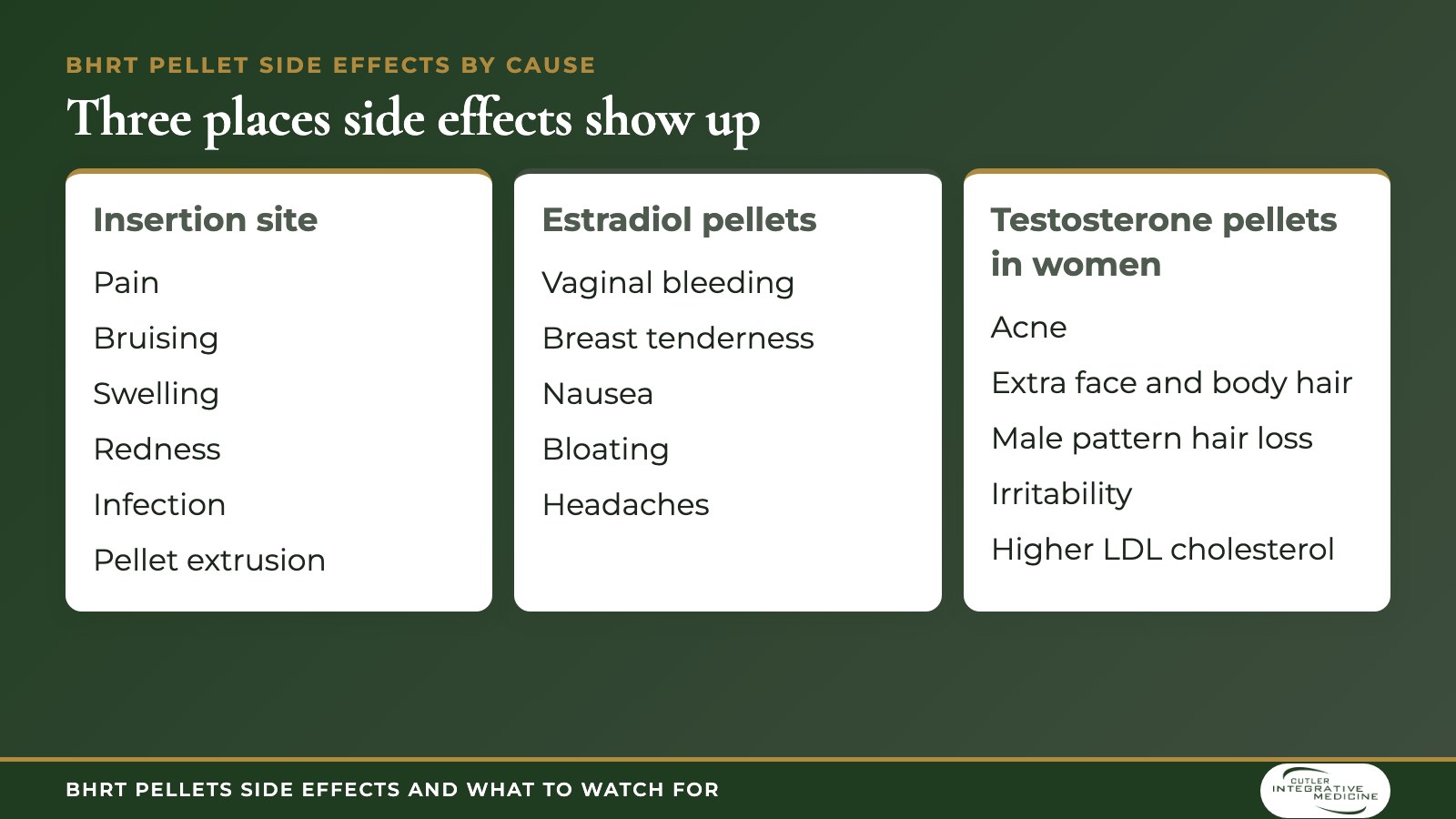
The side effects of BHRT pellets fall into two groups: local reactions at the insertion site and hormone effects throughout the body. Local reactions include pain, bruising, swelling, infection and pellet extrusion. Hormone effects depend on whether the pellet holds estradiol or testosterone.
Hormone effects can resemble the original symptoms, so hormone imbalance support starts with testing rather than guessing. The list below groups the side effects of bioidentical hormone pellets by cause.
The graphic below shows how these side effects divide by hormone and location. Knowing what the pellets are explains why each group appears.
BHRT pellets are rice-sized hormone implants, placed under the skin, that release estradiol or testosterone for about 3 to 6 months. Compounded pellets are made by a pharmacy for one patient, and the FDA has not approved them.
Bioidentical means the hormone matches the structure of a human hormone. Medical News Today describes each pellet as about the size of a grain of rice. Health Law Alliance notes that Testopel is the one FDA-approved testosterone pellet and that no estradiol pellet product is approved.
Insertion takes five steps, according to Medical News Today.
The Steri-Strips come off within days, yet the pellet keeps working for months. That gap makes the insertion site the first place to look for side effects.
Insertion-site side effects include pain, bruising, swelling, redness, infection and pellet extrusion. Pellet extrusion is the body pushing a pellet back out through the skin. Each effect follows from placing a solid implant under the skin through a small cut.
In 2018 the FDA investigated one pellet company and found 4,202 previously unreported adverse events, according to the US Anti-Doping Agency (USADA). The possibly related events included cellulitis, a skin infection, and pellet extrusion.
A 2021 review of 1,204,012 implant procedures in 376,254 patients reported a complication rate under 1%. Extrusion was the most common problem, at under 3% in men and under 1% in women. The author founded the pellet company that supplied the data, so readers should weigh that funding.
A firm spot under the skin raises a separate question for many patients.
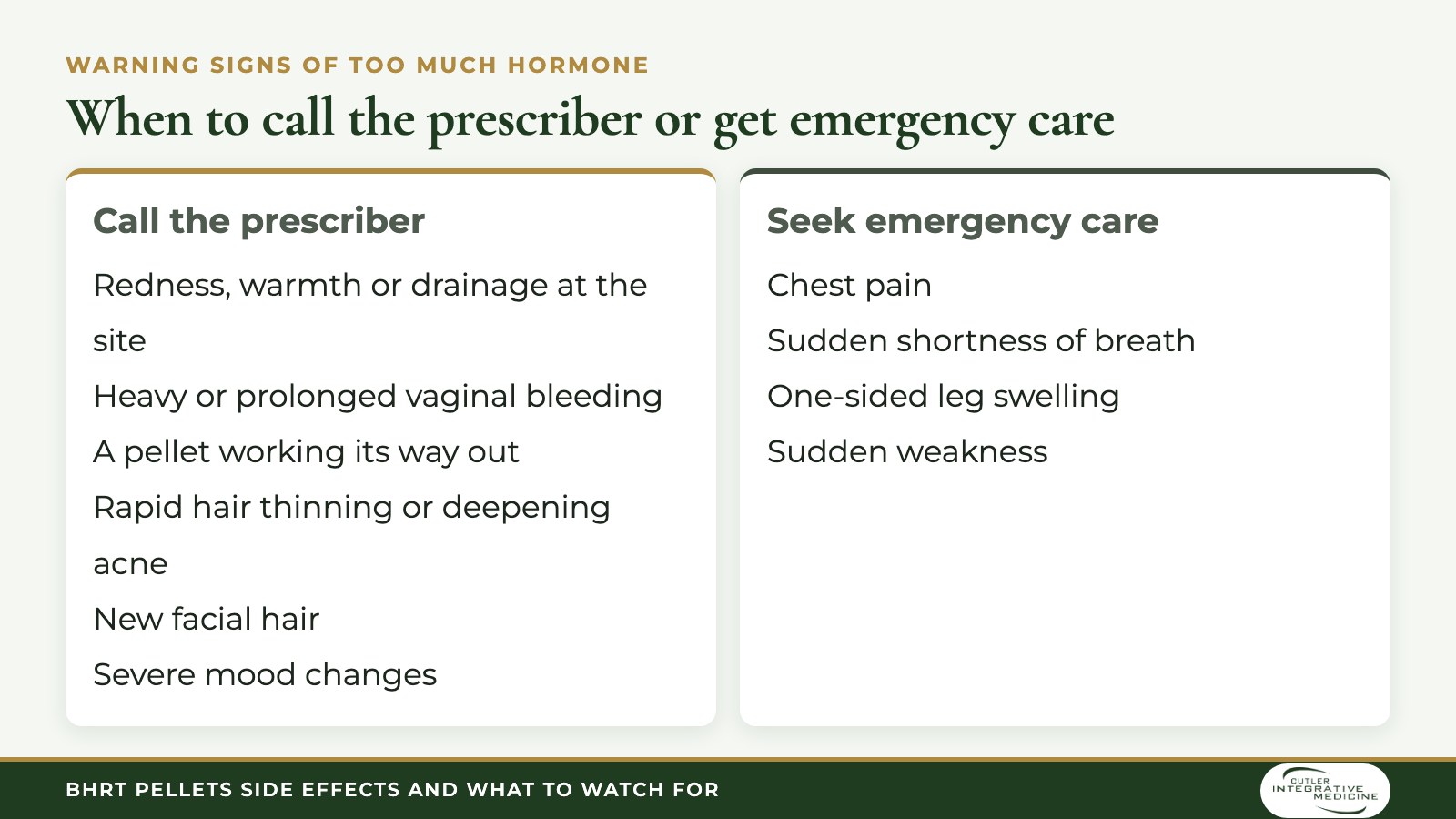
A small firm spot near the incision can appear because a pellet is about the size of a grain of rice. A lump that grows, turns red, feels warm or drains fluid needs a prompt call to the prescriber. Those changes can signal infection or extrusion.
Cellulitis and pellet extrusion both appeared among the events in the FDA investigation. The incision itself is closed with Steri-Strips that may come off after around 5 days. A lump that persists after the incision heals deserves an exam rather than waiting.
Local reactions are only part of the picture, because the hormone itself affects the whole body.
Estradiol pellets can cause vaginal bleeding, breast tenderness, nausea, bloating and headaches, according to one estradiol pellet label. Medical News Today summarizes that label, which also lists spotting, migraine and weight changes.
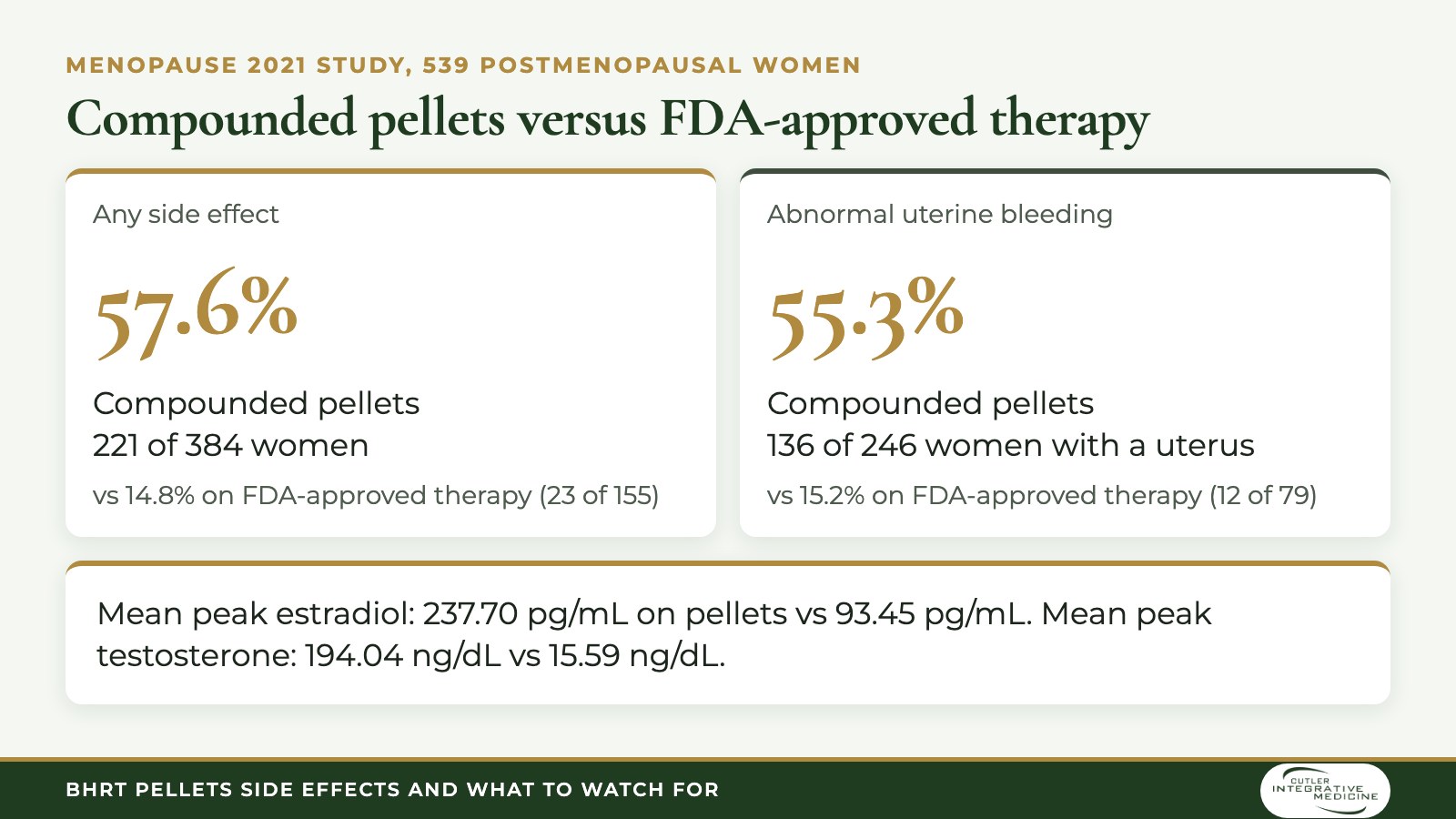
In the 2021 study, 55.3% of women with a uterus on pellets (136 of 246) had abnormal uterine bleeding. On FDA-approved therapy, the rate was 15.2% (12 of 79). A guide to bleeding on HRT explains when spotting needs testing.
A 2025 review in the Journal of Clinical Medicine adds that estradiol pellets used without a progestogen stimulate the uterine lining. That raises the risk of irregular bleeding, hyperplasia and, over the long term, endometrial cancer. Women with a uterus therefore need endometrial protection, and oral micronized progesterone is one option the review names.
Testosterone pellets bring a different set of effects.
Testosterone pellets can cause acne, extra face and body hair, male pattern hair loss, irritability and higher LDL cholesterol in women. Medical News Today links these effects to high hormone levels.
A 2019 Global Consensus Position Statement, endorsed by the Endocrine Society and The North American Menopause Society, addressed these effects. Doses near premenopausal levels cause mild acne and body or facial hair growth in some women. The same statement found no link to alopecia, clitoromegaly or voice change at those doses.
The statement also says that any testosterone product that produces supraphysiologic levels, including pellets and injections, is not recommended. Its only evidence-based use in women is for postmenopausal women with hypoactive sexual desire disorder (HSDD). Any course of women's testosterone therapy has to stay inside the physiologic range.
Supraphysiologic levels are the common thread behind many pellet side effects.
Pellets cause more side effects in some studies because they can push hormone levels above the normal range. Doctors call these supraphysiologic levels. A pellet releases hormone continuously, so levels can overshoot before they settle.
Pinkerton of the University of Virginia wrote in 2022 that supraphysiologic pellet dosing raises even more safety concerns. The 2021 Menopause study compared 384 women on compounded pellets with 155 on FDA-approved therapy at one hospital system. The table shows what it found.
| Measure | Compounded pellets | FDA-approved therapy |
|---|---|---|
| Any side effect | 57.6% (221 of 384) | 14.8% (23 of 155) |
| Abnormal uterine bleeding (women with a uterus) | 55.3% (136 of 246) | 15.2% (12 of 79) |
| Hysterectomy (women with a uterus) | 20.3% (50 of 246) | 6.3% (5 of 79) |
| Mean peak estradiol | 237.70 pg/mL | 93.45 pg/mL |
| Mean peak testosterone | 194.04 ng/dL | 15.59 ng/dL |
Pellet users had higher peaks of both hormones, and four women had estradiol above 1,000 pg/mL. Nine women had testosterone above 400 ng/dL. The graphic below repeats the two headline rates.
Higher side effect rates lead directly to the safety question.
No, bioidentical hormones have not been shown to be safer, because bioidentical describes a hormone's structure, not its safety record. Cleveland Clinic states that claims of greater safety and effectiveness for compounded bioidentical hormones remain unsupported.
The FDA has approved certain bioidentical hormones, and those products carry tested labels. Compounded versions skip that review. Cleveland Clinic also notes that compounding pharmacies do not have to report drug side effects to the FDA. Approved products still share the usual HRT side effects.
The 2022 Menopause Society statement says hormone therapy risks differ by type, dose, duration, route, timing and progestogen use. Compounded pellets raise a narrower question.
No, compounded BHRT pellets are not proven safe, because the FDA does not verify their safety, effectiveness or quality. The FDA states that compounded drugs are not FDA-approved.
In 2020 the National Academies of Sciences, Engineering, and Medicine took up compounded hormone pellets, according to USADA. The report recommended adding pellets to the list of drugs that compounding pharmacies are not allowed to make. The concerns were safety, inconsistent production and unknown dosages.
The 2025 Journal of Clinical Medicine review frames pellet safety as depending on individualized dosing, endometrial protection and laboratory monitoring. Industry-funded data report low complication rates, while the pharmacy-versus-FDA comparison above reports higher side effect rates. A broader look at HRT safety covers approved products. Because a pellet stays in place, the next question is whether it can come out.
No, BHRT pellets cannot be switched off like a patch, because each pellet keeps releasing hormone for months. Health Law Alliance reports that pellets release hormone over three to six months. A patch can be peeled off the same day.
Prescribers manage side effects by watching blood levels and timing the next insertion. The 2025 review recommends against placing new pellets while serum estradiol remains elevated. It also describes tachyphylaxis, where symptoms return early even though levels remain in range or high.
Patients should call the prescriber at the first sign of a problem rather than waiting for the pellet to wear off. Early signs of excess hormone are the next topic.
The first signs of too much hormone include new acne, extra facial or body hair, mood changes, breast tenderness and bleeding. These match the estradiol and testosterone effects described above and track with high blood levels.
The following warning signs call for contacting the prescriber promptly.
The FDA investigation also logged strokes, heart attacks and deep vein thrombosis among the reported events, per USADA. Chest pain, sudden shortness of breath, one-sided leg swelling or sudden weakness need emergency care. The graphic below summarizes when to call.
Some people carry higher risk from the start.
People should avoid BHRT pellets with known or suspected breast cancer, undiagnosed abnormal bleeding, active blood clots or active liver disease. The 2025 Journal of Clinical Medicine review lists these as absolute contraindications for estrogen therapy.
The 2022 Menopause Society statement finds the benefit-risk balance less favorable after age 60 or 10 years past menopause onset. Absolute risks of heart disease, stroke, blood clots and dementia are higher in that group. A separate review of HRT and cancer risk should come before any hormone is started.
The following groups should talk with their doctor before any hormone pellet.
Those who start or stop any hormone should also tell their doctor first.
BHRT pellets last about 3 to 6 months, according to Health Law Alliance. Medical News Today puts the constant supply at about 3 months.
Hormone-related side effects can last as long as the pellet releases hormone, which is about 3 to 6 months. Insertion-site effects fade as the incision heals, and Steri-Strips may come off after around 5 days.
Pellets sit under the skin and release hormone continuously, while injections deliver a dose that the body absorbs over a shorter span. The 2019 Global Consensus names both pellets and injections as products that can cause supraphysiologic testosterone. Other hormone delivery methods differ in how quickly levels rise and fall.
Hormone pellets can be linked to bloating and weight changes, because the estradiol pellet label lists both. Other causes of HRT weight gain include sleep, stress and nutrition.
High testosterone levels in women can cause male pattern hair loss, according to Medical News Today. The 2019 Global Consensus found no alopecia at doses near premenopausal levels. Persistent hormone-related hair loss therefore points to levels that need checking.
The American College of Obstetricians and Gynecologists (ACOG) recommends FDA-approved hormone therapy over compounded therapy, according to Medical News Today. Women who cannot or choose not to use hormones can also consider non-hormonal alternatives and lifestyle plans.
No single form is healthiest for everyone. The 2022 Menopause Society statement says risks differ by type, dose, duration, route of administration and timing. It recommends individualizing treatment and rechecking benefits and risks periodically.
Estradiol pellets used without a progestogen raise the risk of endometrial cancer in women with a uterus, according to a 2025 review. The FDA investigation also logged reports of endometrial and prostate cancer, though reports alone do not prove cause. People with a cancer history should talk with their doctor before any hormone.
Yes, blood tests can show whether hormone levels sit above the normal range. The 2019 Global Consensus advises a baseline testosterone level, a repeat at 3 to 6 weeks and a check every 6 months. The checks screen for overuse.
Pellet extrusion was more common in men, at under 3%, than in women, at under 1%, in the 1,204,012-procedure review. Testopel is the one FDA-approved testosterone pellet. Men with prostate cancer or a history of it should talk with their doctor first.
Cutler Integrative Medicine supports patients on hormone pellets with hormone testing, root-cause care and coordination with the prescribing physician. The clinic does not replace the prescriber's decisions about hormones.
Patients at Dr. Cutler's clinic can start with saliva adrenal testing and blood work. The results show where each hormone sits, which gives the prescriber useful information about dose and timing.
The team also builds a hormone panel around the symptoms a patient reports. The results are then reviewed with the prescriber's records in mind.
Dr. Doug Cutler, ND, then checks stress, gut health, thyroid function, toxin exposure, nutrition and sleep as hormone imbalance causes. Botanical medicine and lifestyle plans support the body while the prescriber manages the pellet.
Visits can take place by telemedicine as well as in person. Patients can reach hormonal imbalance care at the Bingham Farms office, and calling (248) 663-0165 starts the conversation about a visit.








Cutler Integrative Medicine blends naturopathic and conventional care to treat the root causes of illness. Through personalized wellness plans, advanced diagnostics, and holistic therapies.


Copyright © 2025 Cutler Integrative Medicine. All Rights Reserved.