



Perimenopause symptoms last about 4 years on average, according to the Cleveland Clinic, and can continue for 8 years or more. Hot flashes run longer, with a median of 7.4 years in the Study of Women's Health Across the Nation (SWAN). The stage ends after 12 months with no period, so the timeline varies by person and by stage. Starting age, stress, and smoking shape it.
Key Takeaways
Perimenopause symptoms last about 4 years on average, with a range from a few months to 8 or 10 years. The Cleveland Clinic gives the 4-year average and an upper range of 8 years. The Office on Women's Health says the stage can last up to 10 years.
Estrogen swings set the pace, so hormonal balance care starts with learning what your own levels are doing. Knowing how long perimenopause symptoms last also depends on the stage you are in. Perimenopause itself has a separate clock from the symptoms.
Perimenopause lasts about 4 years before menopause for the average woman, and some people stay in it for 8 to 10 years. The Cleveland Clinic notes that some people spend only a few months in this stage. MedlinePlus describes the whole menopausal process as about 7 years, up to 14 years.
Perimenopause can start in the mid-30s or the mid-50s, according to the Cleveland Clinic. The Office on Women's Health says it usually begins in the mid- to late 40s. Starting age matters because it shapes the stages that follow.
The three stages of menopause are perimenopause, menopause, and postmenopause. MedlinePlus lists them in that order. Perimenopause is when hormone levels first change and periods turn irregular.
Menopause is a single point in time. You reach it after 12 months in a row with no period, including no spotting, per the Office on Women's Health. The American College of Obstetricians and Gynecologists (ACOG) puts the average age at 51 years. Postmenopause then lasts for the rest of your life.
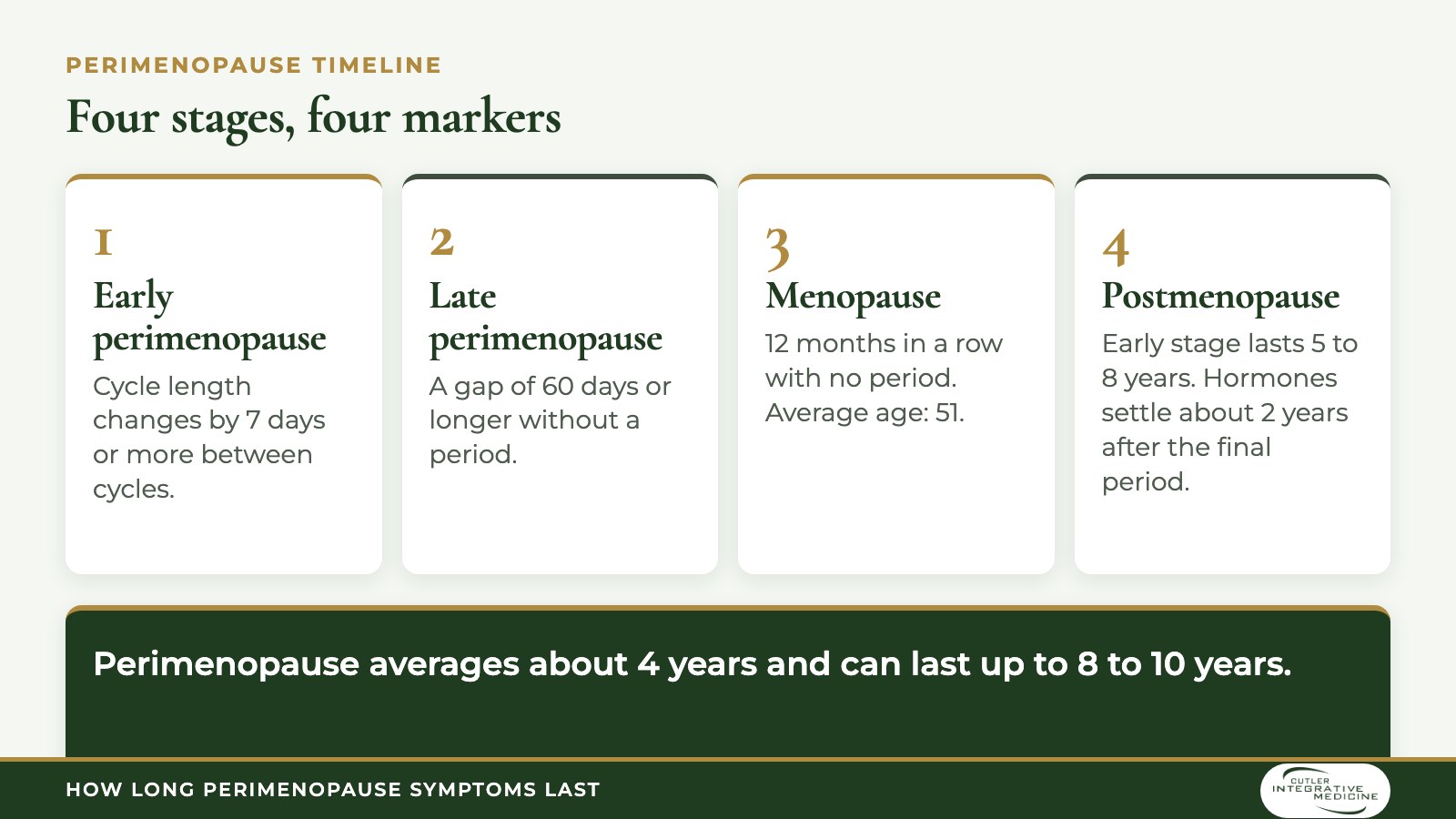
The timeline graphic above maps each stage to its cycle marker and typical length.
The perimenopause stage splits into an early part and a late part. Each part has its own cycle pattern.
Late perimenopause is a gap of 60 days or longer between periods. This cutoff comes from the STRAW+10 staging system, a research standard for the menopausal transition. Early perimenopause is marked by cycles that differ in length by 7 days or more.
The table below compares the two parts of the transition by cycle pattern and hormone behavior.
| Feature | Early perimenopause | Late perimenopause |
|---|---|---|
| Cycle sign | Cycle length differs by 7 days or more | 60 days or longer without a period |
| Hormone pattern | FSH is higher than before but variable | Extreme hormone swings, with FSH sometimes over 25 IU/L |
| Pregnancy | Still possible | Still possible |
| Menopause confirmed | Not yet | After 12 months with no period |
Late perimenopause shows the widest hormone swings, which is why symptoms can feel stronger there. Follicle-stimulating hormone (FSH) is the pituitary hormone that prompts the ovaries to release an egg. Anovulation, meaning cycles without an egg release, also becomes more common in late perimenopause. That shift can show up as low progesterone symptoms. Cycle patterns help you place yourself on this timeline.
Track your cycle length for several months to see what stage of perimenopause you are in. The STRAW+10 cutoffs give clear markers. A 7-day change in cycle length points to the early stage. A gap of 60 days without a period points to the late stage.
Use these steps to place yourself on the timeline:
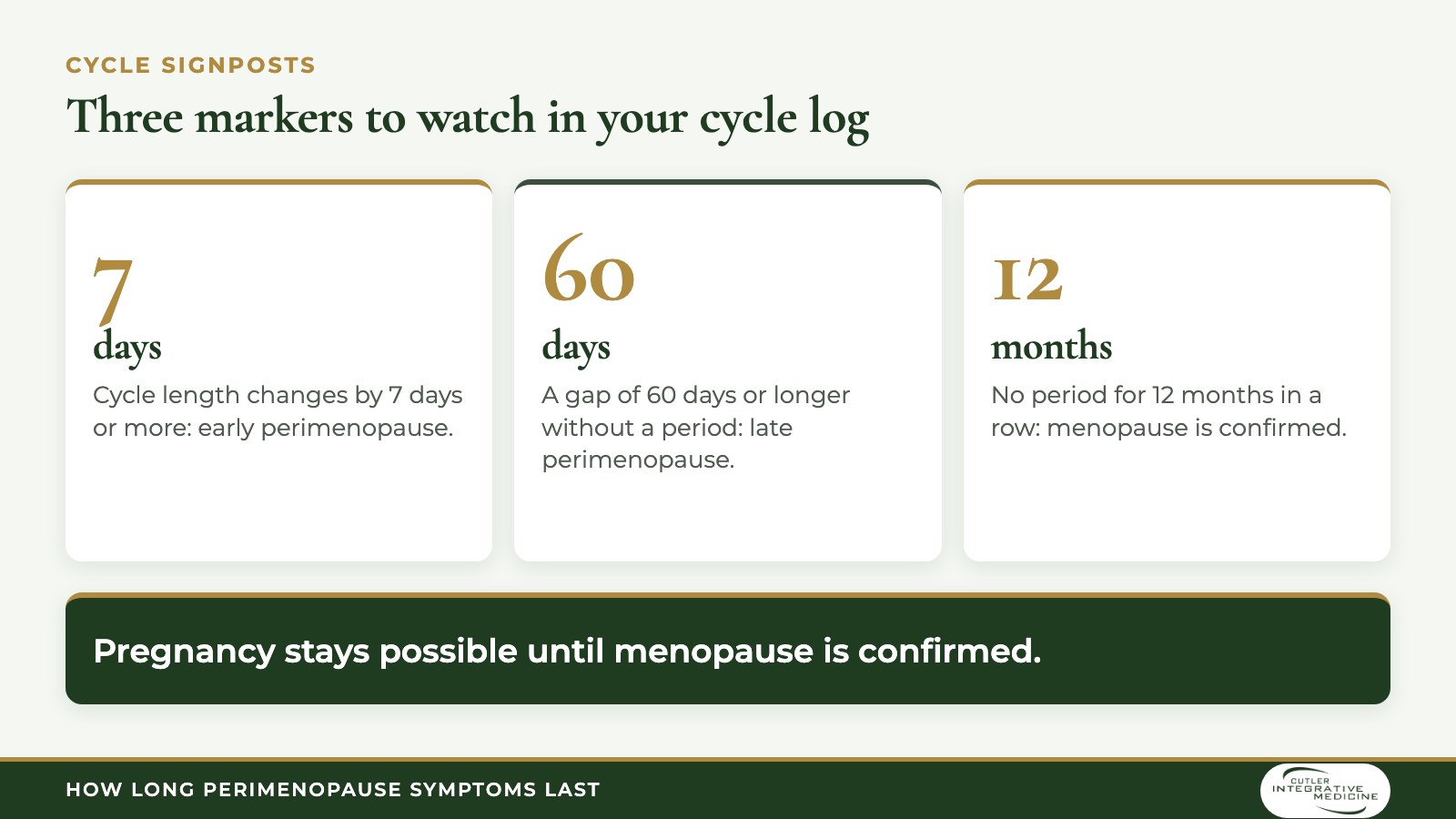
The signpost graphic above shows the three cycle markers to watch: 7 days, 60 days, and 12 months.
The Cleveland Clinic warns that FSH tests can mislead because hormones rise and fall erratically in perimenopause. A single reading therefore cannot give you a stage. A cycle log paired with root-cause testing gives a fuller picture. Symptoms add the next layer, starting with hot flashes.
Hot flashes last a median of 7.4 years from first frequent episode to the last, based on SWAN. SWAN followed 3,302 women at 7 US sites. The analysis included the 1,449 women who had frequent hot flashes or night sweats.
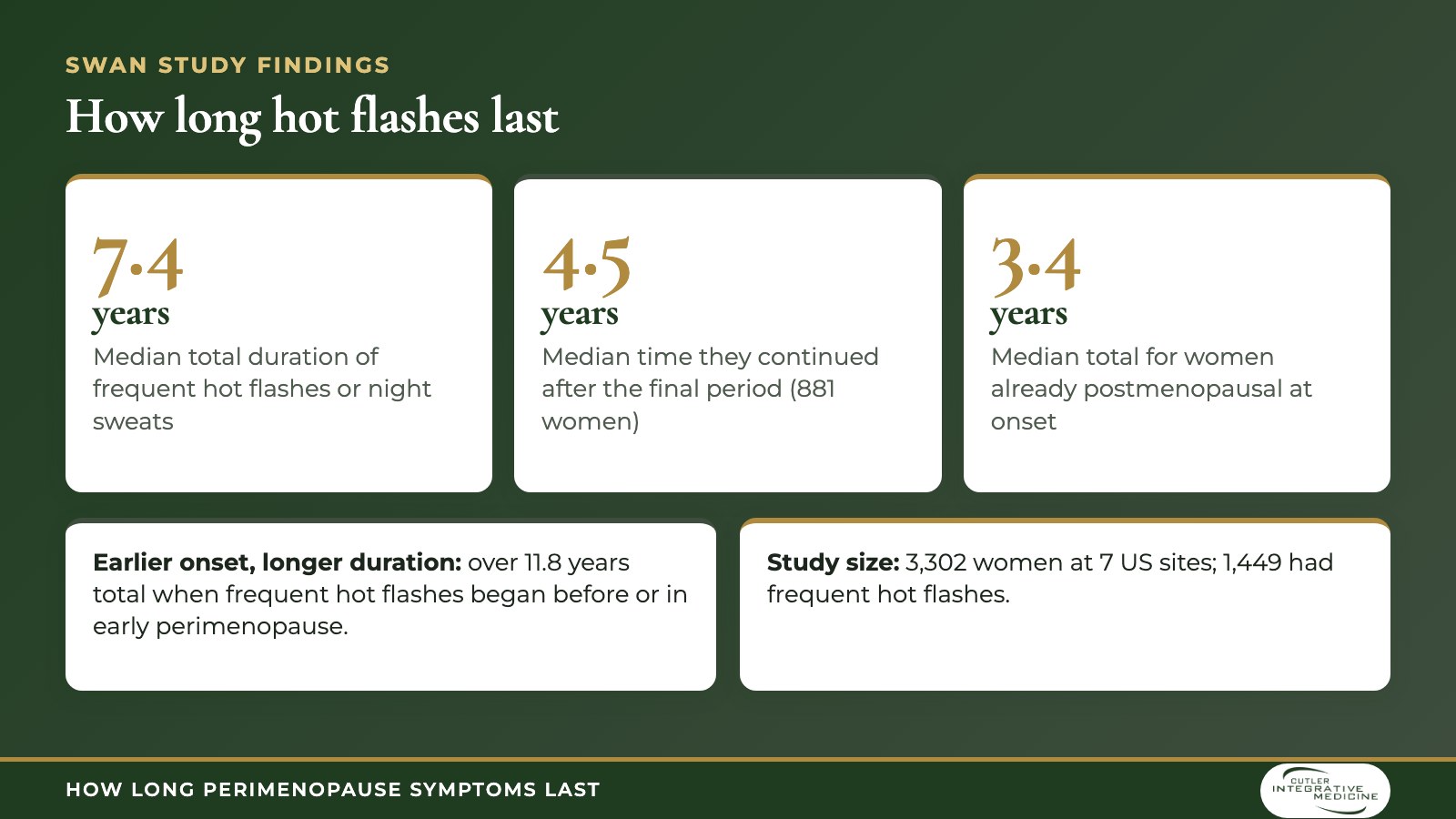
The graphic above shows the SWAN medians. Among 881 women with an observable final period, hot flashes lasted a median of 4.5 more years after it. Hot flashes occur in up to 80% of women and peak around the final menstrual period, per a published review.
The Office on Women's Health gives a wider figure of 7 to 12 years for hot flashes and night sweats. Timing of the first episode changes the total, which is why the symptom comparison comes next.
Hot flashes, night sweats, and genital and urinary symptoms last the longest among perimenopause symptoms. Irregular periods end when menopause arrives. Hot flashes fade over several years, while genital and urinary symptoms can worsen without treatment, per the Office on Women's Health.
The table lists the symptom groups that have published duration figures.
| Symptom | Duration | Source |
|---|---|---|
| Irregular periods | Until 12 months with no period | Office on Women's Health |
| Hot flashes and night sweats | Median 7.4 years; 7 to 12 years on average | SWAN; Office on Women's Health |
| Hot flashes after the final period | Median 4.5 years | SWAN |
| Genital and urinary symptoms | May worsen over time without treatment | Office on Women's Health |
| Faster bone loss | First 4 to 8 years after menopause | ACOG |
Sleep and mood changes have no firm duration figure, so they are not in the table. People who struggle with sleep disorder support can raise night sweats with a provider early. Some of these symptoms do fade, which raises the next question.
Yes, cycle-related perimenopause symptoms go away once menopause is confirmed, but hot flashes and vaginal symptoms can continue. Irregular periods end at the final period. Hot flashes continue for a median of 4.5 years after that point in SWAN.
Hormone levels stabilize about 2 years after the final period, based on the STRAW+10 report. That report says symptoms are likeliest during those 2 years. The same report estimates that early postmenopause lasts 5 to 8 years in total.
Relief options such as perimenopause hormone therapy are decisions for you and your prescribing physician.
A hormone support plan from our clinic focuses on testing, nutrition, and lifestyle. Postmenopause timing comes next.
Symptoms last about 4.5 years after the final period for the average woman with frequent hot flashes, per SWAN. The range is wide. Women who first had frequent hot flashes before perimenopause or in early perimenopause had a median of 9.4 years after menopause.
Women who were already postmenopausal when hot flashes began had the shortest total duration, a median of 3.4 years. Onset timing therefore predicts how long symptoms last better than age alone. The next section covers what else shifts the timeline.
Starting age, stress, and smoking affect how long perimenopause lasts. Several factors change how long perimenopause symptoms last. SWAN linked longer hot flash duration to these factors:
African American women reported the longest total duration in SWAN, with a median of 10.1 years. The Cleveland Clinic adds that regular tobacco users tend to reach menopause 1 to 2 years earlier.
Stress and mood are the factors you can work on directly, and support for both helps.
People managing a heavy stress load can explore a functional medicine approach that looks at sleep, nutrition, and stress together. A shorter or smoother timeline is not promised, but supporting those areas may ease the symptoms along the way. The end of the stage has its own warning signs.
The signs perimenopause is ending are longer gaps between periods, then 12 months with no period. STRAW+10 marks late perimenopause by gaps of 60 days or longer. Menopause is confirmed only after a full year of no bleeding.
Hormone swings also narrow as the stage closes. FSH and estrogen levels keep shifting until about 2 years after the final period, then settle. Tracking fluctuating symptoms shows whether the swings are narrowing as the transition ends.
MedlinePlus advises telling your doctor if periods return after a year of no bleeding. Perimenopause timing also changes with age, which leads to the question about the hardest years.
Perimenopause symptoms are worst around the final menstrual period, which falls near age 51 for the average woman. ACOG gives 51 as the average age of menopause. A published review found that hot flashes peak around the final period.
The Office on Women's Health says perimenopause usually begins in the mid- to late 40s. Symptoms in the late 40s and early 50s therefore fall closest to the peak. Starting earlier can mean a longer total timeline, per SWAN.
The perimenopause vs menopause comparison shows how the symptoms shift after the final period. Related timing questions follow below.
Seven signs of perimenopause are irregular periods, hot flashes, night sweats, trouble sleeping, pain during sex, moodiness, and forgetfulness. The National Institute on Aging (NIA) lists these changes. A fuller perimenopause symptom list covers the rest.
A cycle that moves from 28 to 35 days matches early perimenopause. STRAW+10 defines that stage as a 7-day or larger change in cycle length. Cycle changes also have other causes. A healthcare provider can check thyroid function, because thyroid testing helps rule out a different reason.
Yes, pregnancy is still possible in perimenopause, according to the Cleveland Clinic. The NIA advises using birth control for at least 12 months after your last period. Talk to your doctor before stopping contraception.
Early menopause deserves a doctor visit when menopause is complete before age 40, which the Cleveland Clinic calls premature menopause. Symptoms in the mid-30s can still be early perimenopause. A provider can check hormone levels and rule out other causes.
Do not assume pregnancy is impossible, ignore heavy bleeding, or smoke during perimenopause. MedlinePlus says to tell your doctor about periods that are heavy, very close together, or longer than a week. Smoking is linked to menopause 1 to 2 years earlier, per the Cleveland Clinic.
Yes, perimenopause can last up to 10 years, according to the Office on Women's Health. The average is about 4 years. MedlinePlus says the full menopausal process can take as long as 14 years.
Hot flashes and night sweats last a median of 4.5 years after the final period in SWAN. The Office on Women's Health gives 7 to 12 years in total on average. Genital and urinary symptoms can persist or worsen.
Menopausal symptoms last about 7 years in total on average, and up to 14 years, according to MedlinePlus. SWAN found a median of 7.4 years for hot flashes. Individual timelines vary widely.
Yes, perimenopause can start in the mid-30s, according to the Cleveland Clinic. It usually begins in the mid- to late 40s. Cycle changes at 35 are worth discussing with a provider.
No, a hormone test cannot predict how long perimenopause will last. The Cleveland Clinic says FSH tests can mislead because levels rise and fall. A cycle log and symptom record give a more useful timeline.
Cutler Integrative Medicine supports you through the perimenopause timeline. We test hormone levels, find root causes, and build nutrition and lifestyle plans around your symptoms. A hormone testing plan can pair saliva and blood work with a review of stress, sleep, gut health, and thyroid function.
Our work stays alongside your prescribing physician, who makes any decisions about hormone therapy. The Cutler team also offers telemedicine visits and an in-person clinic in Bingham Farms for Metro Detroit residents. Knowing how long perimenopause symptoms last helps you plan. A clear record of your cycle makes every appointment more useful.
Call (248) 663-0165 to talk with the clinic about your own timeline. Mood changes fit into the plan through emotional health support.








Cutler Integrative Medicine blends naturopathic and conventional care to treat the root causes of illness. Through personalized wellness plans, advanced diagnostics, and holistic therapies.


Copyright © 2025 Cutler Integrative Medicine. All Rights Reserved.