



The right doctor for hormone replacement therapy (HRT) is a licensed prescriber, such as an ob-gyn, primary care doctor, endocrinologist or urologist. In a 2025 Menopause Society analysis of nearly 5,500 women, ob-gyns saw 64.4% of those receiving menopause-related treatment. The sections below explain how each provider fits and what to expect at a first visit.
Key Takeaways
Four types of doctors commonly manage hormone replacement therapy: ob-gyns, primary care doctors, endocrinologists and urologists. Ob-gyns saw 64.4% of women receiving menopause-related treatment. The Menopause Society counted internal medicine at 17.6%, family medicine at 12.4% and endocrinology at 4.5%. Men seeking testosterone therapy can start with a primary care doctor, urologist or endocrinologist.
Anyone with a hormone concern can begin with a hormone imbalance evaluation to clarify symptoms before choosing a prescriber. The table below compares the main provider types.
| Provider | Role in hormone care | Common starting point for |
|---|---|---|
| Ob-gyn | Specializes in women's health, per ACOG | Menopause and perimenopause symptoms |
| Primary care doctor | Reviews overall health and medicines | First screening, referrals, stable therapy |
| Endocrinologist | Focuses on hormone disorders | Complex or unclear hormone results |
| Urologist | Manages male reproductive and prostate health | Low testosterone in men |
| Menopause-certified practitioner | Holds a Menopause Society credential | Menopause-focused care |
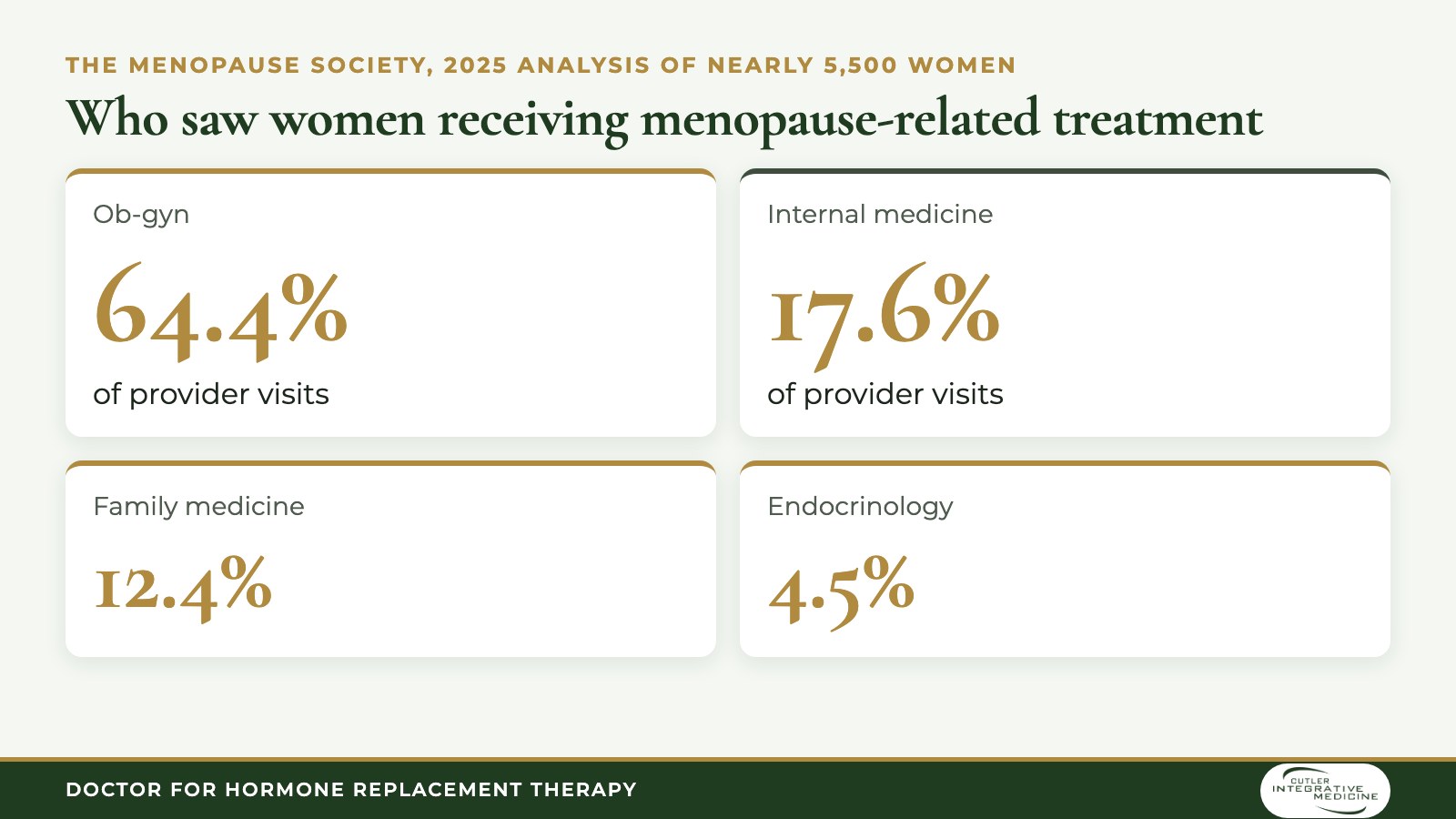
The graphic above shows the provider share from The Menopause Society analysis. The roles overlap, so the choice depends on symptoms, other conditions and local access. The next section helps match a provider to the situation.
See an ob-gyn or menopause-certified practitioner for menopause symptoms. Men with low testosterone can see a primary care doctor, urologist or endocrinologist. Match the specialty to the main concern, such as hot flashes, bone health or a hormone disorder. A doctor who already knows your medical history can screen risks faster.
Women with heavy bleeding, a uterus and symptoms should mention all three to the prescriber. Men with low-testosterone symptoms can read about low T signs before the visit. A specialist referral makes sense when results are unclear or several conditions overlap.
Yes, any licensed clinician with prescribing authority can prescribe hormone therapy, though training in menopause or hormone care varies. Experience with hormone therapy matters more than the title. The Menopause Society reports that systemic estrogen reached 34% of women who received menopause-related treatment, so treatment choices differ widely between providers.
A prescriber should explain benefits, risks and alternatives, not just write a prescription. The Menopause Society says treatment should be individualized and reevaluated periodically. Because training differs, many patients look for a clinician with menopause credentials.
A menopause-certified practitioner is a healthcare professional who holds the Menopause Society Certified Practitioner (MSCP) credential. The Menopause Society keeps a searchable directory of members and MSCPs. The directory states that it does not endorse listed practitioners, so patients still need to confirm fit.
MSCP holders can include physicians, nurse practitioners and certified nurse midwives. Certification signals extra menopause training, yet it is not required to prescribe hormone therapy. The next section covers the ob-gyn.
An ob-gyn is a reasonable choice for HRT. The American College of Obstetricians and Gynecologists (ACOG) describes ob-gyns as doctors with special training in women's health. Ob-gyns also handle the pelvic and bleeding questions that come with hormone therapy. ACOG notes that women and their ob-gyn can discuss which form of therapy works for them.
ACOG lists pills, patches, gels and sprays as systemic estrogen options. Women with a uterus also need a progestogen alongside estrogen, which an ob-gyn can explain. Women who want a broader view can read about menopause treatment options.
Primary care doctors, endocrinologists and ob-gyns treat hormone imbalance, depending on which hormones are involved. An endocrinologist focuses on hormone disorders such as thyroid, adrenal and pituitary problems. Primary care doctors can order the first labs and refer when results are complex.
Hormone symptoms such as fatigue, weight change and poor sleep overlap with thyroid, stress and nutrition problems. Naturopathic doctors address those root causes in states and settings where they practice. The section below explains what that role includes and where it stops.
A naturopathic doctor supports hormone health through testing, nutrition, botanical medicine and lifestyle planning, while prescribing stays with a licensed prescriber. Michigan has no licensing authority for naturopathic doctors, according to the National University of Natural Medicine (NUNM). NUNM lists 23 states, the District of Columbia and Puerto Rico as having ND licensing.
At Cutler Integrative Medicine, we test hormone levels and look for root causes. The naturopathic role centers on nutrition and lifestyle care. We do not prescribe HRT. Patients keep their physician for prescriptions, and we coordinate care around that plan.
Elsewhere, scope varies, and NUNM notes that some states permit naturopathic practice through court decisions or local custom. Patients should confirm any provider's credentials and legal scope before treatment.
Yes, an online doctor for hormone replacement therapy can review symptoms and labs, and can prescribe when licensed in your state. A telehealth visit works best with recent lab results on hand. Patients can read how telemedicine appointments work before booking.
An online visit should still include a health history and risk screen. The FDA states that compounded drugs are not FDA-approved and that it does not verify their safety, effectiveness or quality. Patients should ask any online clinic whether it prescribes FDA-approved products.
A first hormone replacement therapy appointment covers five steps, from symptom review to a shared treatment decision. Cleveland Clinic advises discussing risks and benefits at an office visit dedicated to that conversation. Plan for a visit focused on hormone therapy, not a rushed add-on.
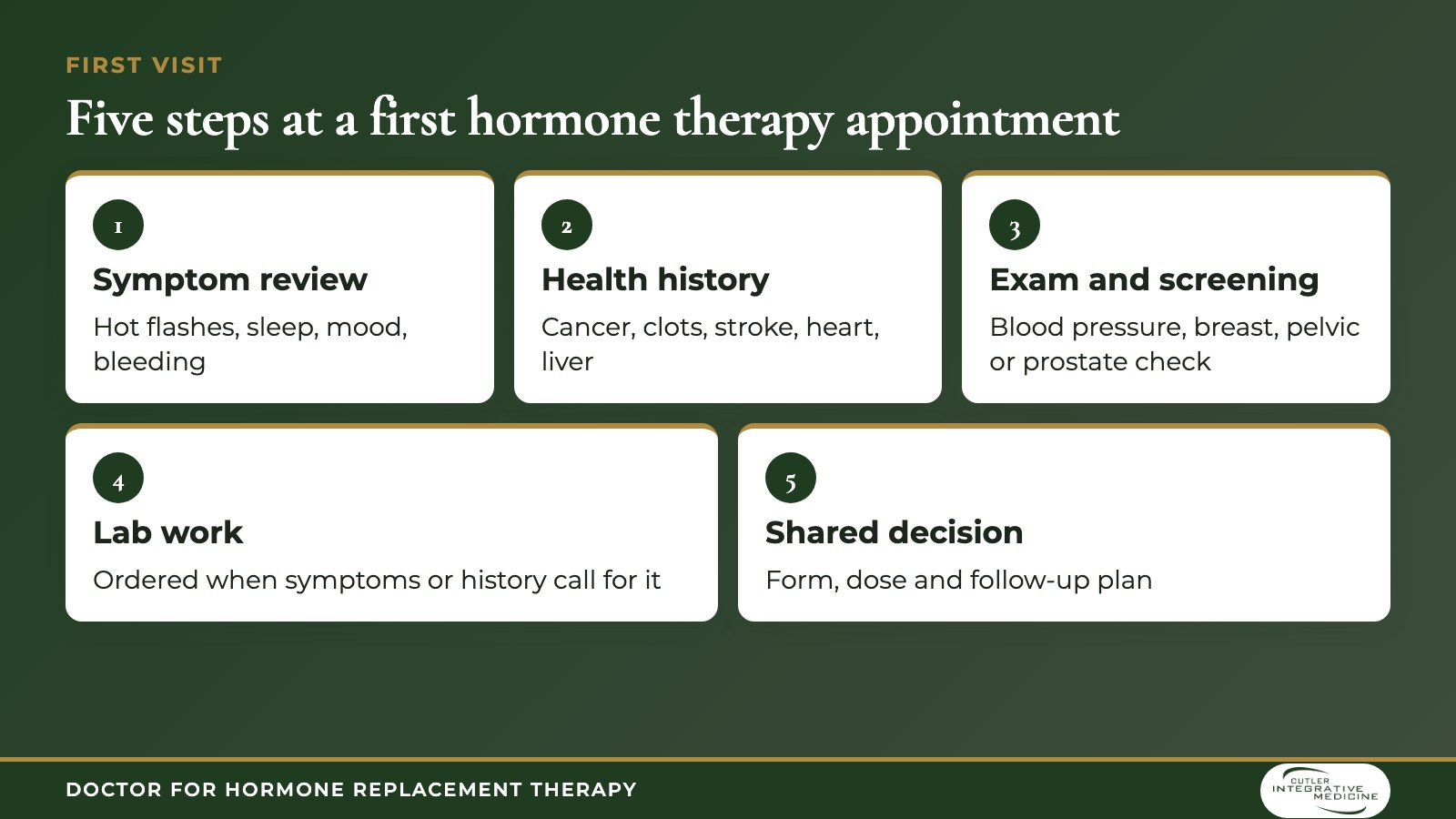
The graphic above lays out the five visit steps. The lab step varies by person, which leads to the next question.
Doctors order different labs by sex and symptoms. Men need repeated morning testosterone tests, while menopause care for women may rely on symptoms. The Endocrine Society advises two fasting morning total testosterone measurements before diagnosing low testosterone in men. Free testosterone is added when total testosterone sits near the lower limit of normal.
Prostate-specific antigen (PSA) testing is part of the screening. The Endocrine Society recommends against starting testosterone when PSA is above 4 ng/mL, or above 3 ng/mL in higher-risk men. Cleveland Clinic says follicle-stimulating hormone (FSH) tests can mislead in perimenopause because hormones rise and fall erratically.
Many patients also want a wider picture, such as adrenal and thyroid results. Our hormone symptom support uses saliva adrenal testing and blood work for that purpose.
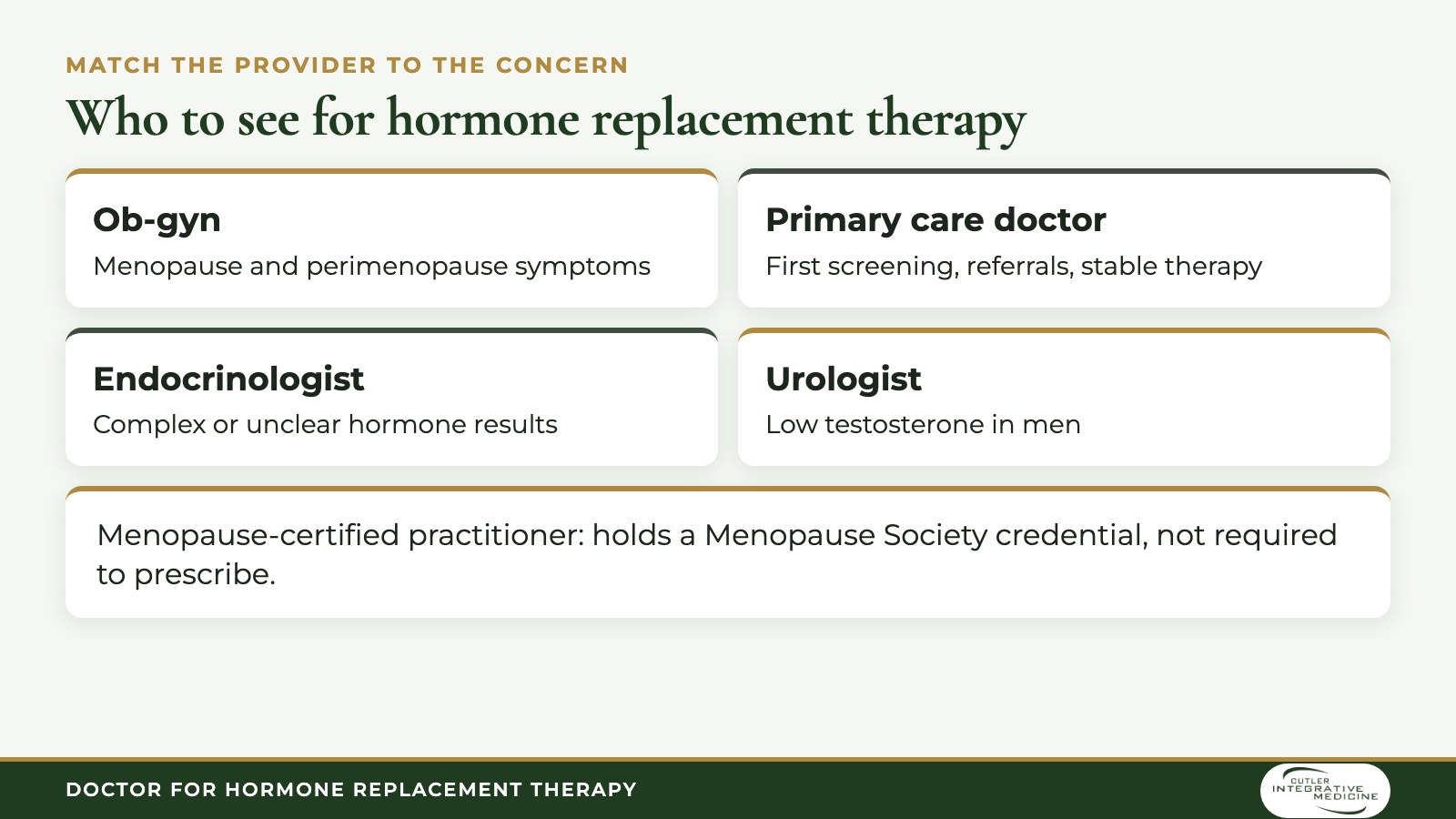
The graphic above summarizes which provider to match with each concern.
Bring a dated symptom log, a full medication list, prior labs and your family health history to a hormone therapy visit. A written record lets the doctor spot patterns faster. Cleveland Clinic says providers weigh health history, age and symptoms when deciding on therapy.
Supplements belong on the medication list so the doctor can check for interactions. With records in hand, the questions for the doctor become more specific.
Ask a doctor about your personal risk, the product form, the dose plan and the follow-up schedule before starting hormone replacement therapy. Five questions cover the decision, and a prepared list makes the visit shorter. Cleveland Clinic says providers weigh health history, age and symptoms before recommending therapy.
The first question depends on timing. The Menopause Society 2022 statement calls the benefit-risk balance favorable for women under 60, or within 10 years of menopause onset. Safety details appear in hormone therapy risks.
Ask your doctor for hormone replacement therapy by naming symptoms, goals and medical history at the start of the visit. Bring a written symptom list with dates. Then request a discussion of the risks and benefits that apply to you.
Patients can also request a referral when the first doctor declines or lacks experience. Cleveland Clinic notes providers may decline hormone therapy after reviewing health history, age and symptoms. A decline usually reflects risk, so ask what alternatives the doctor recommends.
Doctors say no to hormone replacement therapy when risks outweigh benefits for that patient. Health history, age and symptoms drive the call. Cancer, clot, stroke and liver history are common reasons for caution. The Endocrine Society also recommends against testosterone for men with breast or prostate cancer or near-term fertility plans.
The Menopause Society adds that benefit-risk looks less favorable when therapy starts more than 10 years after menopause or after age 60. A decline is not the same as a refusal to help. Patients can ask about nonhormone options and a second opinion.
Search The Menopause Society directory of members and Certified Practitioners, then confirm each clinician's experience directly. The directory does not endorse anyone listed. Men can compare male hormone clinics using the same credential checks.
Women get testosterone only in narrow cases: a 2019 Global Consensus found the one evidence-based use is low sexual desire after menopause. Compounded testosterone is not recommended. Readers can find more on testosterone in women.
Yes, doctors recommend hormone replacement therapy for suitable patients. The Menopause Society calls it the most effective treatment for hot flashes and genitourinary symptoms. Recommendations depend on age, timing and risk, so the decision stays individual.
No, compounded hormones are not a reason to choose a doctor. ACOG recommends FDA-approved hormone therapy over compounded, citing no evidence that compounded is safer or more effective. The FDA does not verify compounded drugs before marketing.
Yes, patients can keep their prescribing doctor and add naturopathic support. Sharing lab results and medication lists keeps everyone informed. Our post on coordinating prescriptions explains that approach.
Yes, a doctor should evaluate your health history and risks before any hormone therapy. Hormone therapy is individualized and reevaluated over time, according to The Menopause Society. Compounded and over-the-counter products carry their own cautions.
Yes, many primary care doctors manage hormone therapy. Internal medicine and family medicine together saw 30.0% of women receiving menopause-related treatment in The Menopause Society analysis. Referral to a specialist is common when cases are complex.
Women usually see an ob-gyn, primary care doctor or menopause-certified practitioner. The choice depends on symptoms, bleeding patterns and other conditions. A specialist referral helps when results or history are complicated.
Primary care doctors, urologists and endocrinologists manage testosterone therapy for men. The Endocrine Society guideline calls for symptoms plus consistently low, repeated morning testosterone results before treatment starts.
Follow-up schedules vary by sex, product and risk. The Endocrine Society says men on testosterone should be monitored, including prostate risk, during the first year. The 2019 Global Consensus advises women on testosterone to retest at 3 to 6 weeks, then every 6 months.
Cutler Integrative Medicine supports patients with hormone testing, root-cause review, nutrition and botanical medicine, while their physician manages any prescription. At the Cutler naturopathic clinic in Bingham Farms, Dr. Doug Cutler, ND, reviews stress, gut, thyroid, toxin and sleep factors that affect hormone symptoms. We work alongside your prescribing doctor.
Patients interested in naturopathic support can call (248) 663-0165 to schedule a visit. Telemedicine is also available for patients who cannot visit in person.








Cutler Integrative Medicine blends naturopathic and conventional care to treat the root causes of illness. Through personalized wellness plans, advanced diagnostics, and holistic therapies.


Copyright © 2025 Cutler Integrative Medicine. All Rights Reserved.