

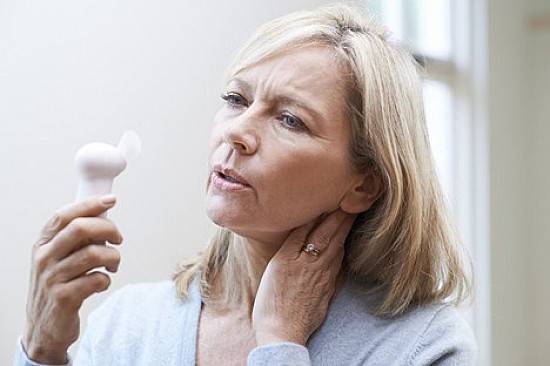
The symptoms of perimenopause at 45 and 48 are irregular periods, hot flashes, night sweats, sleep problems, mood swings, brain fog, vaginal dryness, and achy joints, all caused by estrogen and progesterone rising and falling unevenly. Perimenopause usually begins in a woman's 40s, at an average age of 47, so many women are right in the middle of this hormonal shift at 45 and 48.
This guide explains which symptoms are typical at 45 and which are typical at 48, how to tell which stage of perimenopause you are in, what conditions get mistaken for perimenopause, and when a symptom needs a doctor's attention.
The symptoms of perimenopause at 45 and 48 fall into seven groups: menstrual changes, vasomotor symptoms, sleep problems, mood shifts, cognitive changes, genitourinary symptoms, and physical aches. Each group traces back to the same cause, which is unsteady estrogen and progesterone.
Perimenopause symptoms are common, but they are not universal. University of Utah Health reports that perimenopause symptoms occur in varying degrees in about 75% of women. Sleep is one of the most disrupted areas, and data presented at a National Institutes of Health (NIH) State-of-the-Science conference shows that 39% to 47% of perimenopausal women report sleep problems, compared with 16% to 42% of premenopausal women.
Poor sleep spreads into every other symptom group. Broken nights worsen mood, sharpen brain fog, and drain energy, which is why many women first notice perimenopause as a pattern of sleep disorders rather than as hot flashes.
Sleep loss, mood swings, and cycle changes are all signs of hormonal imbalance during midlife. Seeing these signs at 45 or 48 raises a common question about whether that timing is normal.
Yes, it is normal to be in perimenopause at 45 and 48, because perimenopause usually starts in the 40s and the average age of onset is 47, according to Cleveland Clinic. A 45-year-old is often in the early part of the transition, and a 48-year-old is often in the later part.
Perimenopause also lasts longer than most women expect. Cleveland Clinic reports that the menopausal transition lasts an average of four years, and it lasts eight to 10 years for some women. The symptoms themselves often run longer than the cycle changes, and the NHS states that perimenopause and menopause symptoms usually last 7 to 9 years.
Timing varies from woman to woman for clear reasons. Mayo Clinic reports that smokers reach menopause 1 to 2 years earlier than nonsmokers, and a family history of early menopause, cancer treatment, and a hysterectomy also shift the timeline earlier. Knowing your place in the timeline starts with knowing which stage you are in.
You tell which stage of perimenopause you are in by tracking your cycle length: a cycle that consistently changes by seven days or more signals early perimenopause, and going 60 days or more between periods signals late perimenopause. Mayo Clinic uses these two cycle markers to separate the stages.
Cycle tracking turns guesswork into a clear pattern. Mark the first day of each period on a calendar or app for three to six months, and note flow, spotting, hot flashes, and sleep. A pattern of cycles that run 21 days one month and 30 days the next points to early perimenopause, while long gaps of two months or more point to late perimenopause.
Age gives a rough guide, but cycle changes give the real answer. The table below shows the patterns that are typical at 45 and at 48, though a 45-year-old can be in late perimenopause and a 48-year-old can still be in the early stage.
The two stages share most symptoms but differ in how those symptoms feel. The full list of perimenopause symptoms covers every possible change, while the sections below focus on what each age usually brings.
The symptoms of perimenopause at 45 are usually cycle changes, heavier or closer-together periods, breast tenderness, restless sleep, and stronger mood swings. These early symptoms come from estrogen swinging high and low while progesterone falls as ovulation becomes less regular.
Period changes are the first sign for most women at 45. Women's Healthcare Associates notes that hot flashes and night sweats also appear as early signs for some women, often right before periods, with mood changes, sleep disturbances, and vaginal dryness following later. Early symptoms come and go, so a good month followed by a hard month is a normal early pattern.
The symptoms of perimenopause at 48 are usually skipped periods, more frequent hot flashes and night sweats, vaginal dryness, brain fog, and lower mood. These later symptoms come from estrogen staying low for longer stretches as the ovaries slow down.
Long gaps between periods mark this stage. Hot flashes become more frequent, vaginal and bladder tissue begins to thin, and sleep breaks up more often during the night. Weight gain around the stomach and upper body also becomes more noticeable, a change the NHS lists as common during perimenopause. Every one of these late symptoms connects to the same hormone.
The symptoms of low estrogen levels are hot flashes, night sweats, vaginal dryness, painful sex, urinary urgency, poor sleep, low mood, brain fog, joint aches, dry skin, and thinning hair. Estrogen acts on the brain, blood vessels, skin, bones, bladder, and vaginal tissue, so low estrogen touches almost every system in the body.
Estrogen controls the brain's temperature setting. Low estrogen narrows the range of temperatures the brain accepts as comfortable, so a small rise in body heat triggers a full hot flash. According to the U.S. Food and Drug Administration (FDA), more than 80% of menopausal women experience hot flashes.
Estrogen also keeps vaginal and urinary tissue thick, moist, and elastic. Mayo Clinic explains that falling estrogen makes vaginal tissue drier and less elastic, which causes pain during sex, burning with urination, and a higher chance of urinary and vaginal infections.
Low estrogen affects energy as well. Many women describe a deep tiredness that rest does not fix, and ongoing chronic fatigue often links back to broken sleep, nutrient gaps, and shifting hormones together.
Progesterone matters too. Progesterone falls as ovulation becomes irregular, and lower progesterone relative to estrogen contributes to heavier periods, breast tenderness, and restless sleep. Restoring hormone balance means looking at estrogen, progesterone, stress hormones, and thyroid hormones as one connected system. Periods still continue through most of this hormonal shift.
Yes, it is normal to still have periods at 48 years old, because the average age of menopause in the United States is 51. Menopause only begins after 12 months in a row without a period, so a 48-year-old with regular, irregular, or occasional periods is still in perimenopause.
Periods at 48 often look different from periods at 38. Flow changes, cycles stretch or shrink, and spotting appears between periods. University of Utah Health reports that perimenopause symptoms last about seven years on average, so changing periods at 48 fit within that normal window. Some years of this window feel much harder than others.
Perimenopause is usually the worst in late perimenopause, which most women reach in their late 40s, when periods are 60 or more days apart and estrogen stays low for long stretches. Hot flashes, sleep loss, and mood symptoms all tend to peak in this stage.
Mood risk rises sharply in these years. Research from the Study of Women's Health Across the Nation (SWAN) and other long-term studies found that entering perimenopause doubled the likelihood of significant depressive symptoms, and a formal depression diagnosis was 2.5 times more likely during the menopausal transition. Women with strong hot flashes and night sweats faced even higher risk.
Hot flashes also last long beyond the hardest years. SWAN found that frequent hot flashes and night sweats last a median of 7.4 years. Support for emotional health matters most during this stage, because low mood in late perimenopause is a hormonal symptom, not a personal failure. Some of these symptoms also overlap with other conditions.
The conditions that get mistaken for perimenopause are thyroid disease, depression and anxiety, chronic stress, iron deficiency from heavy bleeding, and pregnancy. Each one causes fatigue, mood changes, weight shifts, or cycle changes that look like perimenopause.
Thyroid disease is the most common mimic. An underactive thyroid causes fatigue, weight gain, dry skin, thinning hair, and low mood, which overlap closely with perimenopause. University of Utah Health notes that doctors run follicle-stimulating hormone (FSH), estrogen, and thyroid-stimulating hormone (TSH) blood tests, since low thyroid function can cause menopause-like symptoms. Midlife women deserve a full check of thyroid issues before every symptom gets blamed on perimenopause.
Stress hormones create a second overlap. Relationship stress, work stress, and poor sleep raise cortisol, and high cortisol disturbs sleep, mood, blood sugar, and cycles. Pregnancy belongs on the list too, because a missed period at 45 can still mean pregnancy. Telling these causes apart early protects your long-term health.
You should know that pregnancy is still possible, bone and heart health start to change, and certain bleeding patterns need a doctor's attention during perimenopause in your mid-40s. Each of these facts shapes the decisions you make in these years.
Pregnancy remains possible as long as you still ovulate. The NHS advises women aged 40 to 49 to keep using contraception for 2 years after their final period, and women aged 50 and over for 1 year after their final period.
Bone and heart health also change during perimenopause. Mayo Clinic explains that falling estrogen speeds up bone loss and raises low-density lipoprotein (LDL) cholesterol, the "bad" cholesterol linked to heart disease. Women lose up to 20% of their bone density in the five to seven years after menopause, according to the National Osteoporosis Foundation, so the habits you build at 45 and 48 protect your bones for decades. Healthy aging after 40 depends on strength training, steady protein intake, and regular checkups.
Bleeding changes are the area that needs the closest watch. See a doctor for any of the following, based on guidance from Mayo Clinic and the NHS:
Many women wait too long to bring these concerns to a doctor. The Society for Women's Health Research reports that 45% of women do not know the difference between perimenopause and menopause before their own transition, and 20% go 12 or more months after symptoms begin before a provider formally assesses them. Earlier care opens more options for managing symptoms.
You can manage perimenopause symptoms at 45 and 48 by testing your hormones, tracking your cycles and symptoms, cutting hot flash triggers, protecting your sleep, eating whole foods, exercising regularly, and choosing the right treatment for your stage. The best results come from treating the cause of each symptom rather than masking it.
Testing comes first in our approach. We use saliva adrenal testing along with blood work to measure hormone levels, and we review environmental toxic exposure, because many household and skincare products contain chemicals that disrupt hormones. Testing shows whether estrogen, progesterone, cortisol, or thyroid hormones drive your symptoms.
Daily habits make a measurable difference. Alcohol, caffeine, smoking, and spicy foods often set off hot flashes, and layered clothing and a cool bedroom ease night sweats. Regular exercise supports mood, bone, and weight, and sustainable changes in nutrition and weight help steady energy and blood sugar through these years.
Medical treatment depends on your stage and history. Hormone therapy, low-dose antidepressants, gabapentin, vaginal estrogen, and lubricants all appear among the treatments University of Utah Health lists for perimenopause symptoms. Some women choose hormone therapy during perimenopause, while others prefer natural and non-hormonal options.
Women across Oakland County come to our office after being told their symptoms are "just stress" or "just age." A personalized plan built on testing helps you balance hormones naturally and match each symptom to the right support.
You do not age faster in perimenopause by calendar years, but falling estrogen speeds up certain body changes, including bone loss, cholesterol changes, drier skin, and thinning hair. Women lose up to 20% of their bone density in the five to seven years after menopause, according to the National Osteoporosis Foundation. Strength training, good sleep, and steady nutrition slow these changes.
The oldest age a woman can still have her period is usually the late 50s, since most women reach menopause between ages 40 and 58, according to The North American Menopause Society. The average age of menopause is 51. Periods that continue past 55 deserve a conversation with your doctor.
Perimenopause lasts an average of four years, and it lasts eight to 10 years for some women, according to Cleveland Clinic. Symptoms often run longer than the cycle changes, and the NHS reports that perimenopause and menopause symptoms usually last 7 to 9 years.
Yes, you can get pregnant during perimenopause at 45, because you still ovulate on some cycles even when periods are irregular. The NHS advises women aged 40 to 49 to keep using contraception for 2 years after their final period.
You do not always need a blood test to diagnose perimenopause, because doctors usually diagnose it from your age, cycle changes, and symptoms. University of Utah Health notes that FSH, estrogen, and TSH blood tests help rule out other causes, such as an underactive thyroid. Testing also guides treatment decisions, including when to start hormone therapy.
The symptoms of perimenopause at 45 and 48 are normal signs of a hormonal transition that usually starts around age 47. At 45, most women notice cycle changes, heavier periods, and mood swings, while at 48 most women notice skipped periods, more hot flashes, vaginal dryness, and brain fog. Tracking your cycle shows your stage, testing rules out thyroid disease and other mimics, and the right plan eases symptoms in both stages.
Perimenopause symptoms often last 7 to 9 years, so the support you choose now shapes many years of your life. Women in Bingham Farms and nearby communities do not have to sort through these changes alone. At Cutler Integrative Medicine, we are here to test, listen, and build a plan around your body, and you can reach out whenever you feel ready to start.







Cutler Integrative Medicine blends naturopathic and conventional care to treat the root causes of illness. Through personalized wellness plans, advanced diagnostics, and holistic therapies.


Copyright © 2025 Cutler Integrative Medicine. All Rights Reserved.