


Yes, natural hormone replacement therapy exists, but "natural" is a marketing label, not a medical standard. The National Academies reported in 2020 that compounded hormones are marketed as "bioidentical" or "natural," yet the FDA does not review them. FDA-approved options made from plant sources, such as oral progesterone, are also available. Evidence differs for each type.
Key Takeaways
Yes, this label describes hormone treatment marketed as plant-based or identical to the body's own hormones. The term has no legal or medical definition, so one product labeled natural can differ widely from another. Hormone replacement therapy (HRT) itself replaces estrogen, progesterone or both when the ovaries make less of them.
Clinics and supplement makers apply the natural label to three different product types. These are FDA-approved bioidentical prescriptions, compounded prescriptions mixed by a pharmacy, and over-the-counter products such as creams and herbs. Hormone imbalance care starts by sorting out which of these a person actually means.
Each category carries a different level of evidence and oversight. The next section explains the word that links them, which is bioidentical.
Bioidentical hormone replacement therapy (BHRT) means treatment with hormones that are chemically identical to those the human body produces. The American College of Obstetricians and Gynecologists (ACOG) says bioidentical hormones come from plant sources. These hormones are similar to those the body produces. Manufacturers convert plant compounds into estradiol, progesterone and testosterone.
Cleveland Clinic describes bioidentical hormones as a type of HRT rather than a separate category. A hormone can be bioidentical and still come as a regulated, FDA-approved product. ACOG gives oral progesterone as an example of an FDA-approved bioidentical hormone.
The source of a hormone therefore matters less than how the final product is made and checked. That difference is the core of the safety question.
Natural hormone products are only as safe as their specific product, dose and regulation. FDA-approved versions have verified safety data, while compounded versions do not. The FDA states that compounded drugs are not FDA-approved. The agency does not verify their safety, effectiveness or quality before marketing. The word natural does not change that status.
ACOG adds that custom compounded hormones vary in strength and purity. A person can take too little or too much of a hormone without knowing it. The Menopause Society's 2022 position statement says risks depend on the type, dose, duration and route of hormone therapy.
Safety also depends on the person's health history, which later sections cover. Before that, the regulatory split deserves its own look.
Some bioidentical hormone replacement therapy is FDA approved, and some is not. The National Academies report notes that the FDA has approved dozens of hormone therapy products, including estrogen, progesterone and testosterone. Compounded bioidentical preparations fall outside that approval process.
Cleveland Clinic says multiple FDA-approved options deliver bioidentical hormones. It also says compounded hormones are not well studied and their long-term effects are unknown. Many providers therefore do not recommend them.
The table below compares the three product types by approval status and evidence.
| Product type | FDA status | Evidence | Example |
|---|---|---|---|
| FDA-approved bioidentical | Reviewed for safety and effectiveness | Tested in clinical trials | Oral progesterone, estradiol patch |
| Compounded bioidentical | Not FDA-approved | Not well studied, long-term effects unknown | Custom creams, capsules, pellets |
| Over-the-counter products | Sold as supplements or cosmetics | Limited or inconsistent | Wild yam cream, red clover |
Only the first row has the regulatory review that ACOG recommends. The next question is whether those products actually work.
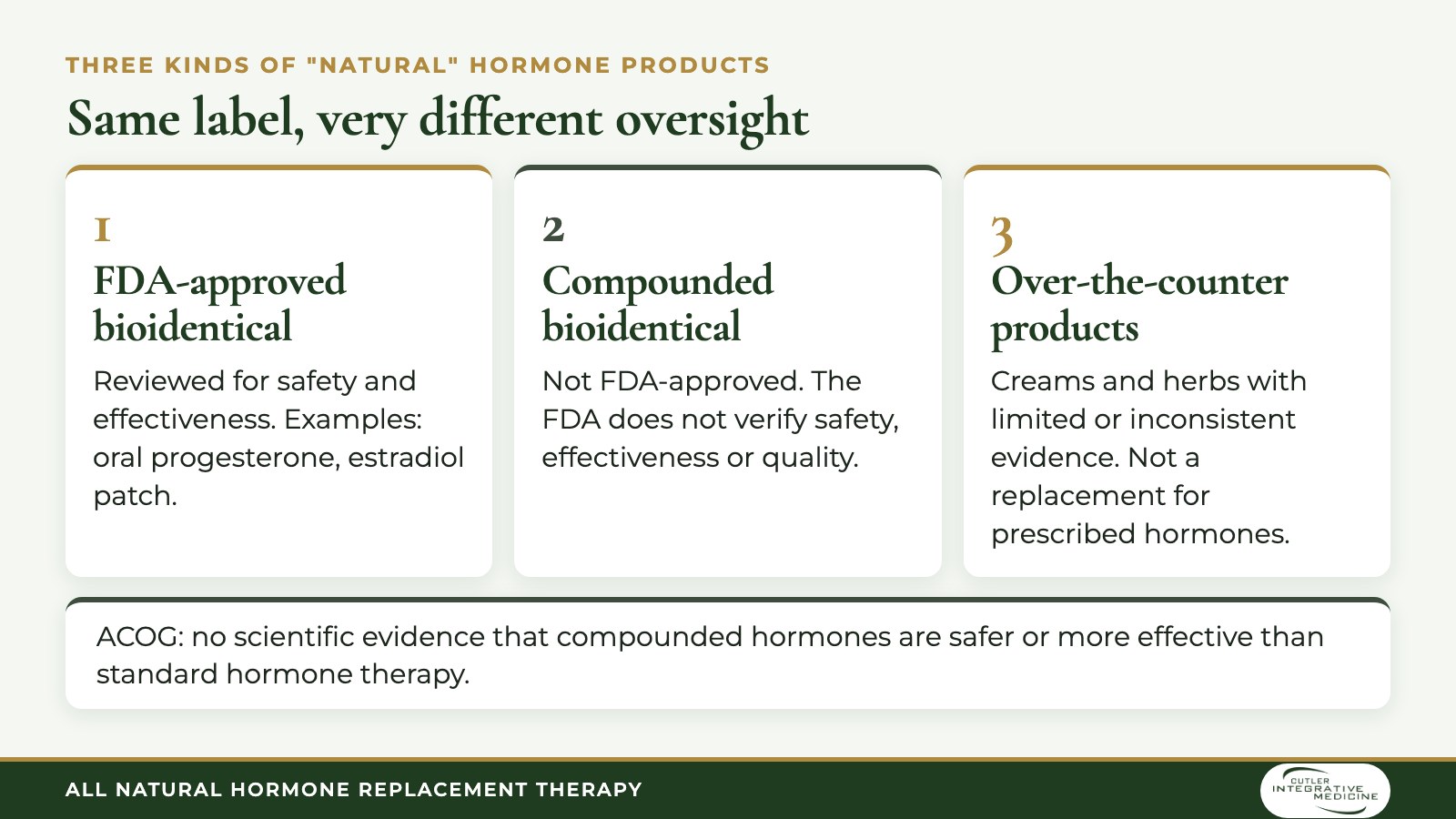
The graphic above lays out the same three product types side by side.
Bioidentical hormone therapy works at an effective dose, and the evidence is strongest for FDA-approved forms. A 2016 Cochrane review pooled 23 randomized controlled trials with 5,779 participants. In four trials with 793 women, the bioidentical estradiol patch reduced hot flush frequency compared with placebo.
The review rated that evidence as low quality. Adverse events such as headache, vaginal bleeding and breast tenderness were more common with the patch than with placebo.
The Menopause Society's 2022 statement says hormone therapy remains the most effective treatment for vasomotor symptoms. Vasomotor symptoms are hot flashes and night sweats.
These results apply to measured, regulated doses. Anyone unsure which category applies can start with a hormone balance evaluation. Products sold without a prescription raise a separate question.
No, estradiol therapy is not sold over the counter, but creams and supplements marketed as natural hormone support are. Over-the-counter products are not replacements for prescribed hormones, because their hormone content and effects are less well documented. Two of these products are progesterone cream and wild yam.
A 2013 systematic review in the Annals of Pharmacotherapy found three randomized trials of bioidentical progesterone cream for hot flashes. The two trials using manufactured creams found no benefit over placebo. The review concluded that the evidence does not support the cream's efficacy.
Wild yam contains diosgenin, a plant compound that laboratories use as raw material for synthetic progesterone. Memorial Sloan Kettering says there is no evidence that the human body can convert diosgenin into progesterone. Wild yam also has estrogenic effects, so people with hormone-sensitive cancers should talk to their physician first.
Plant compounds that act like estrogen are a different group, and they have their own research record.
Soy, red clover and black cohosh have small or inconsistent evidence as natural remedies, and none contains the body's own hormones. Soy isoflavones may reduce hot flash frequency and severity, according to the National Center for Complementary and Integrative Health (NCCIH). NCCIH adds that the effect may be small and research results are not completely consistent.
Isoflavones are plant compounds with a structure similar to estrogen. Studies used soy protein safely for up to 16 weeks and concentrated soy extracts for up to 6 months.
NCCIH says research on red clover has not shown conclusive evidence of benefit for any health condition. Its hot flash studies had inconsistent results, and some carried a high risk of bias.
Black cohosh has more research. A 2023 review of 22 studies found potential benefit for overall menopause symptoms and hot flashes, but not for anxiety or depression. NCCIH also reports rare cases of liver damage in people taking products labeled black cohosh. People who notice dark urine or fatigue should contact a healthcare provider.
Some herbs also interact with medicines, so a provider should review any supplement before it is started. A menopause nutrition guide covers food-based support in more depth.
Get bioidentical hormone replacement therapy safely by following five steps, starting with a hormone evaluation. A prescribing physician decides whether hormone therapy fits, because only licensed prescribers can order it.
Cleveland Clinic notes that hormones rise and fall erratically in perimenopause, so one lab result can mislead. biointelligent lab data adds more data points to that picture.
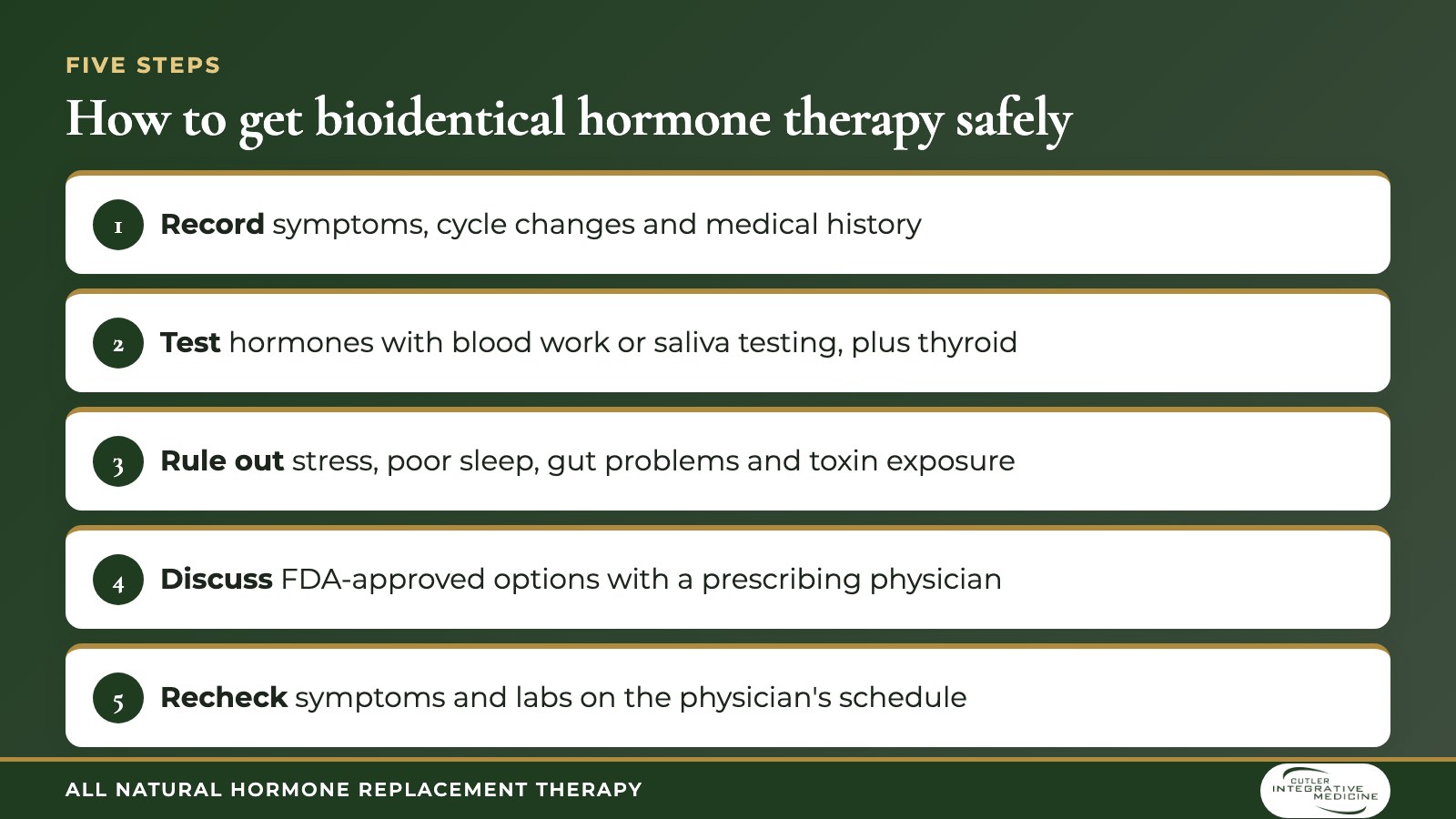
The graphic above summarizes the five steps in order. Some people should not use hormone products at all.
People with certain health conditions should avoid natural hormone products unless a physician approves them. The same cautions apply to bioidentical and conventional hormones, because the label does not remove the risk. Estrogen-like products also fall under this caution.
These groups should speak with a healthcare provider before using any hormone product, herb or cream.
The Menopause Society says the benefit-risk balance of hormone therapy is favorable under age 60 or within 10 years of menopause onset. It becomes less favorable beyond those points. The same hormone therapy safety reasoning applies to every product type.
Choosing not to use hormones still leaves nutrition and lifestyle support. That leads to the next question.
Nutrition, sleep, stress management and exercise can support hormone balance without taking hormones. Lifestyle changes address the root causes that drive hormone shifts, such as chronic stress, poor sleep, gut problems and thyroid function. These steps do not replace estrogen or progesterone, so they support rather than substitute for therapy.
Whole foods, adequate protein, fiber and regular movement form the base. Soy foods are one dietary source of isoflavones, and NCCIH notes studies of soy for hot flashes with small effects. A natural hormone balance plan puts these habits in order.
Thyroid problems can mimic menopause symptoms, so thyroid testing belongs in the workup. Sleep and stress affect adrenal hormones such as cortisol, which can be measured with saliva testing. Support from a naturopathic doctor combines these areas into one plan.
The questions below cover related topics.
Hormone therapy marketed as natural for men usually means bioidentical testosterone. Testosterone replacement requires a prescription and lab monitoring, and compounded versions are not FDA-approved. Men with low energy, low drive or mood changes can review low testosterone symptoms and get lab testing before pursuing treatment.
Yes, women can use hormone therapy after a hysterectomy when a physician approves it. Women without a uterus may use estrogen alone. ACOG says women with a uterus also need a progestin to reduce uterine cancer risk. Details on timing and types appear in a guide to hysterectomy hormone therapy.
Bioidentical hormone replacement therapy carries the same type of cancer questions as other hormone therapy, so a physician should weigh them. The Menopause Society says risk depends on type, dose, duration and route. ACOG states there is no evidence that compounded hormones are safer. Large trials on breast cancer are explained in breast cancer risk coverage.
Yes, people use bioidentical hormone therapy during perimenopause, the years before periods stop. Hormone levels rise and fall erratically during perimenopause, and Cleveland Clinic notes that FSH tests can mislead for the same reason. Low progesterone is one possible cause, covered in low progesterone signs.
Alternatives to natural hormones include lifestyle changes, nutrition, targeted supplements and prescription non-hormonal medicines. ACOG lists antidepressants, gabapentin and clonidine as non-hormonal options for hot flashes. A full list appears under alternatives to HRT.
Bioidentical hormones are made from plant sources, according to ACOG. Manufacturers convert the plant compounds into hormones that match the body's own estradiol, progesterone or testosterone.
Bioidentical hormone replacement therapy works by replacing hormones the body makes less of. Cleveland Clinic says HRT replaces hormones the body is not making enough of. Rising hormone levels may relieve symptoms such as hot flashes.
Bioidentical hormones come as pills, patches, gels, vaginal rings, creams and tablets. Cleveland Clinic lists these forms for estrogen therapy. A physician chooses the form based on symptoms and health history.
BHRT uses hormones identical to the body's own, while traditional HRT may use hormones that only resemble them. Cleveland Clinic says bioidentical hormones are a type of HRT. Both can be FDA-approved when manufactured products are used.
A 2021 study in Menopause found 57.6% of 384 women on compounded pellets reported side effects. The rate was 14.8% of 155 women on FDA-approved therapy. The study included 539 postmenopausal women.
Cutler Integrative Medicine supports hormone health through testing, root-cause care and nutrition, and works alongside each patient's prescribing physician. Dr. Doug Cutler, ND, uses hormone testing and botanical medicine to look at stress, gut health, thyroid function, toxin exposure and sleep. This work adds hormonal wellness care around medical hormone therapy and does not replace it.
Patients in Bingham Farms and across Metro Detroit can call (248) 663-0165 to schedule a visit. Telemedicine is available for those who prefer it. The clinic's functional medicine approach reviews symptoms, labs and history together.
People exploring natural hormone replacement therapy can start with the Cutler wellness clinic. The first step is a conversation about symptoms, goals and any hormone products already in use.








Cutler Integrative Medicine blends naturopathic and conventional care to treat the root causes of illness. Through personalized wellness plans, advanced diagnostics, and holistic therapies.


Copyright © 2025 Cutler Integrative Medicine. All Rights Reserved.